


Are Cremation Diamonds Real Diamonds? The Science of Eternal Remembrance
In the quiet moments of remembrance, we search for ways to keep the essence of a loved one close. Traditional memorials serve their purpose, but for many, the heart seeks something more personal, more permanent—a tangible connection to a life beautifully lived. This search often leads to a unique and profound question: are cremation diamonds real diamonds?
The idea can feel like something from a storybook—transforming the very elements of a person into a radiant gemstone. It raises natural skepticism and a deep-seated need for authenticity. Is this a genuine, scientifically sound process, or merely a symbolic gesture? Is the resulting gem a true diamond, or something else entirely?
This guide will walk you through the science of eternal remembrance. We will explore the molecular truth behind memorial diamonds, compare them to gems unearthed from the earth, and clarify the meticulous processes that ensure their integrity. Here, you will find the answers needed to move forward with clarity and peace of mind, understanding that this is not just a tribute, but a continuation.
Defining the Cremation Diamond: Real Science or Symbolic Gesture?
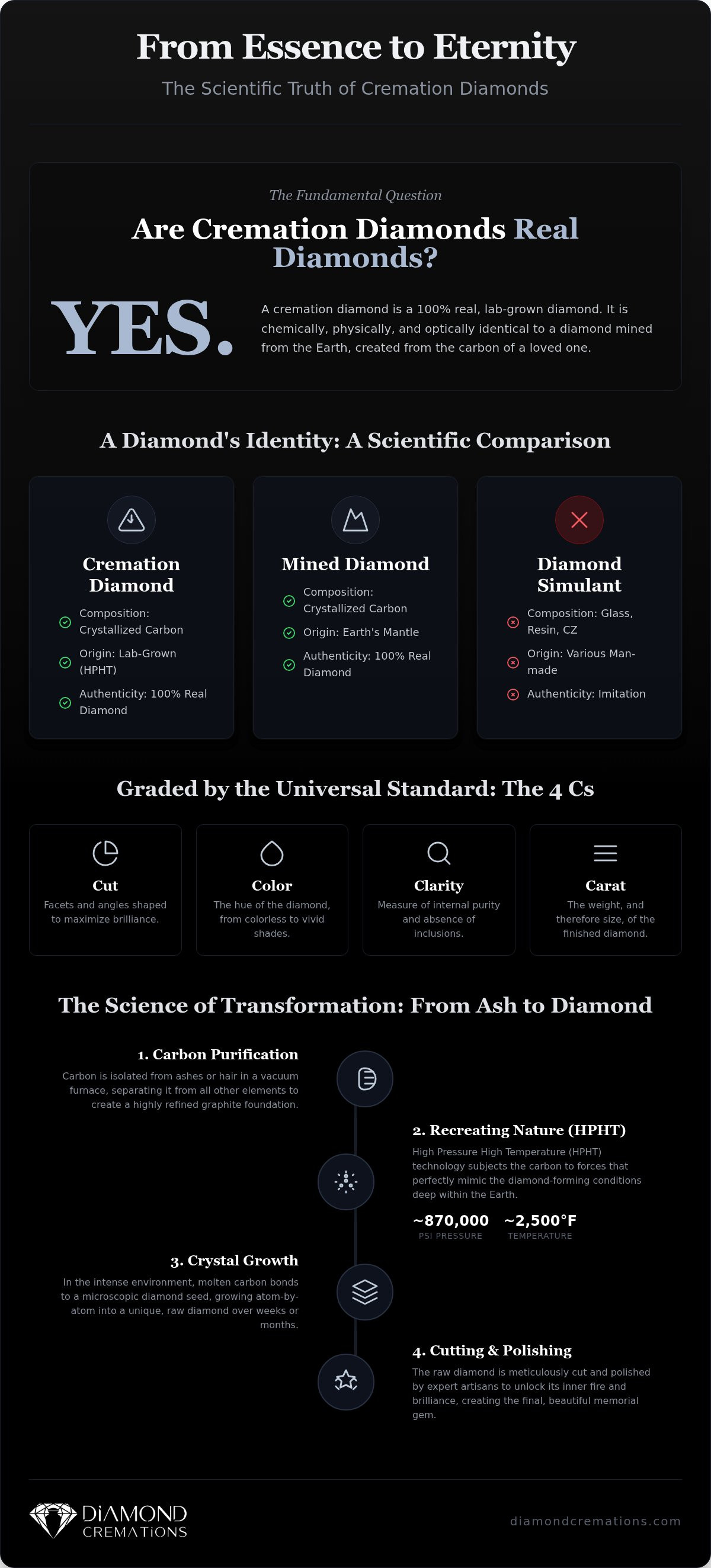
At its core, the answer is unequivocally yes. A cremation diamond is a lab-grown diamond created using carbon extracted from the cremated remains or hair of a loved one. It is not a simulant, a look-alike, or a piece of glass. It is a diamond in every scientific sense, possessing a crystal structure and physical properties that are identical to those of a diamond formed deep within the Earth.
To understand this, we must distinguish between a “memorial stone” and a “Memorial diamond.” While some keepsake items may be made from glass or resin infused with a small amount of ashes, a true memorial diamond is different. The process involves isolating the foundational element of life—carbon—and using it as the building block for the gem. The result is a stone made of pure, crystallized carbon, a molecular remembrance of the life it represents.
This is not a symbolic gesture; it is a scientific transformation. The carbon that once formed the unique blueprint of a person is given a new, enduring form. It is their essence, reformed into a structure of timeless brilliance.
The Chemical Signature of a Diamond
Every diamond, whether from a mine or a laboratory, shares the same fundamental identity: a crystalline lattice of carbon atoms (specifically, the isotope Carbon-12). This rigid, interlocking structure is what gives a diamond its renowned hardness and unmatched ability to reflect light.
A cremation diamond is graded by the same standards used for all gems: the Four Cs.
- Cut: The facets and angles shaped by an artisan to maximize brilliance.
- Color: The hue of the diamond, from colorless to vivid shades.
- Clarity: The measure of internal purity and the absence of inclusions.
- Carat: The weight, and therefore size, of the finished diamond.
The authenticity of lab-grown diamonds is so well-established that the U.S. Federal Trade Commission (FTC) legally classifies them as real diamonds. There is no physical, chemical, or optical difference that the naked eye—or even a standard jeweler's loupe—can detect.
Why the Term "Real" Matters in Grief
During a time of loss, the need for permanence is a powerful emotional anchor. We want to know that the tribute we choose will last—that it will not fade, crumble, or be lost to time. Flowers wither, and memories can soften at the edges, but a diamond endures.
The question "Is it real?" stems from a desire for an honest, lasting connection. A fleeting symbol cannot provide the same comfort as a tribute with exceptional durability. The validation that a cremation diamond is scientifically genuine offers profound peace of mind. It confirms that this is not just a beautiful stone, but a real and lasting piece of your loved one, transformed into a legacy that can be held, worn, and passed down through generations.
The Science of Transformation: How Carbon Becomes a Diamond
The journey from ash to diamond is a testament to scientific innovation, mirroring the immense forces of nature in a controlled and respectful environment. It is a process of purification, pressure, and patience, where biological elements are carefully reformed into geological brilliance. It bridges the gap between a life lived and a legacy that will last forever.
This transformation is methodical and precise. It begins by honoring the remains, isolating the carbon they contain, and nurturing it under the exact conditions required to grow a genuine diamond. For an in-depth look at each step, you can explore the science of how cremation diamonds are made.
The Carbon Extraction Process
The first step is to isolate carbon, the element essential for both life and diamonds. A portion of cremated remains or a lock of hair is all that is required. Diamond Cremations provides a secure collection kit with clear instructions, as the specific amount needed can vary based on the desired diamond.
Once received, the material is placed in a specialized vacuum induction furnace. This advanced environment heats the remains to extreme temperatures, allowing the carbon to be separated from other elements without contamination. This purification process is critical, converting the organic and inorganic compounds into a highly refined form of carbon known as graphite. This purified graphite is the direct link between your loved one and the brilliant gem to come.
HPHT Technology: Recreating Nature
With the purified carbon ready, the growth phase begins. Diamond Cremations uses High Pressure High Temperature (HPHT) technology, a method that faithfully replicates the conditions in the Earth’s mantle where natural diamonds are born.
The graphite is placed in a specialized growth chamber alongside a tiny diamond seed—a microscopic diamond crystal that provides the structural template. The chamber then applies unimaginable force and heat:
- Pressure: Approximately 870,000 pounds per square inch (PSI), simulating the weight of the earth above.
- Temperature: Around 2,500°F (1,370°C), dissolving the purified carbon.
In this intense environment, the molten carbon begins to attach to the diamond seed, atom by atom, extending its crystal lattice. This is not a fast process. Just as nature takes millions of years, this controlled growth cycle unfolds over a period of time, ensuring the formation of a pristine, single-crystal diamond. The resulting raw gem is chemically and structurally indistinguishable from a mined diamond of the highest quality.
Comparing Cremation Diamonds to Mined and Simulant Stones
When considering a memorial diamond, it is crucial to understand where it stands in the world of gemstones. While emotionally unique, its physical properties can be measured and compared against both diamonds from the earth and common imitations like cubic zirconia.
A cremation diamond is not "like" a diamond; it *is* a diamond. It shares the same hardness, refractive index, and thermal conductivity that define all diamonds. This sets it worlds apart from simulants, which may look similar at first glance but lack the substance, durability, and brilliance of a true carbon crystal.
Furthermore, choosing a cremation diamond carries ethical and environmental benefits. It is a singular creation, free from the ecological disruption and historical conflicts associated with some mining operations. It is a choice of personal significance and conscious creation.
Diamond vs. Cubic Zirconia vs. Glass
It is easy to be misled by materials marketed as "memorial stones" that are not diamonds at all. Simulants like cubic zirconia (CZ), moissanite, or even glass can be beautiful, but they do not share the properties of a diamond and will not endure in the same way.
Here’s a clear comparison:
| Property | Cremation Diamond | Mined Diamond | Cubic Zirconia (CZ) | Glass |
|---|---|---|---|---|
| Composition | Crystallized Carbon | Crystallized Carbon | Zirconium Dioxide | Amorphous Solid |
| Hardness (Mohs Scale) | 10 (Highest) | 10 (Highest) | 8-8.5 | ~5.5 |
| Brilliance & Fire | Exceptional | Exceptional | High, but different | Low |
| Durability | Extremely durable | Extremely durable | Prone to scratches/clouding | Brittle, easily scratched |
| Passes Diamond Tester? | Yes | Yes | No | No |
A key takeaway is durability. A diamond's hardness of 10 on the Mohs scale means it resists scratching from any other material. Simulants do not. Over time, CZ and glass will show wear, lose their luster, and become cloudy. A diamond’s brilliance is timeless. Reputable providers are transparent about their process and the nature of the final gem, offering a path to independent verification if desired.
The Ethical and Personal Value
Beyond the physical, the value of a cremation diamond is deeply personal. While some argue that mined diamonds are more "real" because they are natural, a memorial diamond possesses a provenance that is arguably more profound. Its carbon source is not ancient geology, but a cherished life.
This creates a gem with an unparalleled emotional weight. It is inherently conflict-free, created with purpose and intention. It is not just a stone; it is a story. Its value is not defined by market trends, but by the love it represents—a legacy that is both scientifically real and priceless in its significance.
Ensuring Authenticity: Process and Verification
In a decision this important, trust is paramount. You need absolute confidence that the diamond you receive is not only a real diamond but is also the result of a process that has honored your loved one's remains from start to finish. This assurance comes from two key areas: a meticulous chain of custody and the option for independent, third-party grading.
Diamond Cremations has built its entire service around transparency and security. Every step is documented and tracked to ensure the carbon provided for a specific order remains with that order throughout its transformation. This internal commitment to integrity is the foundation of our promise to you.
The Secure Collection and Tracking System
The process of ensuring authenticity begins the moment you decide to proceed. Diamond Cremations provides a secure kit for collecting the ashes or hair. This kit is designed with security features and is uniquely identified to your order.
From the moment the kit is received at our laboratory, a rigorous chain-of-custody protocol is initiated. Every transfer, from the purification chamber to the HPHT press to the hands of our gem cutters, is meticulously documented. This system ensures a clear, unbroken link between the remains you entrust to us and the final, brilliant diamond. This documented procedure is our commitment to you that the legacy of your loved one is handled with the utmost respect and care.
Understanding GIA and IGI Reports
For those who wish to have an additional layer of scientific verification, Diamond Cremations offers optional, independent gemological certification. This service provides a formal grading report from a respected laboratory like the Gemological Institute of America (GIA) or the International Gemological Institute (IGI).
It is important to understand what these reports verify. A gemological report is a scientific assessment of the diamond's physical properties. It will:
- Confirm the stone is a diamond.
- State its origin as "Laboratory-Grown."
- Document its 4Cs: carat weight, color, clarity, and cut quality.
This third-party certificate serves as definitive proof that your memorial stone is, in fact, a real diamond with the specific qualities you selected. While these labs do not verify the carbon's personal source, their analysis confirms the gem's authenticity, providing scientific validation to complement the procedural assurance of our chain-of-custody.
Cultivating a Lasting Legacy with Diamond Cremations
Choosing a memorial diamond is a hopeful act of transformation. It is the decision to turn the finality of goodbye into a radiant and ongoing presence. It is a journey from grief to a tangible tribute that shines with the memory of a unique life, allowing a loved one's story to continue in a new and beautiful form.
The process is deeply personal, allowing you to create a gem that truly reflects the individual it honors. You can select the perfect shape—from a classic Round Brilliant to a modern Princess or a soft Cushion cut. You also choose the color, creating a bespoke tribute. Diamond Cremations offers a curated selection of colors, achieved through carefully controlled conditions during the growth process:
- Colorless/White: A timeless symbol of purity and light.
- Blue: A serene hue representing peace and loyalty.
- Yellow: A warm, sunny color evoking joy and friendship.
- Pink: A gentle shade of love, compassion, and beauty.
The estimated completion time for this profound transformation is approximately 60–90 days after the required materials are received and processing begins. Some special requests or custom jewelry settings may require additional time, but our team will provide a clear timeline for your unique order.
Bespoke Jewelry Settings
Once your diamond has been grown and cut by master artisans, it can be set into a piece of fine jewelry. This final step transforms the gem into a wearable connection, a handcrafted circle of love that keeps your loved one's presence near. Whether you envision a simple pendant resting close to the heart or an elegant ring to be worn every day, our team helps you select a setting that honors their personality and your bond.
Taking the First Step
Beginning this journey is a gentle and supported process. It starts with a simple, no-pressure consultation where we can answer your questions and guide you through the options. With nationwide service in the United States, our empathetic concierge team is here to assist you with care and discretion every step of the way.
Your loved one’s story is not over. It is ready for its next chapter, one of enduring light and brilliance.
Frequently Asked Questions
- Is a cremation diamond a real diamond or a synthetic stone?
- A cremation diamond is a real diamond. The FTC classifies lab-grown diamonds as real because they are physically, chemically, and optically identical to mined diamonds. The term "synthetic" can be misleading; it simply means the diamond was created in a lab rather than mined, but it is 100% crystallized carbon.
- How can I be sure my loved one’s ashes are actually in the diamond?
- Assurance comes from a strict, documented chain-of-custody process. Diamond Cremations uses a secure collection and tracking system that follows the remains from the moment they are received through every stage of purification, growth, and cutting, ensuring an unbroken link between your loved one and your finished diamond.
- Do cremation diamonds look different from mined diamonds?
- No. To the naked eye, a gemologist, or a jeweler, a cremation diamond is visually indistinguishable from a high-quality mined diamond. They have the same brilliance, fire, and sparkle because they share the exact same crystal structure and chemical composition.
- Can you make a diamond from hair if I don’t have ashes?
- Yes, hair is an excellent source of carbon and can be used to create a memorial diamond. This is a meaningful option if cremation was not chosen or if you wish to create a living tribute for someone still with you. Diamond Cremations provides specific instructions for collecting the necessary amount of hair.
- Will a jeweler be able to tell that it is a cremation diamond?
- A jeweler cannot visually distinguish a cremation diamond from a mined diamond. Using specialized gemological equipment, they can identify it as a laboratory-grown diamond, but they cannot determine the specific origin of its carbon. Its memorial nature remains your personal and private story.
- Do cremation diamonds pass a diamond tester?
- Yes. Standard handheld diamond testers work by measuring thermal conductivity. Because cremation diamonds are chemically real diamonds, they have the same thermal properties as mined diamonds and will test positive.
- How much ash is needed to create a real diamond?
- Only a portion of cremated remains is required to extract the necessary carbon. The specific amount may vary depending on the individual order and the desired diamond. Diamond Cremations provides a collection kit with clear instructions to ensure the proper amount is provided.
- Are cremation diamonds certified by the GIA?
- Independent certification from a gemological laboratory like the GIA or IGI is an optional service that you can select. If you choose this option, you will receive a formal report that grades the diamond's characteristics (the 4Cs) and verifies its identity as a laboratory-grown diamond.