


Are Memorial Diamonds a Good Investment? Emotional Value vs. Financial Return
What if the most lasting value of a memorial diamond isn’t something you can measure in dollars? If you’re asking, “are memorial diamonds a good investment,” the honest answer depends on what you mean by investment. A memorial diamond is a real lab-grown diamond, but it shouldn’t be chosen with the expectation of resale, appreciation, or financial return.
It’s understandable to weigh a meaningful purchase against conventional investments. A diamond’s personal significance may endure, while its financial value is uncertain and shouldn’t be assumed to grow over time. Keeping those two kinds of value separate can help you consider the choice without diminishing what it may mean to your family.
This article explains how emotional and financial value differ, what to consider about resale, and why a memorial diamond is better viewed as a personal tribute than a financial asset. It also describes how carbon is extracted and purified from provided ashes or hair, how HPHT growth works, and what material documentation and optional diamond certification can establish.
Key Takeaways
- Are memorial diamonds a good investment? Consider them a personal keepsake, not an asset you can count on to appreciate or resell for a predictable return.
- Separate the diamond’s financial prospects from the meaning it may hold for you and your family.
- Before choosing, define your purpose, set realistic expectations, and consider which diamond characteristics and jewelry feel most personal.
- Review how customer-provided material is identified, tracked, handled, and documented. A grading report assesses the diamond, not whose material supplied its carbon.
Are memorial diamonds a good investment? Define what “investment” means
Financial return and personal significance are different forms of value. A financial investment is an asset someone acquires with the expectation that it may retain or grow in value, though neither outcome is assured. A memorial diamond can hold deep meaning for its owner without functioning as a conventional financial investment.
So, are memorial diamonds a good investment? If you mean an asset chosen for dependable resale or potential appreciation, you shouldn’t assume a memorial diamond will meet that expectation. If you mean a lasting, personal way to remember someone, its importance may be measured differently. Distinguishing these goals lets you weigh practical questions alongside personal priorities.
What does “good investment” mean for a memorial diamond?
Consider three separate questions: What does the diamond mean to you? Do you value owning and wearing it, or keeping it as a keepsake? Might you want to resell it someday? These considerations are related, but they aren’t interchangeable. Emotional significance doesn’t establish a market price, and ownership alone doesn’t ensure a future buyer.
No one can promise appreciation or resale. A future sale may depend on factors such as buyer demand, the diamond’s characteristics, available documentation, and the circumstances of the transaction. If financial return is essential to your decision, treat it as uncertain rather than an expected benefit.
Why memorial diamonds are different from conventional investments
A memorial diamond is personalized for remembrance and individual significance. Carbon is extracted and purified from provided ashes or hair for diamond growth, creating a genuine lab-grown diamond. A Memorial diamond is a useful starting point for understanding the category and its connection to cremated remains or hair.
That purpose differs from selecting an asset primarily for liquidity or market performance. A share or other financial asset may be evaluated through its potential returns and ease of sale. A memorial diamond is more often valued for its personal meaning, chosen characteristics, and place in a family’s story. Those qualities can matter profoundly to its owner, but they don’t automatically translate into financial gain.
Keep these measures distinct when weighing your options:
- Sentimental value: the meaning the diamond holds for you.
- Ownership: having a tangible keepsake you may choose to wear or preserve.
- Financial value: an uncertain resale outcome, not a promised return.
Choosing remembrance over financial performance is a valid priority. Make that choice with a clear understanding of what the diamond can represent and what its financial prospects cannot promise.
How memorial diamond creation and grading affect what you are evaluating
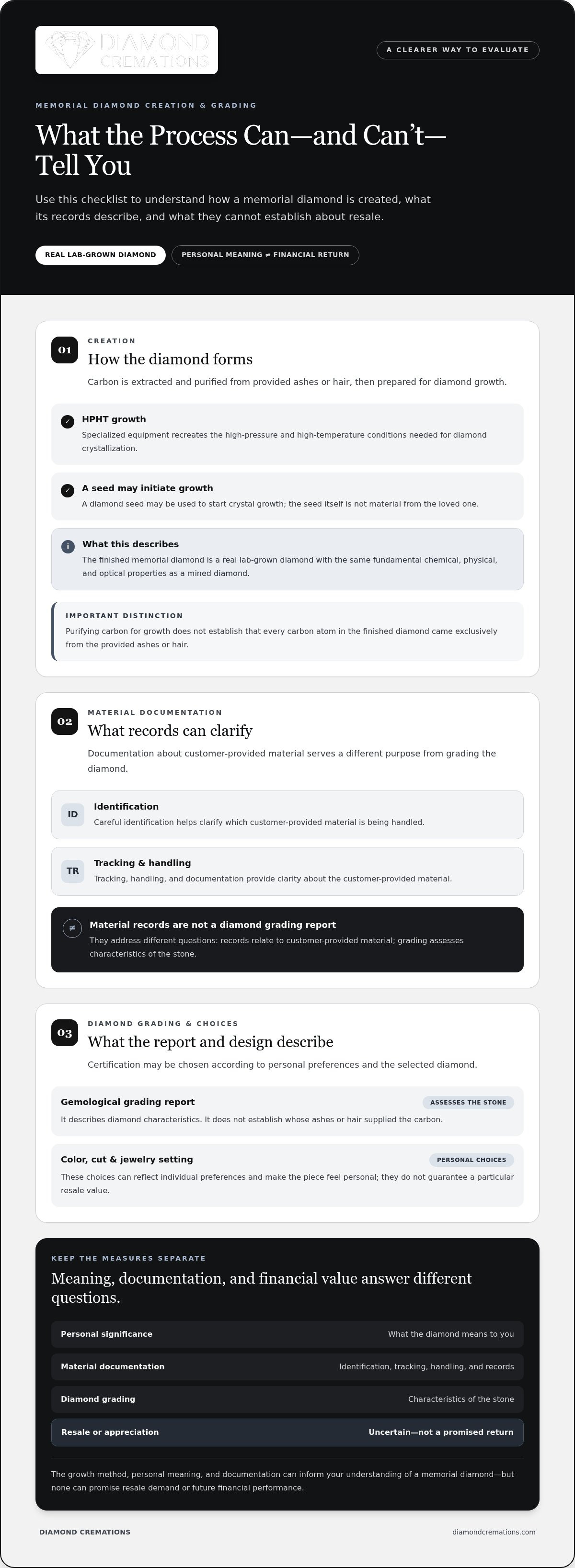
Understanding how a memorial diamond is created can clarify what its documentation describes, and what it doesn’t. Carbon is extracted and purified from provided ashes or hair, then prepared for diamond growth. The finished memorial diamond is a real lab-grown diamond with the same fundamental chemical, physical, and optical properties as a mined diamond.
For HPHT growth, specialized equipment recreates the high-pressure and high-temperature conditions needed for diamond crystallization. A diamond seed may be used to initiate growth; the seed is not material from the loved one. The growth process explains how the diamond forms, but it doesn’t predict what someone might pay for it in a future sale.
What the HPHT process can, and cannot, tell you
Purifying carbon from provided material is part of preparing it for growth. It doesn’t establish that every carbon atom in the finished diamond came exclusively from those ashes or hair. Information about the process helps explain how the diamond is made. Careful identification, tracking, handling, and documentation provide clarity about customer-provided material.
Neither the growth method nor the personal nature of the process establishes resale demand or future financial performance. If you’re asking whether memorial diamonds are a good investment, these details can inform your understanding of the diamond, but they can’t promise a return.
What certification establishes about a memorial diamond
Certification may be chosen according to personal preferences and the selected diamond. A gemological grading report assesses diamond characteristics; it doesn’t establish whose ashes or hair supplied the carbon. Grading describes the stone, while records about customer-provided material address its identification and handling.
Customization also shapes what you’re choosing. Color, cut, and jewelry setting can reflect individual preferences and make the piece feel personal. These choices describe the diamond and how it may be worn or kept, but they don’t guarantee a particular resale value. Review grading and material documentation as separate kinds of information, each with a different purpose.
If you’re considering a memorial diamond for its personal meaning, you can explore memorial diamond options and consider which characteristics feel right for your remembrance.
Can you resell a memorial diamond or expect it to appreciate?
A memorial diamond may be resold, but you shouldn’t assume there will be a buyer, that it will appreciate, or that a sale will produce a predictable financial return. The answer to “are memorial diamonds a good investment” depends on the kind of value you’re seeking. For financial planning, resale is uncertain. For remembrance, a diamond may hold personal value that has no direct connection to what another person might pay.
Any resale outcome can depend on buyer demand, the diamond’s characteristics, available documentation, and the circumstances of the transaction. A grading report describes diamond characteristics, while records about customer-provided material relate to identification and handling. Neither guarantees a sale or determines what a buyer will offer. It’s more prudent to choose a memorial diamond for the meaning it holds now than to rely on future resale.
Why a diamond’s personal story may not translate into market value
The connection between a memorial diamond and a loved one can be deeply meaningful to the family who chose it. A future purchaser may not share that history. The diamond’s personal story and its graded characteristics are different things: one speaks to remembrance, the other describes the stone.
This doesn’t mean resale is impossible or that every buyer will respond in the same way. When secondary market purchasers and estate specialists such as CT Gold & Silver assess jewelry and precious materials, valuations are based strictly on verifiable material traits rather than personal history. Emotional significance is individual and cannot be assumed to raise market value, so keeping those ideas separate helps set clear expectations without diminishing the diamond’s importance to its owner.
Memorial diamonds versus other ways of remembering
Families choose different forms of remembrance according to what feels right to them. A memorial diamond can be set into jewelry and kept close or stored as a keepsake. Its characteristics can be personalized, including its shape and how it’s worn. Other memorial choices may offer their own forms of meaning, permanence, or daily connection. There isn’t one right answer for every family.
If shape is part of your decision, consider how you want the diamond to look and fit into your life. Round, oval, princess, cushion, pear, and emerald shapes offer different visual impressions. While insights from fine jewelry specialists such as Mike Nekta New York illustrate how cut, carat, and settings influence stone appearance and pricing across the jewelry market, the best choice for a memorial piece is personal, not a promise of stronger resale prospects. Prioritize purpose, comfort, and significance over trying to predict a future market.
A simple test can help: if the diamond’s meaning would still matter even if you never resold it, its value to you may be primarily commemorative. If you need a dependable financial return, don’t treat resale or appreciation as assured.
How to decide whether a memorial diamond is worth it for you
There’s no single measure of worth that fits every family. Start by separating what you hope the diamond will mean from what you expect financially. If you’re asking whether memorial diamonds are a good investment, remember that a future financial return isn’t something to count on. You may value the diamond as a personal keepsake, place importance on resale, or consider both, as long as you treat any resale outcome as uncertain.
Move through the decision at a pace that feels comfortable. Define the purpose, set realistic expectations, consider personalization, and review how customer-provided material is handled and documented. The choice should reflect your priorities, not a sense of urgency.
Questions to consider before choosing a memorial diamond
Think about the role you want the diamond to play. Would you wear it as jewelry, keep it as a private keepsake, or see it as part of a family legacy? Consider whether daily wear, portability, or sharing the story with family matters to you. There’s no need to make the choice for anyone else.
Personalization can help shape a piece around your intentions. Consider preferred color, shape, carat size, and jewelry setting. Diamond Cremations creates custom memorial diamonds and jewelry, with personalized concierge service. These choices can help make a meaningful keepsake, but they shouldn’t be treated as predictors of financial return.
Finally, weigh the commitment against what matters most to you. If a dependable financial outcome is essential, don’t rely on appreciation or resale. If the personal connection is central, consider whether that meaning would remain important even without a future sale.
How to assess transparency, handling, and documentation
Customer-provided ashes or hair carry personal significance, so clear identification, tracking, careful handling, and documentation matter. Review information that explains how material is accounted for through the process. These records help describe its handling and serve a different purpose from a gemological grading report.
A grading report assesses diamond characteristics. It doesn’t establish whose material supplied the carbon, and process documentation isn’t biological verification. Understanding these distinctions helps you evaluate the diamond, its documentation, and its personal meaning without expecting one record to prove everything.
Take time to consider the process and available memorial diamond options.
Choosing a memorial diamond for meaning, not promised returns
A memorial diamond can be meaningful without being presented as a financial asset. To make a considered choice, think about your purpose, your expectations, the personalization that feels right, and how the material-handling process is explained.
If a financial return is essential to your decision, don’t rely on a memorial diamond to provide one. Resale and appreciation aren’t predictable outcomes. If remembrance is central, ask whether a diamond feels like a fitting way to honor someone important to you, and whether you would value it even without a future sale. There’s no single right memorial choice, only the one that aligns with your needs and values.
A concise way to frame the final decision
Take a moment to weigh the choice without pressure. Is your priority a personal keepsake, a piece of jewelry to wear, or something the family may share as part of a loved one’s legacy? What expectations do you have about financial return? Which diamond characteristics and setting would make the piece feel personal? Clear answers can help you distinguish what you hope the diamond will mean from what it can reliably provide financially.
Diamond Cremations creates memorial diamonds using carbon extracted and purified from provided human or pet ashes or hair. Personalization can include diamond characteristics and jewelry choices. Available colors may include colorless or white, blue, yellow, and pink, while shapes may include round, princess, oval, cushion, pear, and emerald. The final appearance can vary, so consider these options without expecting an exact shade or result.
Explore memorial diamond options at your own pace
As you review your options, consider how the process is explained and how customer-provided material is identified, tracked, handled, and documented. These details clarify how the material is handled. Gemological grading, when chosen for the selected diamond, describes diamond characteristics; it doesn’t establish whose material supplied the carbon.
Ultimately, the question “are memorial diamonds a good investment” has two different answers. As a way to seek financial returns, a memorial diamond shouldn’t be relied upon. As a personal form of remembrance, its value may lie in the meaning you and your family give it. Take time to consider whether the form, personalization, and documented process feel right.
Explore Diamond Cremations’ memorial diamond options whenever you’re ready. There’s no need to rush a personal decision.
Choose the kind of value that matters to you
Are memorial diamonds a good investment? As a source of financial return, they shouldn’t be treated as an asset expected to appreciate or provide predictable resale. Their value is more personal: a lasting keepsake may carry significance that can’t be measured by a market price.
Before deciding, clarify your purpose, set realistic expectations, and consider how personalization and transparent material handling fit your priorities. Diamond Cremations creates genuine lab-grown memorial diamonds using carbon extracted and purified from provided ashes or hair. Families across the United States can explore personalized diamond characteristics and memorial jewelry, with certification available according to preferences and the selected diamond.
If a memorial diamond feels like a meaningful way to remember someone, explore the possibilities at your own pace.
Whatever you choose, let your decision reflect what feels right for you and your family.
Frequently Asked Questions
Are memorial diamonds a good financial investment?
Are memorial diamonds a good investment? Not if you’re relying on dependable financial returns. A memorial diamond is best considered a personal keepsake, not an asset expected to appreciate or provide predictable resale value. Its significance to you may be lasting, but emotional meaning and market value are different. If financial performance is your priority, don’t count on a memorial diamond to deliver it.
Can you resell a memorial diamond?
A memorial diamond may be resold, but a future buyer or sale price can’t be guaranteed. Resale outcomes may depend on buyer demand, the diamond’s characteristics, available documentation, and the circumstances of a transaction. A grading report describes diamond characteristics, but it doesn’t promise a sale. Choose a memorial diamond for its personal meaning rather than relying on resale as part of the decision.
Do memorial diamonds increase in value over time?
You shouldn’t expect a memorial diamond to increase in financial value over time. Market performance can’t be predicted, and sentimental importance doesn’t necessarily translate into a higher resale price. A diamond may remain deeply meaningful to its owner without becoming more valuable as a financial asset. Consider appreciation uncertain, and base your decision on whether the diamond’s personal significance and form of remembrance feel right to you.
Are memorial diamonds real diamonds?
Yes. Memorial diamonds are real lab-grown diamonds with the same fundamental chemical, physical, and optical properties as mined diamonds. To create one, carbon is extracted and purified from provided ashes or hair, then prepared for diamond growth. Specialized equipment recreates the high-pressure and high-temperature conditions needed for crystallization. A diamond seed may initiate growth, but the seed itself doesn’t come from the loved one.
What does certification prove for a memorial diamond?
Certification or a grading report assesses characteristics of the diamond, such as its quality attributes. Certification may be chosen according to personal preferences and the selected diamond. A report doesn’t prove whose ashes or hair supplied the carbon. That is distinct from careful identification, tracking, handling, and documentation of customer-provided material. Reviewing both kinds of information clarifies what the report establishes and what material records are intended to document.
Is a memorial diamond worth it if I do not plan to resell it?
It may be worth considering if you value it as a personal keepsake rather than for future resale. A memorial diamond can be worn as jewelry or kept as a reminder, and its meaning may matter regardless of market value. Think about the role you want it to play, the personalization that feels appropriate, and whether the choice fits your priorities. There’s no single right way to remember someone.
Can memorial diamonds be made from hair instead of ashes?
Yes. Memorial diamonds can be created using carbon extracted and purified from provided hair, as well as from ashes. The purified carbon is prepared for diamond growth using specialized equipment that recreates the conditions needed for crystallization. Careful identification, tracking, handling, and documentation of customer-provided material help clarify its journey. The finished diamond is a real lab-grown diamond, though not every carbon atom is claimed to come exclusively from the provided material.