


Certified Memorial Diamond: What Certification Means and What It Proves
What does a certificate actually prove about a memorial diamond? A certified memorial diamond comes with documentation that can describe its gemological qualities, such as cut, color, clarity, and carat weight. But a grading report alone doesn’t establish which person or pet provided the material used in the process.
It’s understandable to want paperwork that connects the diamond to someone you love. Grading and material documentation serve different purposes: a gemological report assesses the diamond, while records of identification, tracking, handling, and documentation relate to the material entrusted to the process.
This guide explains what a memorial diamond certificate can and can’t verify, how certification differs from material documentation, and what to look for in each. You’ll also learn how certification choices may depend on the diamond selected and your preferences.
Key Takeaways
- A certified memorial diamond is a genuine lab-grown diamond. Its report describes the stone rather than identifying whose material was used.
- Grading information and records about customer-provided material offer different kinds of clarity.
- Compare documentation by its issuer, scope, diamond identification, and grading details, not by the word “certified” alone.
- Decide what matters most to you, then consider certification and material documentation separately.
- Diamond Cremations offers optional diamond certification alongside careful identification, tracking, handling, and documentation of material.
What Does a Certified Memorial Diamond Mean?
A certified memorial diamond is a genuine lab-grown diamond accompanied by a professional assessment of its gemological characteristics. Diamond Cremations offers certification as an option, depending on your preferences and the diamond selected. It isn’t automatically included with every diamond.
Certification assesses a diamond’s stated qualities. It doesn’t prove whose ashes or hair supplied material for its creation.
Memorial diamonds have the same fundamental chemical, physical, and optical properties as mined diamonds. They differ in origin, not in being genuine diamonds. For broader background on lab-grown diamond methods, properties, and identification, see Wikipedia’s overview of the Synthetic diamond.
What information can a diamond certificate provide?
A report assesses a diamond according to the issuing organization’s grading process. Depending on the report and issuer, it may describe characteristics such as carat weight, color, clarity, or cut, and may include details used to identify the stone. The specific information varies, so read the report rather than assuming every certificate covers the same qualities.
A grading description can help you understand how the issuer evaluated a stone’s characteristics. It is a professional assessment, not a personal account of the diamond’s connection to your loved one. Review the report’s scope and identification details to understand exactly what it documents.
What certification does not establish
Diamond grading doesn’t identify whose ashes or hair supplied material for a memorial diamond. By itself, it also doesn’t document how customer-provided material was identified, tracked, or handled. Those records serve a separate purpose.
Material documentation supports traceability through identification, tracking, handling, and recordkeeping. At Diamond Cremations, these practices complement the optional gemological assessment. A grading report describes the diamond; material records document handling and process connections. Neither should be treated as proof beyond its stated scope, or as evidence of every detail of how a memorial diamond was created.
How Certification Differs from Memorial Diamond Provenance
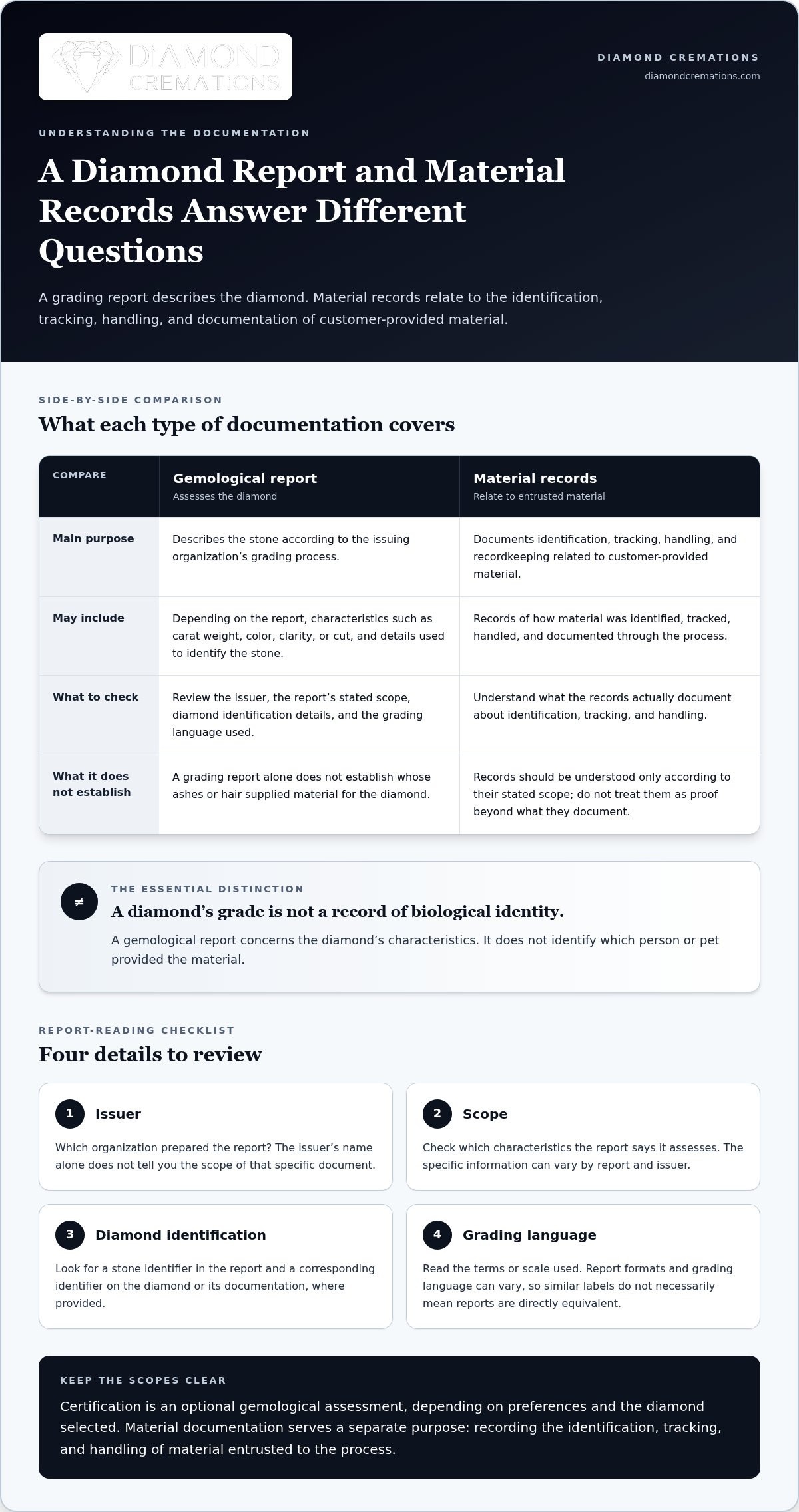
A grading report and material records answer different questions. One describes the diamond; the other documents the handling of customer-provided material associated with the process. Both can contribute to transparency, but each should be understood according to what it actually establishes.
Diamond grading
Assesses the stone according to the issuing organization’s grading process. The report may describe diamond characteristics and include details that help identify the specific stone. Its scope depends on the issuer and document.
Material provenance
Records relate to customer-provided material and its handling. Identification, tracking, careful handling, and documentation support traceability through the process, but the records should be understood according to what they document.
A grading report describes the diamond; material records document the identification, tracking, and handling of what was entrusted to the process.
Diamond grading and material tracking answer different questions
Think of a grading report as an assessment of the finished stone: what characteristics does the issuer describe, and how does the report identify the diamond? Material tracking addresses a different question: how was the customer-provided material identified and documented as it moved through the process?
A report from a gemological organization, such as the Gemological Institute of America (GIA), concerns gemology, not biological identity. Even for a certified memorial diamond, the report doesn’t establish whose ashes or hair supplied the carbon. It isn’t a personal identification document.
Why careful documentation matters to a memorial
Clear records can make the handling of entrusted material easier to understand. Identification helps distinguish material, tracking supports traceability, careful handling reflects attention throughout the process, and documentation records these practices. These steps support transparency, but shouldn’t be described as independent verification unless the documentation establishes that.
For further context on certification and the integrity of transformation, read diamond certification and the integrity of transformation. You can also explore memorial diamond options and consider how grading and material documentation fit your priorities.
How to Read and Compare a Certified Memorial Diamond
A certificate is most useful when you understand what it covers. For a certified memorial diamond, review the document rather than relying on the word “certified” in a description. Diamond Cremations offers certification as an option, depending on your preferences and the diamond selected.
Questions a grading report should help answer
Use this checklist to read the report carefully:
- Issuer: Which organization prepared the report? Gemological organizations such as the International Gemological Institute (IGI) assess diamonds, but the issuer’s name alone doesn’t tell you the scope of a particular report.
- Scope: What characteristics does the document say it assesses? Focus on the grading information actually stated.
- Diamond identification: Does the report include an identifier for the stone? If so, look for a corresponding identifier on the diamond or its documentation, where provided.
- Grading language: What terms or scale does the issuer use? Report formats and grading language can vary, so don’t assume two reports are directly equivalent because they use similar labels.
Compare documents by what they show
Consider what each document can answer. A grading report concerns the diamond; records about customer-provided material concern its identification and handling. Keep those purposes distinct as you compare documentation.
Neither document should be read as proof beyond its contents. A grading report doesn’t establish whose ashes or hair supplied material, and material records aren’t a gemological assessment of the finished stone. Compare the actual records and their stated scope, not brand claims or a certificate label alone.
As you consider certification, decide whether an assessment of the diamond’s characteristics matters to you, then review it separately from material documentation. You can explore Diamond Cremations’ memorial diamond options and consider which documentation best supports your preferences.
What to Consider Before Choosing Memorial Diamond Certification
Start with the kind of reassurance you’re seeking, then consider what each document can tell you. Diamond Cremations offers certification depending on your preferences and the diamond selected. It isn’t automatically included with every diamond.
Choose documentation based on what it verifies and what matters to you.
A calm sequence for deciding
- Clarify your priority. Are you most interested in the diamond’s assessed characteristics, documentation of customer-provided material, or both? These needs call for different records.
- Understand the report’s scope. If you’re considering grading, read what the report says it assesses and how it identifies the diamond. Don’t assume it establishes personal identity or explains every detail of the creation process.
- Consider material documentation. Identification, tracking, handling, and records support traceability of the material entrusted to the process. Review these separately from a gemological assessment.
A grading report and material-handling documentation complement each other, but they aren’t interchangeable. Neither establishes the biological identity of the person or pet associated with the provided material. Keeping that distinction in mind can make your decision clearer.
Let the diamond’s design guide your questions
Certification choices can depend on the diamond selected as well as your preferences. Diamond Cremations customers can personalize carat size, shape, color, and jewelry setting, so consider the design alongside the documentation. Shape options may include round, princess, oval, cushion, pear, or emerald.
Shape may influence how you imagine wearing or displaying the diamond, while the report addresses the stone’s assessed characteristics. These are separate considerations. If you’re still exploring design, the guide to choosing a memorial diamond shape offers more perspective on the options.
Distinguish what you want to learn about the diamond from what you want documented about the material. That gives you a thoughtful basis for deciding whether optional certification is right for the memorial diamond you choose.
Certified Memorial Diamonds with Diamond Cremations: A Thoughtful Next Step
Choosing documentation for a memorial diamond is easier when each record has a clear purpose. A grading report describes the diamond’s characteristics. Records of customer-provided material support traceability by documenting its identification, tracking, and handling. They offer different kinds of information, but neither establishes biological identity.
Diamond Cremations creates genuine lab-grown memorial diamonds using carbon extracted and purified from provided human or pet ashes or hair. The purified carbon is prepared for diamond growth under high-pressure, high-temperature conditions. This doesn’t mean every carbon atom in the finished diamond comes exclusively from the remains. The result is a genuine lab-grown diamond, while careful records document the handling of material entrusted to the process.
What the Diamond Cremations process is designed to honor
Careful identification, tracking, handling, and documentation matter because the material has personal significance. These practices support transparency about its handling, while gemological certification serves a separate purpose: assessing the diamond. Certification is available depending on your preferences and the diamond selected; it isn’t automatic for every memorial diamond.
Keeping those roles distinct can help you decide what information you want. If you value an assessment of the finished stone, consider the grading report’s stated scope. If you’re seeking traceability of the material provided, look to documentation relating to its handling. Each contributes clarity in its own way.
Explore a memorial diamond at your own pace
You can consider certification alongside the design choices that feel right to you, including carat size, shape, color, and jewelry setting. Color possibilities include colorless or white, blue, yellow, and pink. The color category alone doesn’t determine an exact finished shade.
A certified memorial diamond may suit you if professional grading aligns with your preferences and the diamond selected. The decision is yours, and it can be made with a clear understanding of what each document does and doesn’t establish.
Choose Documentation with Clarity and Confidence
A certified memorial diamond comes with a professional assessment of the stone, not proof of whose ashes or hair supplied material for its creation. A grading report describes the diamond’s assessed characteristics, while careful identification, tracking, handling, and documentation support traceability of customer-provided material.
Focus on what each document verifies and what matters most to you. Diamond Cremations offers professional certification depending on your preferences and the diamond selected; it isn’t automatically included with every diamond. Understanding that choice can help you make an informed, personal decision.
Take the time you need. With clear information and thoughtful choices, you can find a meaningful way to honor a lasting connection.
Frequently Asked Questions
Is a certified memorial diamond a real diamond?
Yes. A certified memorial diamond is a genuine lab-grown diamond, not an imitation or simulant. It has the same fundamental chemical, physical, and optical properties as a mined diamond. Carbon for its growth is extracted and purified from provided ashes or hair, though that doesn’t mean every carbon atom in the finished stone comes exclusively from the remains. Certification assesses the diamond according to the issuer’s grading process.
What does certification prove about a memorial diamond?
Certification provides a professional assessment of the diamond according to the issuing organization’s process and the report’s stated scope. Depending on the report, it may describe gemological characteristics and details used to identify the stone. Read the document to see what it assesses. A certificate isn’t proof of the diamond’s personal history, the source of its carbon, or every detail of how it was created.
Does a diamond certificate prove the diamond came from my loved one’s ashes?
No. A diamond certificate grades or assesses the stone; it doesn’t establish whose ashes or hair supplied material for its creation. That connection relates to records about customer-provided material and its handling, such as identification, tracking, and documentation. These records serve a different purpose from gemological grading. Review each document according to what it states rather than assuming one verifies what the other addresses.
Are all Diamond Cremations memorial diamonds automatically certified?
No. Professional diamond certification is available, but it isn’t automatically included with every Diamond Cremations memorial diamond. Whether it’s selected depends on customer preferences and the diamond. If you’re weighing this option, consider whether a professional assessment of the stone’s characteristics matters to you. Keep that choice separate from material-handling documentation, which relates to traceability of customer-provided material.
What should I look for in a memorial diamond certificate?
Start with the report issuer and read the document’s stated scope. Look at the grading information and any diamond identification details, then match an identifier to the corresponding stone if one is included and available for comparison. Report formats and grading language can vary. Don’t assume every report contains the same fields or that a certificate proves the material’s personal origin.
What is the difference between diamond certification and chain of custody?
Diamond certification concerns the stone’s gemological assessment; chain-of-custody documentation concerns the identification, tracking, handling, and records associated with customer-provided material. The two complement one another but aren’t interchangeable. A grading report doesn’t establish whose ashes or hair supplied material, while handling records aren’t a grading assessment of the finished diamond. Consider each document according to its stated contents and purpose.
Can I choose certification for a memorial diamond?
Yes. Diamond Cremations offers professional certification as an option, depending on your preferences and the diamond selected. It isn’t automatically included with every diamond. Consider whether a gemological assessment would be meaningful to you, then review the report’s scope and identification details. Material documentation is separate and supports traceability through records of identification, tracking, and handling.