


Convincing Family About Memorial Diamonds: A Thoughtful Guide
What if the first step isn’t persuading your family, but helping them understand why this form of remembrance matters to you? Convincing family about memorial diamonds can feel delicate, especially when you’re unsure how relatives will respond or how to explain the process. A calm, honest conversation makes room for questions without asking everyone to feel the same way.
It’s natural to want your choice respected while also honoring the different ways your family remembers someone. You don’t need perfect words or every answer before you begin. Start by sharing what a memorial diamond would mean to you, then listen to what others want to understand.
This guide can help you explain your reasons, describe how carbon from provided ashes or hair is used in diamond growth, and respond to questions without overstating what the process can promise. You’ll also find ways to invite family into the conversation gently, so any decision reflects care for the person you’re remembering and respect for one another.
Key Takeaways
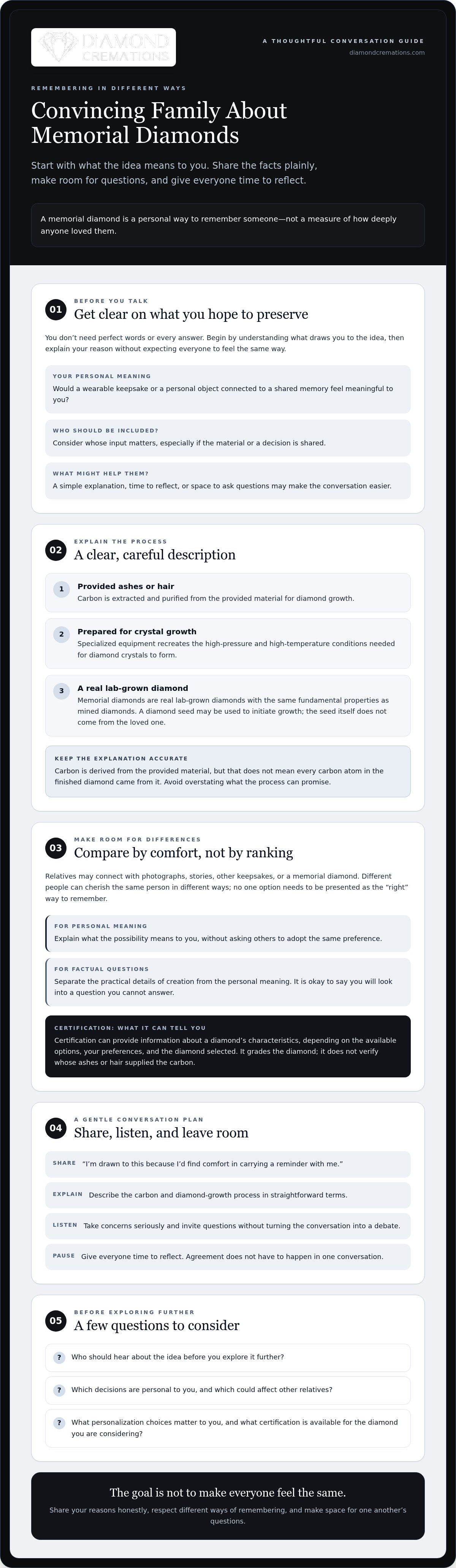
- Before raising the idea, identify what a memorial diamond would mean to you and what you hope to preserve.
- Describe the process plainly: carbon is extracted and purified from provided ashes or hair for diamond growth.
- Take concerns seriously, and compare remembrance options by personal comfort rather than ranking one as better.
- When convincing family about memorial diamonds, share your reasons, invite questions, listen, and give everyone time to reflect.
- Before exploring next steps, consider personalization choices and ask what certification is available for the diamond you’re considering.
Before Convincing Family About Memorial Diamonds, Clarify What You Hope to Preserve
Bringing up a new memorial idea while you and your family are grieving can feel difficult. You may worry that relatives will misunderstand your reasons, or that the conversation will become a debate about the “right” way to remember someone. Before convincing family about memorial diamonds, take some time to understand what draws you to the idea.
A memorial diamond is a personal way to remember someone, not a measure of how deeply anyone loved them. It’s a real lab-grown diamond created using carbon extracted and purified from provided ashes or hair. For a general overview of what memorial diamonds are, it may help to separate the practical details of creation from the personal meaning you’re considering.
What does a memorial diamond represent to you?
Try naming the connection behind your interest. Perhaps you imagine wearing jewelry that reminds you of a loved one during ordinary moments, or you value having a personal object connected to a shared memory. Your reason doesn’t need to persuade everyone. It needs to be honest. Keep factual questions about how a diamond is made separate from what the possibility means to you emotionally.
Personal language can make that distinction clear. For example: “I’m drawn to this because I’d find comfort in carrying a reminder with me.” That leaves room for your family to feel differently. Avoid presenting your choice as something everyone should want or suggesting it’s a better way to remember. Different people can cherish the same person in different ways.
Is family agreement necessary before you begin?
Families don’t always share the same preferences for remembrance. Some may feel connected to photographs, stories, or other keepsakes; others may be open to a memorial diamond. Rather than assuming you need unanimous enthusiasm, consider whose input matters for the decisions ahead. If the material or choice is shared, discuss that openly and find out what each person needs to understand before moving forward.
Before raising the subject, ask yourself:
- Who should hear about the idea before I explore it further?
- Which decisions are personal to me, and which could affect other relatives?
- Would my family benefit from a simple explanation, time to reflect, or a chance to ask questions?
These questions aren’t a test of loyalty or agreement. They help you approach the conversation with care by clarifying what you hope to share and where you’re prepared to listen. You can explain your reasons without asking others to adopt them.
Explain Memorial Diamonds Simply, Without Overstating the Science
Once you’ve clarified why the idea matters to you, a clear explanation can help your family consider it without confusion. Memorial diamonds are real lab-grown diamonds, not imitation stones. Their fundamental properties are the same as mined diamonds, though they’re created in a laboratory rather than formed underground. The FTC’s guidance on describing lab-grown diamonds is a useful reference for why clear wording about their origin matters.
For a simple, accurate summary, explain that carbon is extracted and purified from provided ashes or hair, then prepared for diamond growth. Avoid saying the finished stone is made entirely from the loved one’s remains. The process uses carbon derived from the provided material, but that doesn’t mean every carbon atom in the finished diamond came from it. This distinction keeps a meaningful explanation honest.
How can you describe the transformation accurately?
You don’t need to give a technical lecture. You could say: “Purified carbon is prepared for diamond growth in specialized equipment that recreates the high-pressure and high-temperature conditions needed for crystals to form.” This is the HPHT process. A diamond seed may be used to initiate growth, but the seed itself doesn’t come from the loved one.
Stick to what you know, and be comfortable saying you’ll look into questions you can’t answer. When convincing family about memorial diamonds, measured language builds more trust than grand claims or details you’re unsure of.
What can certification tell your family?
Certification can provide information about a diamond’s characteristics, depending on the available options, your preferences, and the diamond selected. It grades the diamond; it doesn’t verify whose ashes or hair supplied the carbon. Those are separate questions, so don’t present a grading report as proof of a material’s source.
If relatives want to understand the practical choices as well as the science, you can explore memorial diamond options together. The goal isn’t to have an answer for every question at once. Explain the process carefully, distinguish what certification can show from what it can’t, and leave room for your family to consider the information.
Address Family Concerns About Memorial Diamonds With Honest Comparisons
A relative’s hesitation may come from a question about the science, a personal belief, or simply a different way of remembering. Treating that concern as worth hearing can make the conversation more open. The aim isn’t to overcome resistance or secure a shared verdict. It’s to understand what matters to each person and offer clear information.
When comparing remembrance choices, focus on what feels meaningful to each individual. A diamond may offer a personal keepsake someone can wear in daily life; another person may feel closer to a photograph, a shared ritual, or another form of remembrance. These choices don’t need to compete. Consider personalization, how someone wants to keep a memory present, and what feels comfortable. Avoid claiming one option is more loving, lasting, or suitable for every family.
What if relatives question whether it is a real diamond?
You can explain that a memorial diamond is a lab-grown diamond with the same fundamental chemical, physical, and optical properties as a mined diamond. Its origin is different: it’s grown in a laboratory using purified carbon extracted from provided ashes or hair. That factual distinction may answer the question, but it may not resolve every emotional or cultural reservation. Listen first, then offer to share more about the process if they’d find that helpful.
If certification comes up, be precise about what it can establish. A grading report evaluates a diamond’s characteristics; it doesn’t identify whose material supplied the carbon. Certification availability depends on preferences and the diamond selected. Don’t present a grading report as proof of source identity.
What if relatives prefer a different kind of memorial?
That preference deserves respect, too. Ask what forms of remembrance already feel meaningful to them, and consider how a diamond might sit alongside those practices rather than replace them. One person may want a wearable keepsake, while another prefers a tradition the family already shares. Different choices can reflect different relationships, not different levels of care.
As you think about convincing family about memorial diamonds, you might ask: “What kind of reminder feels comforting to you?” Then share your own answer without expecting it to become theirs. This shifts the conversation from defending a single choice to learning what each person values. If agreement isn’t immediate, acknowledge the difference and take time before deciding what, if anything, to explore next.
Use a Gentle Conversation Plan to Share the Idea and Hear Their Concerns
A thoughtful conversation doesn’t have to end in immediate agreement. Choose a calm moment when people have time to talk, rather than raising the subject during a tense family gathering or when someone is already overwhelmed. Keep the first conversation simple: share why you’re considering a memorial diamond, explain the option briefly, invite questions, and listen. Then pause. Everyone may need time to reflect.
How can you introduce the idea without pressuring anyone?
Begin with your own reason, not a request for approval. You might say, “I’ve been thinking about a memorial diamond because having a personal keepsake would mean a lot to me. I’m still learning about it, and I’d like to hear what questions come up for you.” Then ask an open question, such as, “What would you like to understand about it?” Make clear there’s no need to decide together in that moment.
This approach lets relatives respond in their own way. Some may want practical details; others may need time before discussing the idea further. Try not to interpret silence as agreement or disagreement. If someone isn’t ready, you can say, “That’s okay. We can leave it here for now.” Convincing family about memorial diamonds doesn’t mean making everyone share your preference. It means communicating your reasons clearly while giving others room to form their own views.
How should you respond to strong or mixed reactions?
If a relative reacts strongly, pause before offering more information. Ask what concerns them most, then listen for the underlying question, whether it’s about the process, the meaning, or the family’s preferred way to remember. Answer what you know in plain language. If you’re unsure, say so rather than guessing, and offer to check reliable information before continuing the discussion.
Mixed reactions are possible, even among people who care deeply about one another. You can acknowledge the difference without turning it into a debate: “I hear that this isn’t right for you, and I respect that. I’m still considering it for myself.” If the conversation becomes hurtful or overwhelming, set a kind boundary: “I want to talk about this respectfully. Let’s take a break and return to it another time.” Revisit the subject only when everyone feels ready, and don’t treat a pause as a promise to agree later.
Choose a Next Step That Respects the Family and Your Own Decision
A family conversation doesn’t have to produce a final decision. If you’re considering moving forward, clarify the practical details that matter to you and any relatives whose input is relevant. Clear answers can help you decide whether to explore a provider further, while leaving room for different feelings about remembrance.
What should you clarify before exploring a provider?
Ask how customer-provided material is identified, tracked, handled, and documented. You can also ask what a diamond’s grading or certification covers for the specific selection you’re considering. A grading report evaluates diamond characteristics; it doesn’t establish whose material supplied the carbon. Certification availability can depend on your preferences and the diamond selected, so confirm the details rather than assuming it’s included.
Other questions may depend on the service and your circumstances. Write them down before contacting a provider, then ask directly. For example:
- How is customer-provided material documented through the process?
- What does certification cover for this particular diamond?
- Which personalization options are available for the selection I’m considering?
- What other service details should I understand before deciding?
Give yourself permission to seek clear answers before making a commitment. If a detail isn’t explained, ask for clarification instead of relying on assumptions or someone else’s experience with a different provider.
How can you explore personalized memorial-diamond choices?
Once you feel ready, consider which details would make the diamond meaningful to you. Diamond Cremations offers personalization choices that include size, shape, color, and jewelry setting. Available colors may include colorless or white, blue, yellow, and pink, though you should confirm the exact options for a particular selection. For shape inspiration, the guide Choosing the Perfect Memorial Diamond Shape: A Guide to Timeless Remembrance may help you think through what suits your preferences. No one shape needs to represent the same thing for every family.
Convincing family about memorial diamonds doesn’t require unanimous enthusiasm. It can mean sharing your reasons honestly, hearing others with care, and deciding what feels right for your own remembrance while respecting different perspectives. When you’re ready, learn more about Diamond Cremations and consider whether its memorial diamond options fit what you’re seeking. There’s no need to rush the decision.
Move Forward at a Pace That Feels Right
Convincing family about memorial diamonds starts with understanding your reasons, then sharing them honestly without expecting everyone to feel the same. Clear explanations can help relatives ask informed questions, while listening and allowing time keeps the conversation respectful. A different preference doesn’t diminish anyone’s connection or way of remembering.
If you’re ready to explore the practical details, Diamond Cremations serves families throughout the United States. Personalization choices can include diamond size, shape, color, and jewelry setting. Professional diamond certification may be available depending on your preferences and the diamond selected, so confirm what applies to the option you’re considering.
You don’t need to settle every question today. Take the time you need, stay open to your family’s perspectives, and choose a next step that feels thoughtful and true to you.
Frequently Asked Questions
How do I explain memorial diamonds to my family?
Explain that a memorial diamond is a real lab-grown diamond made using carbon extracted and purified from provided ashes or hair. Briefly describe the process, then share what having this personal keepsake would mean to you. Keep your emotional reasons distinct from factual details, and invite questions rather than expecting immediate agreement. If you’re unsure about a technical point, say so and check before answering.
What if my family does not agree with choosing a memorial diamond?
Listen to their concerns, but remember that different family members can prefer different ways of remembering someone. You might say, “I understand this isn’t the choice you’d make, but I’d like you to know why I’m considering it.” If the decision involves material or input shared with others, discuss those details directly. A respectful conversation doesn’t require everyone to feel the same way.
Are memorial diamonds real diamonds?
Yes. Memorial diamonds are real lab-grown diamonds with the same fundamental chemical, physical, and optical properties as mined diamonds. Their origin differs: they’re created in a laboratory rather than formed underground. Explaining that distinction clearly can answer questions without dismissing personal or cultural reservations. If a relative wants more detail about diamond growth, offer to review reliable information together instead of pressing them to agree.
Can a memorial diamond be made from ashes or hair?
Yes. Carbon is extracted and purified from provided human or pet ashes or hair, then prepared for diamond growth. It’s most accurate to say the process uses carbon derived from the material, not that every carbon atom in the finished diamond necessarily came from it. The amount of material and other requirements can vary, so ask the provider about details for the specific selection.
Does a diamond certificate prove whose ashes were used?
No. A diamond grading report evaluates the diamond’s characteristics; it doesn’t establish whose ashes or hair supplied the carbon. Certification may be available depending on preferences and the diamond selected, so confirm what applies rather than assuming it’s included. Questions about identifying, tracking, handling, and documenting provided material are separate from grading and are worth asking the provider directly.
Is a memorial diamond the right choice for everyone in the family?
No single remembrance choice needs to suit every family member. One person may value a personal piece of jewelry, while another may prefer a different keepsake or shared tradition. These preferences can coexist. Consider what feels meaningful to you, and invite relatives to express what matters to them, especially if a decision involves material or input they share.
How can I talk about a memorial diamond without pressuring my relatives?
Choose a calm time, explain why you’re considering the option, and ask what they’d like to understand. For example: “I’m thinking about this because a personal keepsake would matter to me. What questions do you have?” Listen without treating questions as objections you must defeat. Let relatives take time, accept different views, and pause the discussion if anyone feels overwhelmed.