


Problems with Keeping an Urn at Home: What Families Should Know
Keeping an urn close may feel comforting one day and difficult the next. The problems with keeping an urn at home can be emotional as well as practical: seeing it may offer a sense of closeness, or make it harder to decide what feels right. Family members may have different wishes, and cultural or religious beliefs can shape how they think about cremated remains.
If you’re weighing these questions, it’s understandable to want clarity without feeling hurried. There’s no single choice that suits every family, and keeping an urn at home doesn’t mean you need to decide on a permanent resting place right away.
This article explores the emotional considerations, everyday practicalities, and general U.S. rules around keeping cremated remains at home. It also looks at how beliefs and family conversations may influence the decision, and offers thoughtful alternatives for remembering someone. These can include a personal keepsake, such as a memorial diamond made using purified carbon extracted from provided ashes or hair. The goal is to help you consider what feels meaningful and manageable, at your own pace.
Key Takeaways
- Choosing to keep an urn at home is personal. Consider what brings comfort and what suits your household.
- The problems with keeping an urn at home may involve privacy, household routines, future moves, or differing family preferences. They aren’t universal risks.
- Compare keeping the urn with other respectful resting places and personal keepsakes, taking emotional comfort and future flexibility into account.
- Before deciding, discuss family preferences, identify practical concerns, and check current official information for relevant local requirements.
- A memorial diamond is one optional keepsake. Carbon extracted and purified from provided ashes or hair is used for diamond growth.
Keeping an Urn at Home: Concerns vs. Personal Choice
There isn’t one universally correct way to keep or remember someone’s cremated remains. For some families, an urn at home feels comforting and fitting. For others, questions may come up about where to place it, how household members feel about it, or whether they might prefer a different arrangement later.
It helps to separate practical concerns from personal beliefs. Practical concerns affect household comfort, routines, or future decisions. They don’t prove that keeping an urn at home is unsafe or inherently wrong. Beliefs about what should happen to ashes may come from faith, culture, family tradition, or individual conviction. Both types of consideration deserve respect, but they’re not the same.
For neutral background on cremation and its history, see Cremation. That context may be useful, but the decision about what feels appropriate remains personal.
What people may mean by problems with keeping an urn at home
The phrase “problems with keeping an urn at home” can describe very different experiences. One person may find an urn reassuring; another may feel unsure about where it belongs or prefer more privacy. People who share a home may also have different comfort levels. These reactions don’t need to be treated as problems that must be fixed.
Feelings and circumstances can change. An arrangement that feels right now may need reconsideration after a move, a change in household routines, or a conversation with relatives. Family members may have different responses at the same time. Listening without assuming one response is more appropriate can help everyone explain what they need.
Is keeping ashes at home bad luck or against a belief?
Ideas about luck, ashes, and memorial practices vary among individuals and traditions. There is no single belief that applies to everyone within a religion or cultural community. Even relatives who share a background may interpret a custom differently or make personal choices that reflect their circumstances.
If a particular tradition matters to your family, seek guidance from reliable sources that represent it, or speak with a trusted religious or community leader. Be clear about whose interpretation you’re considering rather than treating one account as universal. You can weigh that guidance alongside household preferences and practical needs.
An urn at home is a personal choice, not an automatic problem. Separating practical concerns, beliefs, and individual preferences can help families consider their options with care, without pressure or judgment.
Practical and Emotional Considerations When Keeping an Urn at Home
An urn’s place in a home can affect how it fits into everyday life. Some people appreciate seeing it in a shared room; others prefer a quieter location or find their feelings change from day to day. Different responses can coexist within one family. A suitable choice respects the person remembering and the people who share the space.
How an urn at home can affect daily life
Think about your household as it is now and how it might change. A prominent display in a living room may feel welcoming to one person but too private for another. Visitors might ask about it, and children may have questions. Families can decide together how much they want to share, without treating the urn as either a secret or a focal point.
Moves, changing routines, and future caregiving arrangements can also affect where an urn is kept. The Funeral Consumers Alliance discusses practical problems with keeping remains on private property, including the possibility that an urn’s meaning or placement may need reconsideration as circumstances change. Thinking ahead can make a later decision feel less sudden without requiring you to make one now.
Respectful placement and care without pressure
Choose a location based on personal meaning, privacy, and household comfort. It might be a shared area, a private room, or a less prominent shelf. A stable location where the urn is less likely to be disturbed may suit your household. No particular display style or ritual is necessary.
It can also help to distinguish where an intact urn is placed from whether anyone wants to open it or handle its contents. Those are separate decisions. Your family can consider the urn’s location without making a decision about its contents, and set boundaries that feel comfortable to everyone involved.
- Shared space: Consider whether household members feel at ease with the urn being visible.
- Privacy: Decide whether visitors should be able to see it and how your family wants to respond to questions.
- Future changes: Agree on who should be involved in decisions if the household moves or care arrangements change.
These considerations aren’t evidence that keeping an urn at home is harmful. They’re practical ways to make the arrangement feel respectful and manageable. If a wearable keepsake feels more suited to your family, you can explore memorial diamond options as one possible way to remember someone.
Keeping an Urn at Home or Choosing Another Memorial: How to Compare
Once you understand what feels challenging, compare the options by how well they fit your family’s needs, not by whether one seems more correct. Keeping an urn, choosing another respectful resting place, or selecting a personal keepsake can each be meaningful. Choices involving the remains may also depend on personal beliefs and applicable local requirements, so check current official information where relevant.
| Consideration | Keep the urn at home | Choose another resting place | Select a personal keepsake |
|---|---|---|---|
| Emotional comfort | May feel reassuring if seeing the urn brings closeness. | May feel fitting if the family prefers a dedicated place for remembrance. | Can offer a personal reminder in a smaller, more private form. |
| Household fit | Consider privacy, shared spaces, and who lives in the home. | May separate remembrance from daily household routines. | May suit someone who prefers not to display an urn. |
| Family preferences | Works best when household members can discuss placement respectfully. | May reflect a shared belief or family tradition. | Can be considered alongside other choices, rather than as the family’s only memorial. |
| Future flexibility | Consider how a move or household change could affect the arrangement. | May establish a place outside the home for remembrance. | Offers a different way to remember, while decisions about the urn can be considered separately. |
Which remembrance option may suit your circumstances?
If seeing an urn brings comfort, keeping it at home can remain a meaningful choice. If you’d prefer a smaller reminder, memorial jewelry or another personal keepsake may feel better suited to everyday life. Families don’t need to feel alike to make a considerate decision. Talk about what each person values, where preferences differ, and whether more than one form of remembrance could be appropriate.
How a memorial diamond differs from keeping an urn
A memorial diamond is a distinct keepsake, not a replacement for the person or the relationship you shared. Diamond Cremations extracts and purifies carbon from provided ashes or hair for diamond growth, creating a genuine lab-grown diamond. It can offer a wearable way to remember someone without keeping a full urn at home, while your family considers what to do with any remaining ashes.
Choosing a keepsake doesn’t mean every family member must choose the same form of remembrance. If the problems with keeping an urn at home mainly involve space, privacy, or household preferences, a diamond may be one option to consider. It isn’t a solution every family needs. The diamond’s shape is also a personal choice, so consider how you want the finished keepsake to look and feel as you explore the options.
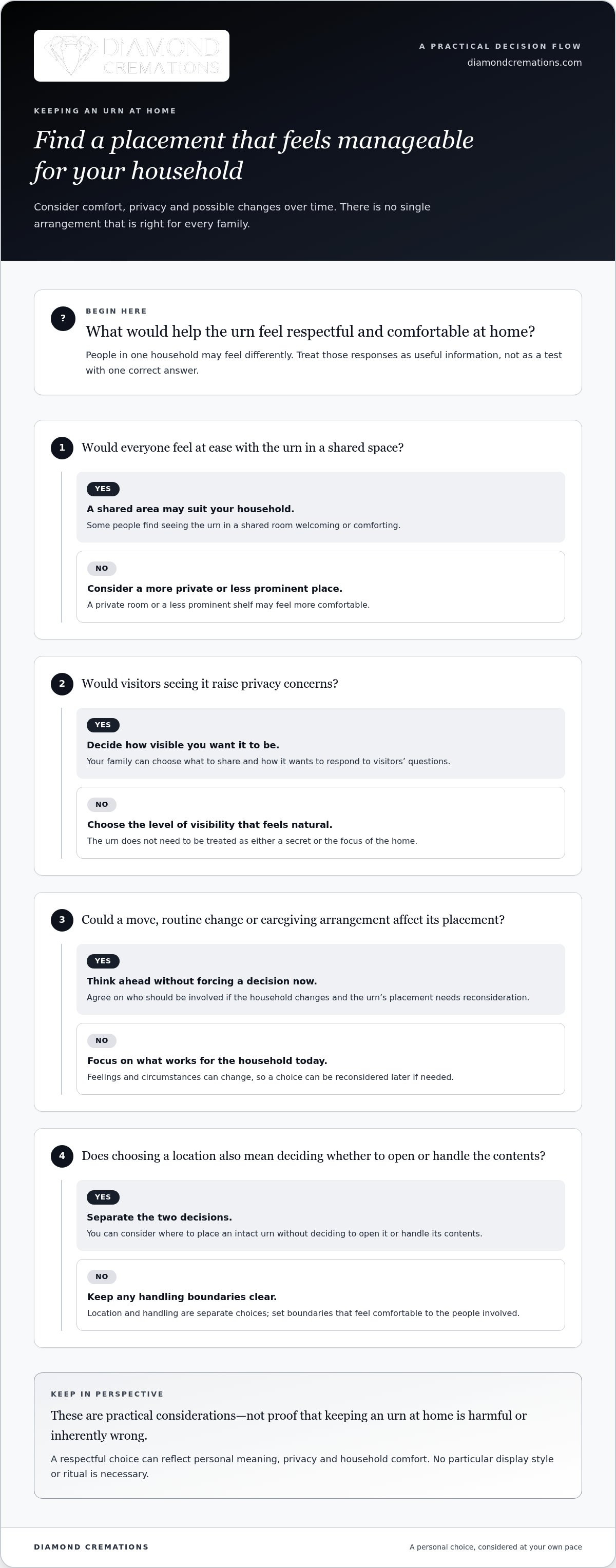
How to Decide Whether to Keep an Urn at Home
A decision about an urn can feel difficult when emotional needs, household preferences, beliefs, and practical questions overlap. Consider them one at a time. Unless a specific practical deadline applies, you don’t need to settle on a permanent arrangement immediately. Taking a pause can give everyone room to understand what matters before choosing a next step.
A simple decision framework for the household
Start with what keeping the urn means to each person, then name the concern each person hopes to address. Is it about comfort in a shared space, a religious belief, or a question about local requirements? Keeping these questions separate can make the conversation less about persuasion and more about understanding the choices.
- Identify the concern: Describe the specific issue behind any worries about problems with keeping an urn at home.
- Hear each preference: Give household members space to explain what remembrance and comfort mean to them.
- Check requirements: Legal requirements can vary by jurisdiction. Use current official information relevant to your location rather than relying on assumptions or outdated advice.
- Agree on a pause: If your family needs time, choose a temporary arrangement that feels respectful and comfortable, then set a time to revisit the discussion.
This approach helps distinguish personal preferences from questions with factual answers. It also keeps one person’s uncertainty from being mistaken for a final decision on behalf of everyone.
When family members disagree about the urn
Loved ones can care deeply for one another and still want different forms of remembrance. One person may value having the urn close; another may prefer a different resting place or a smaller personal keepsake. Neither response is more valid. Try listening for the need behind each preference, such as closeness, privacy, tradition, or flexibility.
A shared memorial or individual keepsakes may allow family members to remember in different ways, if that feels right to them. It’s also reasonable to keep the conversation open and return to it later. Agreement doesn’t have to mean everyone feels exactly the same.
After discussing preferences and checking relevant official information, consider whether the current arrangement works for now. Revisit it if household circumstances change or someone’s feelings shift. A thoughtful decision can happen gradually.
Memorial Diamond Keepsakes: An Optional Alternative to Keeping a Full Urn
A memorial diamond may appeal to someone who prefers a smaller, personal keepsake to keeping a full urn at home. It’s one option among many, not a necessary answer to the problems with keeping an urn at home. Families can choose it as part of their remembrance while continuing to consider what feels right for the urn and any remaining ashes.
What to understand about ashes-to-diamond memorials
Diamond Cremations creates genuine lab-grown diamonds using carbon extracted and purified from provided ashes or hair. The purified carbon is prepared for diamond growth. In high-pressure, high-temperature (HPHT) growth, specialized equipment recreates the conditions needed for diamond crystallization. A diamond seed may be used to begin growth, but it does not come from the loved one.
A memorial diamond is a keepsake, not a replacement for a person or the relationship you shared. Its meaning comes from the role it holds for the person or family who chooses it. Some may value a wearable reminder; others may prefer a different form of remembrance or keeping the urn close. There’s no single choice every family needs to make.
Explore a personal memorial option at your own pace
Diamond Cremations offers personalization by carat size, shape, color, and jewelry setting. Options depend on the selected diamond. Possible shapes include round, princess, oval, cushion, pear, and emerald; available colors may include colorless or white, blue, yellow, and pink. These choices can make a keepsake personal, but they aren’t requirements for choosing one.
Diamond Cremations provides personalized concierge service and secure collection, with careful identification, tracking, handling, and documentation of customer-provided material. Certification is available according to customer preferences and the diamond selected; it isn’t automatically included with every diamond. Certification grades the diamond and doesn’t establish the biological identity of the material used.
Keeping an urn at home remains a valid choice. A memorial diamond is another possibility to consider, at a pace that feels comfortable for you and your family.
Explore memorial diamond options whenever you feel ready.
Choose a Memorial That Feels Right for Your Family
The problems with keeping an urn at home can involve household comfort, personal beliefs, or differing family preferences. They don’t mean keeping an urn is automatically wrong. Consider what each person needs, check current official information for any local requirements, and give yourselves time to revisit the decision if circumstances change.
If you’d prefer a personal keepsake, Diamond Cremations creates genuine lab-grown memorial diamonds using carbon extracted and purified from provided ashes or hair. You can personalize the diamond’s size, shape, color, and jewelry setting, with options tailored to the selected diamond. Nationwide service and personalized concierge support guide families through the process.
Whether you keep the urn, choose another form of remembrance, or take more time to decide, your family can move forward at its own pace. To explore a personal keepsake, view memorial diamond options.
Frequently Asked Questions
Is it safe to keep an urn at home?
An intact urn can be kept at home in a place that feels respectful and comfortable for the household. Cremated remains shouldn’t be treated as inherently dangerous, and there isn’t one required location for every family. If an urn is damaged or its contents are exposed, handle the situation thoughtfully and consult current public-health guidance where needed. Choose a place that suits household members and feels appropriate to you.
Is it bad luck to keep ashes in the house?
There’s no single belief about luck and keeping ashes at home. Views differ among families, faith traditions, and cultures, and some people don’t associate an urn with luck at all. If your concern comes from a particular tradition, look for guidance that reflects it without assuming every follower shares one interpretation. Your comfort matters too, alongside the beliefs and preferences of other household members.
Can you legally keep an urn at home?
Legal requirements may depend on the jurisdiction and circumstances, so don’t assume one rule applies everywhere. If legal certainty matters to your decision, check current official information relevant to where you live. This article offers general considerations, not legal advice. Family, cultural, or religious preferences may also shape what feels appropriate, but those considerations are distinct from legal requirements.
How long can you keep an urn at home?
There’s no single personal timeline that suits every family. Some people find comfort in keeping an urn at home for many years, while others reconsider as their feelings or household circumstances change. Think about what feels comfortable, what family members prefer, and whether any local requirements apply. Taking time to reflect isn’t a measure of how much you remember or care for your loved one.
What should you do if family members disagree about keeping an urn at home?
Start by asking what each person finds meaningful or difficult, without treating disagreement as a lack of love. The problems with keeping an urn at home may feel different to each family member, so separate practical concerns from religious or cultural beliefs. If you need time, consider a temporary arrangement. A shared memorial or personal keepsake may also let relatives remember in ways that feel comfortable to them.
What are alternatives to keeping a full urn at home?
Families may choose another respectful resting place or a personal keepsake, depending on their wishes and any applicable requirements. A memorial diamond is one possible keepsake. Diamond Cremations extracts and purifies carbon from provided ashes or hair for diamond growth. It can offer a personal way to remember someone, but it isn’t the right choice for every family. Keeping the urn at home remains a valid option too.
Can ashes be made into a memorial diamond instead of keeping an urn?
Yes. Diamond Cremations creates genuine lab-grown memorial diamonds using carbon extracted and purified from provided ashes or hair. The diamond can be personalized by carat size, shape, color, and jewelry setting, depending on the selected diamond. This is one alternative to consider, not an expectation or a replacement for the person or relationship. Explore the process and available choices at a pace that feels right for you.