


What to Do with Ashes When You Move: A Guide
If you’re wondering what to do with ashes when you move house, start by planning how to keep the urn safe and accounted for, not by deciding where it will stay forever. It’s understandable to feel protective of the remains and unsure whether to carry them, take them on a flight, or include them with household belongings. A move can make practical choices feel weighty, but you don’t have to settle on a permanent place before you’re ready.
With thoughtful preparation, you can keep cremated remains secure while you focus on the move. This guide explains how to prepare the container, plan transport by car, plane, or moving service, and choose a meaningful place once you’ve settled. The right arrangements depend on your travel plans and the applicable carrier requirements. You’ll also find ways to consider longer-term remembrance, including a memorial diamond made using carbon extracted and purified from ashes or hair. First, plan for the journey. You can decide what comes next later.
Key Takeaways
- You don’t have to choose a permanent memorial during moving week. First, keep the remains identified, protected, and accounted for.
- Use a preparation checklist, and follow the container maker’s care guidance when available.
- Plan transport around your route and travel method. Review current official guidance for flights and the published terms for any household moving service.
- After you arrive, consider privacy, accessibility, household routines, and emotional comfort before choosing a lasting place at home.
- Once settled, you can keep the urn, create a remembrance space, or consider a memorial diamond made using carbon extracted and purified from provided ashes or hair.
Moving House with Ashes: Start with a Calm Plan
You don’t need to choose a permanent memorial during moving week. A move involves enough decisions already, and you can handle what to do with ashes when you move house in stages. Start with a clear priority: keep the remains identified, protected, and under the care of someone you trust.
You can move ashes carefully before deciding where they belong in the long term. Separate the process into preparation, transport, and settling-in decisions. First, choose who is responsible and prepare the container. Then plan how it will travel. After you arrive, give yourself time to decide where it should stay.
Decide what needs attention before moving day
Before routine packing begins, note where the urn or container is kept and choose who will be responsible for it from preparation through arrival. Set it aside from household boxes and keep its handling out of the general packing process. If responsibility is shared, agree on a simple plan: who will prepare it, who will keep track of it during the move, and who will place it safely in the new home.
A straightforward plan can prevent uncertainty when several people are coordinating the move. The aim isn’t to make the day feel formal. It’s to ensure everyone knows who is caring for something important.
Give yourself room to choose a new place
On arrival, a temporary, respectful place can be enough. Choose a quiet spot that the person responsible can access and that feels comfortable within the household’s daily routines. Some families prefer privacy; others want the urn visible as part of a remembrance space. Neither choice is right for everyone.
Let the new home become familiar before settling on a permanent display or storage arrangement. Consider what feels meaningful, what offers practical access, and how the choice fits with everyone who shares the space. Cremated remains are often kept in an urn, though families may consider different arrangements over time. The immediate move and the longer-term memorial are separate decisions, and you can approach them at different paces.
How to Prepare Cremated Ashes for a House Move
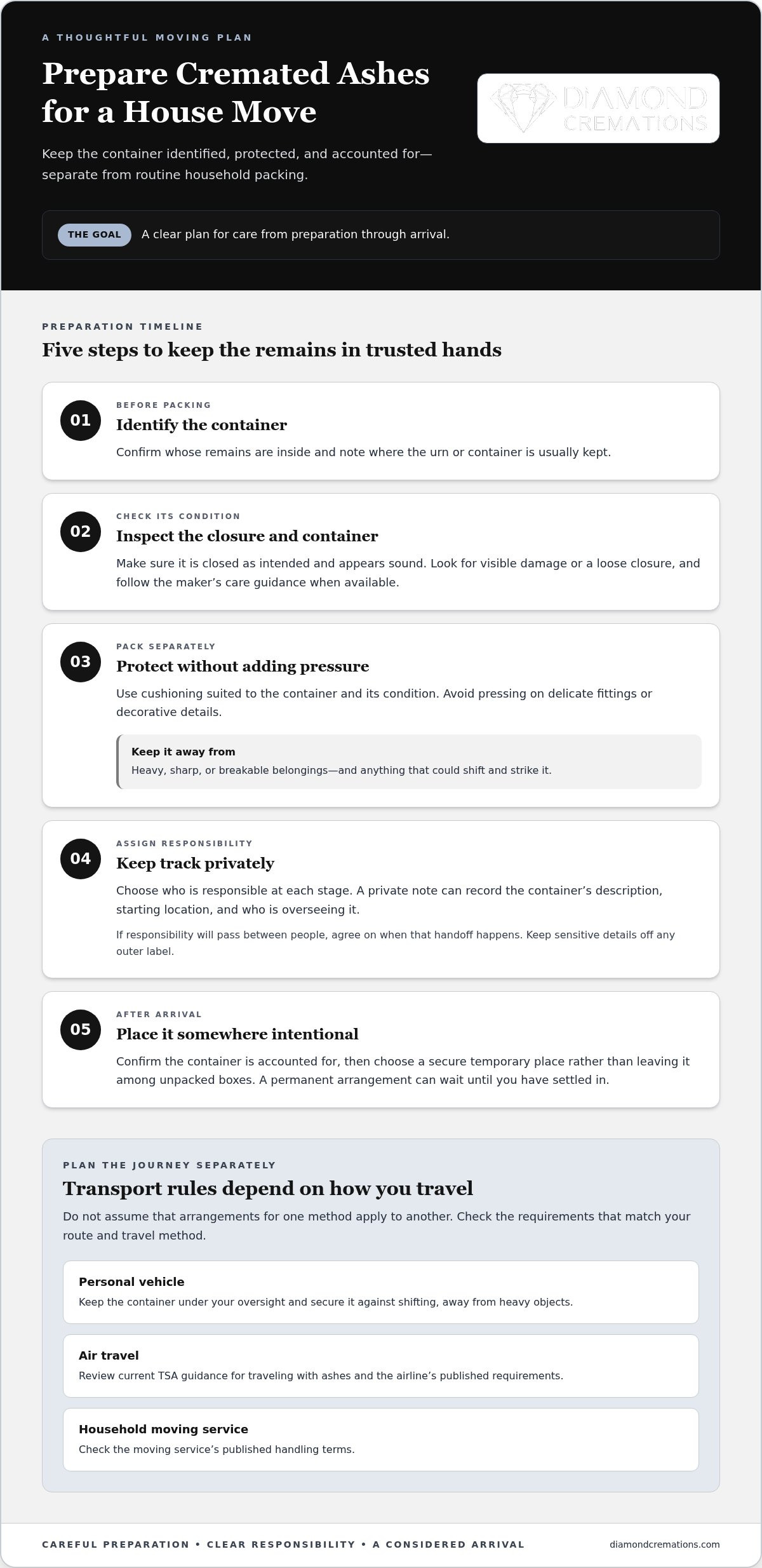
A little preparation can help keep an urn or other container secure and accounted for while everything else is in motion. Treat it as a separate item, not another box on the household packing list. Use this checklist to plan what to do with ashes when you move house, while following the container maker’s care guidance when available.
- Identify: Confirm whose remains are in the container and note its usual location.
- Inspect: Check that the container is closed and appears to be in sound condition. Look for visible damage or a loose closure.
- Protect: Cushion it appropriately without pressing on fragile details or decorative features. Keep it apart from heavy, sharp, or breakable household items.
- Keep track: Choose who is responsible for it at each stage of the move, and record the plan privately.
- Place intentionally: Once it arrives, choose a secure temporary location rather than leaving it among unpacked boxes.
Choose a secure container and protect it thoughtfully
Before packing, make sure the container is closed as intended and free from obvious damage. Follow the maker’s care instructions if you have them. Use cushioning suited to the container and its condition, without putting pressure on delicate fittings or ornamentation. No packing method can guarantee protection, so don’t place the container beneath heavy belongings or beside objects that could shift and strike it.
Keep related paperwork together in a separate, clearly identified place, rather than attaching sensitive documents to the outside of the container. If the move involves air travel, review the TSA guidelines for traveling with ashes and the airline’s current published requirements. Careful identification and packing do not determine whether a container meets a carrier’s rules.
Keep the remains identified and accounted for
Choose one responsible person to keep track of the container, and make sure everyone involved knows who that is. A private inventory note can record its description, starting location, and who is overseeing it. Avoid putting personal or sensitive details on an outer label that may be visible to others. The goal is a clear record for the people coordinating the move, not a public disclosure.
Before the move begins, agree on when responsibility will pass from one person to another, if needed. On arrival, confirm that the container is accounted for and place it somewhere intentional while you continue unpacking. If you later consider a different form of remembrance, such as a memorial diamond, you can explore memorial diamond options after the move, without making that decision part of the packing plan.
Transporting Ashes by Car, Plane, or Moving Service
The best transport plan depends on how much direct control you want and what requirements apply to your route. A personal vehicle lets you keep the container with you, while air travel involves security screening and airline rules. If household movers are involved, their published handling terms matter. Don’t assume arrangements or permissions for one method apply to another.
Taking ashes in a personal vehicle
Traveling by car can make it easier to supervise the container yourself. Secure it against shifting, keep it away from heavy objects, and keep it within your oversight rather than among boxes that may be moved around. Think ahead about stops and overnight breaks: decide where the container will stay and who will be responsible for it if you leave the vehicle. These are practical precautions, not a guarantee about what is permitted on every route.
Flying with cremated remains
Before departure, review the current TSA guidance for cremated remains and your airline’s published rules. TSA permits cremated remains in carry-on and checked baggage, but recommends carry-on to reduce the risk of loss or misrouting. The container must be scannable by X-ray. TSA officers won’t open it for inspection, and a container that cannot be successfully scanned won’t pass through the security checkpoint. A container suited to home display may not be suitable for screening, so review the requirements before travel rather than discovering a problem at the airport.
Airline requirements can differ from TSA screening rules and may be more restrictive. Review the airline’s current policy before you leave, including any requirements about where the container must travel. Allow time to resolve questions before departure.
Using a household moving service
Don’t assume a moving company will transport cremated remains with your household belongings. Review its current terms for personal property and plan how the container will travel accordingly. If its terms don’t cover the remains, arrange to transport them separately. A clear plan helps avoid leaving the container in a shipment without everyone understanding who is responsible for it.
In short, a car may offer more personal oversight, air travel calls for advance review of TSA and airline requirements, and a moving service requires a clear understanding of its handling terms. Requirements can vary and change, so use current official guidance and the relevant carrier’s published rules to plan your route.
Where to Keep Ashes After Moving into Your New Home
Once the move is complete, choose a place for the ashes that fits the home and the people who live there. There’s no single universally right place for an urn. Some families prefer a visible remembrance space; others value privacy or want to wait before making a lasting choice. Let comfort and practical needs guide you rather than pressure to decide immediately.
Choose a place that feels comfortable and practical
Consider whether the location is stable, protected from accidental knocks, and easy for the responsible person to access. Think about the household’s everyday rhythm: a busy entryway may feel less suitable than a quieter shelf or room. If children, pets, or shared living arrangements are part of the picture, consider how the location can feel respectful and appropriate for everyone.
Privacy matters, too. A place that feels meaningful to one person may feel too exposed to another. If family members share responsibility or remembrance, talk through preferences together. You might choose a private location now and revisit the decision after settling in. The goal is not to find a perfect arrangement, but one that feels considerate and workable for your household.
Make a gradual transition after the move
Unpack the urn when there’s a calm moment, rather than treating it as one more task amid boxes and interruptions. Place it somewhere temporary and secure while you get to know the new home. If it feels meaningful, create a small remembrance space with a photograph or another personal item. There’s no need to add anything simply because you feel you should.
Your first arrangement doesn’t have to be your final one; you can reconsider it as your home and needs become clearer. That flexibility can make the decision feel less like a deadline and more like a personal choice made at your own pace.
If, after settling in, you’d like to consider a different kind of keepsake, a memorial diamond is one option. Diamond Cremations extracts and purifies carbon from provided ashes or hair for diamond growth. It’s a separate remembrance choice, not something you need to decide while unpacking.
Memorial Options to Consider After Moving with Ashes
Once you’ve settled, you can decide how you’d like remembrance to take shape in your new home. There’s no single next step, and the move doesn’t require you to change your existing arrangement. You might keep the urn in a considered place, create a small remembrance space, or explore a memorial keepsake such as a diamond. Each option offers a different way to remember, and you can take time to choose.
- Keep the urn: Continue with an arrangement that already feels familiar, or choose a new place for it in your home.
- Create a remembrance space: Set aside a shelf or another personal spot for a photograph, meaningful object, or other expression of remembrance.
- Consider a memorial diamond: Explore a lasting keepsake made using carbon extracted and purified from provided ashes or hair.
When a memorial diamond may feel like a meaningful choice
A memorial diamond is an option, not a required step after a move. Diamond Cremations extracts and purifies carbon from provided ashes or hair, then prepares the purified carbon for diamond growth using specialized equipment that recreates the high-pressure, high-temperature conditions needed for crystallization. The finished memorial diamond is a lab-grown diamond. This process does not mean every carbon atom in the diamond comes exclusively from the provided material.
Personal preferences can inform the diamond’s appearance. Available shapes include round, princess, oval, cushion, pear, and emerald. Color options may include colorless or white, blue, yellow, and pink. The precise shade can vary, so a color description shouldn’t be taken as a promise of an exact result.
Consider design and certification at your own pace
There’s no need to settle on a design while unpacking. When you’re ready, consider which shape and color feel most appropriate and whether certification matters to you. Certification is available depending on your preferences and the diamond selected. It grades the diamond’s characteristics; it doesn’t establish whose carbon was used.
Choosing what to do with ashes when you move house involves both the practical journey and the personal decisions that follow. You can keep the existing arrangement, create a remembrance space, or explore a different keepsake in your own time. If a memorial diamond feels right, explore the options as one way to honor a loved one.
Carry Your Plan Forward at Your Own Pace
A thoughtful move plan starts with keeping cremated remains identified, protected, and accounted for. Choose a responsible person, prepare the container with care, and review current requirements if your journey includes air travel or a moving service. Once you arrive, a temporary, respectful place is enough while you settle in.
Deciding what to do with ashes when you move house doesn’t mean choosing a permanent memorial right away. You can keep the urn, create a personal remembrance space, or consider another keepsake when the time feels right. Make the decision gradually, with your household’s comfort and wishes in mind.
Diamond Cremations creates memorial diamonds from human or pet ashes or hair by extracting and purifying carbon for diamond growth. Secure collection and personalized concierge service support the process, and certification is available based on your preferences and the selected diamond.
One careful step at a time is enough. Your new home can become a place for remembrance in a way that feels right to you.
Frequently Asked Questions
What is the safest way to move ashes to a new home?
Keep the remains identified, protect the container from impact, and assign one responsible person to track it throughout the move. Check that the container is closed and in sound condition, follow the maker’s care guidance when available, and keep it apart from heavy belongings. No packing method can guarantee protection in every situation. If your plans involve air travel or a moving company, review the current requirements that apply.
Can I take cremated ashes with me on a plane?
For domestic U.S. flights, TSA permits cremated remains in carry-on and checked baggage, though carrying them on is recommended to reduce the risk of loss or misrouting. The container must be scannable by airport X-ray equipment; TSA officers won’t open it, and an unscannable container won’t pass through security. Review current TSA guidance and your airline’s rules before departure, since airline requirements may differ.
Should ashes go in the moving truck or my car?
There’s no universal answer. Keeping the container with you may offer more direct supervision, while a moving company’s current terms determine whether it will transport the remains. Don’t assume a household mover will accept or specially handle them. Consider your route, travel plans, and comfort level, then plan according to the company’s published requirements. If you choose your car, decide where the container will stay during stops and overnight breaks.
How should I pack an urn for moving?
Check that the container is closed and in sound condition, then cushion it to reduce shifting and impact without pressing on fragile details. Keep it away from heavy, sharp, or breakable household items, and make sure the responsible person knows where it is. Follow the maker’s care instructions if available. No particular packing material can guarantee the urn will remain undamaged, so handle it thoughtfully throughout the move.
Do I need to decide where to keep ashes before moving?
No, you don’t need to choose a permanent place before moving. First focus on transporting the remains carefully. After you’ve settled, consider privacy, accessibility, household routines, and what feels meaningful. A temporary, respectful location can be enough while you get familiar with your new home. If family members share responsibility or remembrance, a conversation can help everyone feel considered. You can decide what to do with ashes when you move house in stages.
Can ashes be kept at home after moving?
Many people choose to keep an urn at home, but the arrangement that feels right depends on personal preference and household circumstances. Consider a stable place where the container is accessible to the responsible person and less likely to be disturbed. You can start with a temporary location while settling in. If you have questions about local requirements, consult current official information relevant to your circumstances rather than assuming one rule applies everywhere.
Can cremated ashes be turned into a memorial diamond?
Yes. Diamond Cremations creates lab-grown memorial diamonds using carbon extracted and purified from provided human or pet ashes or hair. The purified carbon is prepared for diamond growth using specialized equipment that recreates the conditions needed for crystallization; not every carbon atom in a finished diamond necessarily comes from the provided material. Certification options depend on customer preferences and the selected diamond. A memorial diamond is an optional keepsake, not a decision you need to make during moving week.