


Combining Ashes of Two People: A Guide to Shared Memorials and Eternal Unity
The Meaning of Unity: Can You Combine the Ashes of Two People?
The decision to combine the ashes of two people is a deeply personal and powerful choice, transforming two individual legacies into a single, shared story. This act, known as commingling, is a profound way to honor a bond that transcends a lifetime. It is a physical representation of an inseparable connection, whether between spouses who shared decades of marriage, a parent and child, or any two loved ones whose lives were deeply intertwined.
For many, this process reframes the narrative of loss into one of enduring legacy. The cremated remains become more than a symbol of absence; they become a testament to a shared journey, forever united. With cremation becoming a prominent choice for families—the National Funeral Directors Association (NFDA) projects the U.S. cremation rate will reach 63.4% by 2025—more people are seeking meaningful ways to personalize this final chapter. Combining ashes is one such way, offering a sense of peace and permanence to those left behind.
- Defining commingling: The intentional and respectful mixing of cremated remains from two or more individuals into a single vessel or memorial.
- Common reasons for combining: Honoring a lifelong marriage, a parent-child bond, a profound friendship, or the connection between a pet and owner.
- The emotional shift: Moving from viewing remains as a symbol of "loss" to seeing them as a "shared legacy."
- A universal choice: While often chosen for spouses, this option is available for any two individuals whose family wishes to honor their unified story.
Is Commingling Ashes Legal in the United States?
A common question families have is whether combining cremated remains is legally permissible. While this article does not constitute legal advice, we can provide some general information. In the United States, laws regarding the handling of human remains primarily govern the processes before and during cremation. Once the cremated remains have been processed and lawfully released to the family or the person with the legal authority to control them, families generally have considerable discretion over how they are honored and memorialized.
However, it's important to be thorough and respectful of all parties involved, especially when dealing with the remains of two different people. Applicable state or local laws, specific cemetery regulations, or a funeral provider’s internal policies may apply. When two individuals' remains are involved, it is highly recommended to confirm consent and document instructions before any irreversible commingling takes place. This helps prevent future family disputes and ensures the wishes of all relevant parties are honored.
- Understanding Authorization: The person who holds the right of disposition for each individual has the authority to make decisions. When combining remains, it's best practice to ensure this authority is clear for both sets of remains.
- The Importance of Written Consent: Many funeral homes or memorial providers will request clear, written instructions from the authorized family members before they will physically combine two sets of remains. This documentation protects both the family and the provider.
The Symbolic Power of Inseparable Remembrance
For many grieving families, the act of combining ashes provides a profound sense of closure and peace. It transforms the abstract sentiment of "together forever" into a tangible reality. This final, unified memorial can be a powerful comfort, symbolizing a bond that cannot be broken, even by death. Rather than being a disrespectful act, commingling is viewed by many as the ultimate tribute—a final declaration of unity and love.
- A Source of Comfort: Knowing that two loved ones are eternally together can provide immense peace to surviving family members.
- A Physical Reality: The concept of "Together Forever" moves from a comforting phrase to a physical state, honoring the depth of the relationship.
- A Final Tribute: Combining ashes is an intentional act of remembrance, framed not as a loss of individuality but as a celebration of a shared existence.
Exploring Your Options: Companion Urns vs. Commingling Remains
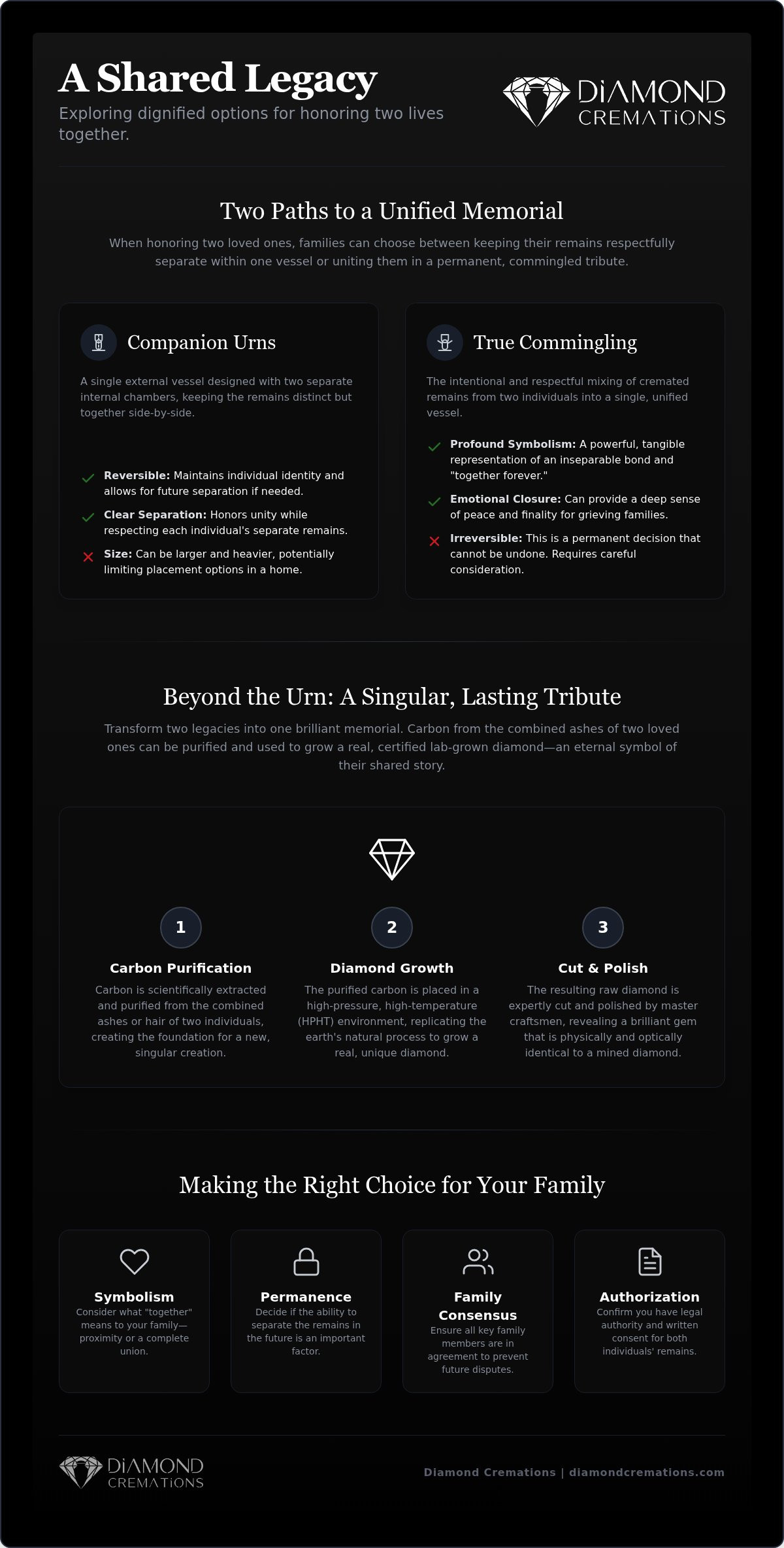
When considering a shared memorial, families face a key decision: should the remains be kept near each other or truly become one? This choice often comes down to the difference between a companion urn, which keeps the ashes separate but side-by-side, and true commingling, which unites them in a single vessel. The right path depends on your family’s emotional goals, practical considerations, and whether you desire the option to separate the remains in the future.
- Near vs. One: Evaluate whether the symbolism of being in proximity is sufficient, or if the act of becoming a single entity is more meaningful.
- Practical Considerations: Think about where the memorial will be kept. A large companion urn may be suitable for a cemetery niche, while a smaller, single vessel might be better for home display.
- Reversibility: The most critical factor is permanence. A companion urn is reversible, while true commingling is not.
- Family Consensus: This decision should ideally involve key family members to ensure the chosen method brings comfort to everyone.
Companion Urns: Side-by-Side Separation
Companion urns are designed to hold the cremated remains of two individuals within a single external vessel. They typically feature two separate internal chambers or use two distinct bags to ensure the ashes do not mix. This option is ideal for those who want to honor a couple's unity while preserving their individual remains. For more on this, our guide to cremation jewelry vs. urns offers further perspective on choosing a final resting place.
- How they work: A single, often larger, urn contains two separate compartments, keeping the remains distinct but housed together.
- Pros: Maintains the individual identity of each person and allows for the possibility of future separation if family circumstances change.
- Cons: These urns are often larger and heavier, which may make them less suitable for display in some homes.
True Commingling: A Permanent Union
True commingling involves physically mixing the cremated remains of two people into one container or scattering vessel. This is an irreversible act that creates a single, unified set of remains. It is a powerful and definitive statement of togetherness, chosen by those who want to create an inseparable memorial. The resulting remains can be kept in a standard-sized urn, making it a more practical option for home display.
- The process: A funeral director or a family member carefully and respectfully blends the two sets of remains into one.
- Pros: A deeply symbolic act of unity; often requires less physical space than a companion urn.
- Cons: The decision is permanent and cannot be undone, which may be difficult for some family members who prefer individual memorials.
Legal and Practical Steps for Combining Cremated Remains
Once your family has decided to combine ashes, there are several practical steps to consider. The process requires careful coordination, clear communication, and meticulous documentation to ensure the remains are handled with the utmost respect. Whether you are working with two different funeral homes or have had the ashes in your care for years, a thoughtful approach is essential.
- Coordinating with Professionals: If the cremations occurred at different times or places, you will need to coordinate the transfer of remains.
- Chain of Custody: Proper documentation is crucial. A clear chain of custody for both sets of remains, and for the final combined set, provides peace of mind.
- Handling Remains at Home: If you are performing the commingling yourself, it's important to create a serene, dignified space and use care to handle the remains respectfully.
- Professional Assistance: Asking a funeral director to perform the commingling ensures it is done professionally and with the proper documentation.
Securing the Necessary Permissions
Before any physical mixing occurs, it’s vital to confirm you have the proper authority. This involves identifying the person who holds the legal right of disposition for each individual. If the individuals passed away years apart, this might involve locating original paperwork or confirming the line of succession for who is in charge of the remains. It is always best to draft a clear, written letter of instruction for the funeral director or memorial provider, signed by the authorized parties. This ensures everyone is in agreement and that your wishes are carried out correctly.
The Role of the Funeral Director
While some families choose to combine ashes themselves, many prefer the assistance of a funeral director. A professional can provide a dignified and respectful environment for the process. Their experience helps ensure careful handling that minimizes the loss of material and preserves a clear chain of custody. Professionals are also equipped to manage the necessary paperwork, updating the records to reflect that the remains are now "Commingled Remains." This formal documentation can be important for future arrangements, such as placement in a columbarium or scattering at sea.
Beyond the Urn: Transforming Two Legacies into One Memorial Diamond
For those seeking a modern and deeply personal way to combine two legacies, a memorial diamond offers an enduring form of unity. This remarkable process transforms the essential element of life—carbon—from the ashes or hair of two individuals into a single, radiant lab-grown diamond. It is a testament to a shared heritage, a beautiful and tangible symbol that contains the contribution of both loved ones.
The science behind this transformation mirrors the forces of nature. Using a sophisticated HPHT (High-Pressure/High-Temperature) process, purified carbon is subjected to pressures of approximately 800,000 PSI and extreme heat. This environment replicates the conditions deep within the Earth where natural diamonds are formed, allowing a unique, shared gemstone to grow. The final result is not a substitute or imitation; it is a real diamond with the same physical, chemical, and optical properties as a mined one, created from a deeply personal source. You can learn more about the science in our guide on how cremation diamonds are made.
The Process of Creating a Multi-Source Diamond
The journey of creating a shared memorial diamond begins with the respectful collection of ashes or hair from both individuals. From this material, carbon is extracted and purified in a highly controlled laboratory environment. This combined carbon is then placed into a specialized growth cell with a tiny diamond seed, which acts as the foundation for crystallization. Over time, under immense pressure and heat, the carbon from your loved ones crystallizes around the seed, growing into a new, raw diamond that is a singular embodiment of their union. The entire process is a patient journey, moving from elemental carbon to a brilliant gemstone over the course of several months.
Personalizing Your Shared Memorial
A shared memorial diamond is as unique as the bond it represents. Families can personalize this tribute to reflect a collective legacy, choosing from various characteristics to create a truly bespoke gemstone.
- Selecting Colors: Choose from a spectrum of colors, including Colorless, Blue, Yellow, or Pink, to represent the nature of the shared bond.
- Choosing Cuts: The raw diamond can be cut into a variety of classic shapes, such as Round, Cushion, Emerald, or Princess, to best reflect a shared style or personality.
- Optional Gemological Reports: For verification of the diamond's qualities, you can request an optional independent gemological report. A respected institution, such as the Gemological Institute of America (GIA) or International Gemological Institute (IGI), can provide a quality assessment that evaluates the finished diamond's characteristics (e.g., carat, color, cut, and clarity). It is important to understand that these reports evaluate the gemstone itself and do not establish the biological identity or provenance of the carbon source.
Choosing the Right Path for Your Family’s Shared Heritage
Deciding on the best way to combine the ashes of two people is a journey of reflection. It requires balancing the wishes of the deceased, the emotional needs of the living, and the long-term legacy you wish to create. Whether you choose a companion urn, the irreversible act of commingling, or the transformation into a shared memorial diamond, the right choice is the one that brings your family the most comfort and peace.
- A Decision-Making Framework: Consider the emotional, practical, and long-term implications of each option.
- Balancing Wishes: Honor the memory of your loved ones in a way that feels authentic to their story and provides solace to those who remember them.
- The Long-Term Legacy: Think about how this memorial will be cherished and potentially passed down through future generations.
Reflecting on Your Emotional Goals
Before making a final decision, ask yourself and your family a few key questions. Are you seeking a private tribute to keep at home, or a public memorial site where others can visit? Do you prefer a traditional vessel like an urn, or a wearable, portable legacy like a diamond? How does the idea of combining ashes align with your family’s spiritual or philosophical beliefs? Answering these questions can help clarify which path will be the most meaningful for everyone involved.
Beginning the Journey of Transformation
If you feel that a shared memorial diamond is the right choice for your family, the next step is to explore your options with a specialist. A compassionate expert can guide you through the process, from the secure collection of the remains to the final design of your tribute. This journey is a profound act of alchemy, transforming two individual legacies into one inseparable, radiant symbol of unity.
Speak with a concierge at Diamond Cremations to discuss your shared memorial
Frequently Asked Questions About Combining Ashes
**Is it possible to mix the ashes of a human and a pet?
** Yes, it is possible and is a choice some families make to honor the profound bond between a person and their beloved animal companion. The legal discretion that applies to human remains generally extends to this practice. Memorial service providers, including Diamond Cremations, can often accommodate this request for services like creating a shared memorial diamond.
**Do we have to combine all of both people’s ashes to create one memorial diamond?
** No, you do not need to permanently mix all of both individuals’ cremated remains to create a shared memorial diamond. Only the small amount of source material required for the diamond creation process needs to be submitted. The remaining cremated remains can be kept separate, divided among family, or memorialized in another way if you wish. It is important to confirm the exact material requirements and handling instructions with Diamond Cremations before sending any remains.
**How much ash is needed to create a single combined memorial diamond?
** The amount of source material required depends on the laboratory process and the materials being provided. For a shared memorial diamond, ashes, hair, or a combination of source materials may be used from each individual. Diamond Cremations will provide the exact collection requirements before any remains or hair are submitted, so families never need to send more material than necessary.
**Can I combine ashes that were cremated many years apart?
** Yes. Properly stored cremated remains do not degrade in a way that prevents them from being used for memorialization. As long as they have been kept in a secure, dry container, remains from decades ago can generally be considered for commingling or for creating a memorial diamond, subject to the memorial provider’s material requirements.
**Do I need a special permit to scatter combined ashes in the ocean?
** The same rules that apply to scattering the ashes of a single individual also apply to combined ashes. In the U.S., the Environmental Protection Agency (EPA) requires that scattering at sea be performed at least three nautical miles from shore. While a federal permit is not required for this, some states may have their own regulations, and you must report the scattering to the EPA within 30 days. It's advisable to check local and state rules.
**What happens if some family members do not want the ashes mixed?
** Family disagreement is a sensitive issue that requires open and compassionate communication. Because commingling is an irreversible decision, it is important to try and reach a consensus. If an agreement cannot be reached, a companion urn that keeps the remains separate but together may be a respectful compromise. Another option is to create multiple, smaller memorials, such as memorial diamonds, allowing different family members to honor the deceased in their own way while still keeping a part of them close.
**Can a memorial diamond be made from both hair and ashes of two people?
** Yes. The key element for creating a memorial diamond is carbon, which is present in both cremated remains and hair. You can combine ashes from one person with hair from another, or use a mix of both from each individual. This flexibility allows for the creation of a diamond even if one person was not cremated.
**Is commingling ashes a permanent decision?
** Yes, the physical act of mixing two sets of cremated remains is permanent and irreversible. Once combined, they cannot be separated. This is why it is so important for all involved family members to be in agreement before proceeding. Options like companion urns or separate memorial keepsakes should be considered if there is any hesitation.
**Will a combined memorial diamond look different from a single-source diamond?
** No, the appearance of the diamond is not determined by the number of sources but by the unique combination of elements present in the carbon and the specific growth process. Each diamond is entirely unique, but a diamond created from two people will not look visibly different from one created from a single person. Its distinction lies in the profound personal story it represents.