


Cremation Jewelry vs. Urns: Choosing the Right Path for Remembrance in 2026
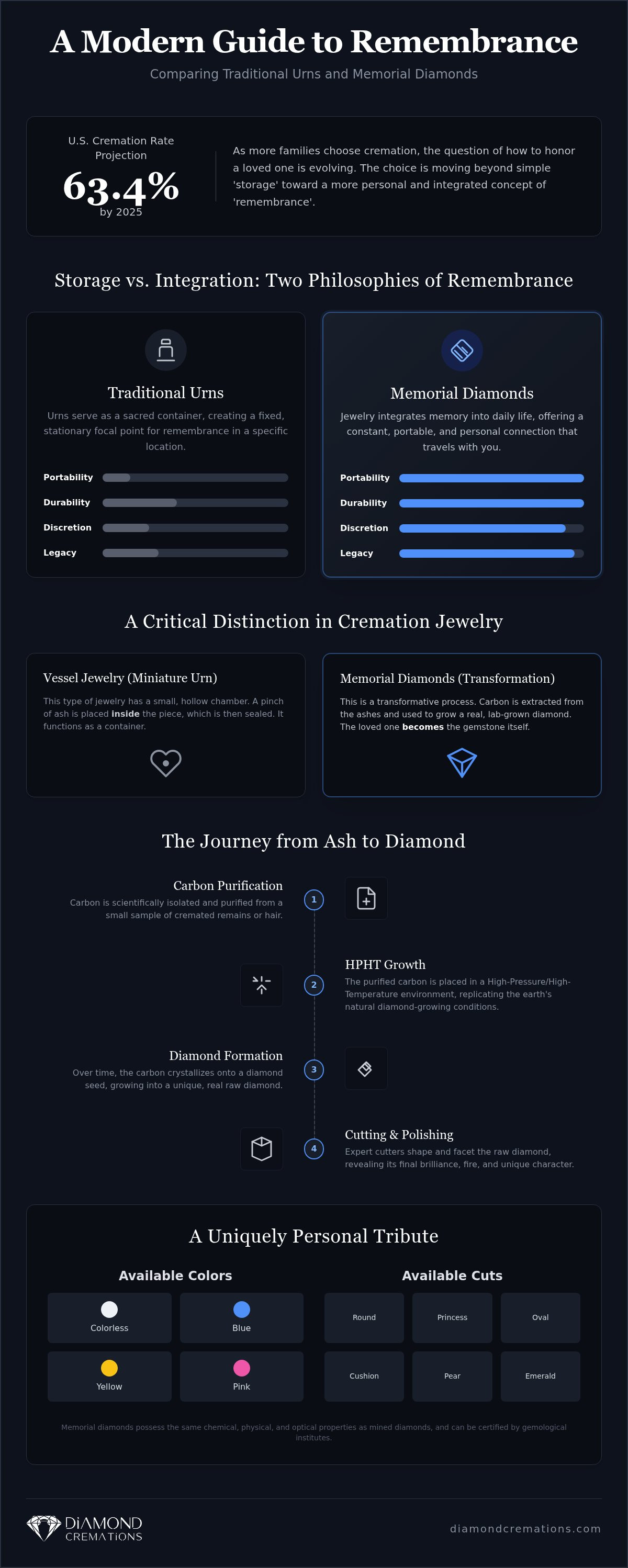
With the U.S. cremation rate projected to reach 63.4% in 2025, more families than ever face the quiet, profound question of what to do next. The decision between traditional cremation urns and modern cremation jewelry is more than a practical choice; it's a deeply personal exploration of how a legacy will live on. This guide offers a clear, compassionate comparison to help you navigate this path, moving from the immediate weight of grief toward a tribute that provides lasting comfort and connection.
Deciding What to Do with Cremation Ashes
Receiving a loved one’s remains is a moment of immense responsibility. The initial question of "where do they go?" often evolves into a more meaningful one: "how do we honor them?" In recent years, a significant shift has occurred, moving away from a traditional mindset of simple ‘storage’ toward a more active, personal concept of ‘remembrance.’ The ashes are more than an endpoint; they are a physical link to a shared history, a tangible connection to a life lived.
Modern families, often spread across cities or even countries, are increasingly choosing to split remains to create multiple, individual tributes. This allows each person to grieve and remember in their own way, transforming a single point of memorial into a shared, yet personal, legacy.
The Emotional Transition from Grief to Legacy
Cremated remains contain mineral material along with carbon that may be isolated for use in creating a memorial diamond. This possibility offers families another way to transform a portion of their loved one’s remains into a lasting memorial. This transition allows you to move beyond the clinical nature of Cremation and embrace a tribute that is both poetic and permanent. The choice of memorial becomes a reflection of the individual—their passions, their personality, and the unique light they brought into the world.
Practical Considerations for Modern Memorials
Our lives are more mobile than ever, and the idea of a single, large urn in a fixed location presents challenges. It can be difficult to move, risks being damaged, and can be hard to pass down through generations. Furthermore, while scattering ashes can be a beautiful ceremony, some families find it lacks the long-term sense of connection and closure they need. This introduces a critical distinction in modern memorials: portable versus stationary. A portable memorial allows a loved one’s memory to be integrated into daily life, offering a constant, quiet presence, while a stationary one provides a dedicated place for reflection.
Understanding the Traditional Role of Cremation Urns
A cremation urn is a vessel designed to hold the full or partial volume of cremated remains. Historically, urns have been used across countless cultures as a sacred container, a final resting place that keeps a loved one’s physical presence contained and protected. They offer the profound psychological comfort of having a specific ‘place’ to visit within the home—a focal point for grief, remembrance, and honor.
Materials and styles vary widely, from ornate marble and warm hardwood for display to simple, biodegradable urns designed for burial or scattering. The urn serves as a traditional, dignified, and widely understood method of caring for a loved one's remains.
Types of Urns and Their Intended Uses
The function of an urn often dictates its design. Common types include:
- Display Urns: These are crafted from beautiful, durable materials like metal, ceramic, or wood and are intended for placement on a mantel, in a niche, or as part of a home memorial.
- Burial Urns: Designed for interment, these urns may need to be placed within a burial vault to meet cemetery requirements, protecting the vessel from the elements.
- Keepsake Urns: These are small, often decorative vessels that hold only a small fraction of the ashes. They are designed to be shared among family members, allowing multiple people to keep a small, physical memento.
The Limitations of Stationary Remembrance
Despite their traditional significance, stationary urns have inherent vulnerabilities. A ceramic or glass urn can be shattered in an accident or a move. A large, singular vessel is also susceptible to loss in a fire or theft. For many, a prominent urn can feel like a shrine to loss rather than a celebration of life, a constant reminder of absence. Furthermore, the question of who inherits a single, large urn can become a difficult and emotional decision for future generations, making it a challenging heirloom to pass down.
Comparing Cremation Jewelry vs. Urns for Long-Term Remembrance
The choice between cremation jewelry and an urn centers on a fundamental difference in philosophy: storage versus integration. An urn stores remains in a fixed location, creating a destination for remembrance. Jewelry, however, integrates that memory into the fabric of daily life, creating a constant, portable connection.
This comparison highlights key distinctions in portability, discretion, and durability. Jewelry allows you to carry a loved one’s memory with you, whether you’re at home or traveling the world. It offers a layer of privacy; a beautiful piece of jewelry is a discreet tribute that you can choose to share or keep personal. When it comes to durability, the contrast can be stark. A fragile ceramic urn is vulnerable, while a memorial created from one of the hardest substances on earth—a diamond—offers unparalleled permanence.
Vessel Jewelry vs. Transformative Diamonds
It's crucial to understand that not all cremation jewelry is the same. The category is primarily split into two types:
- Vessel or Urn Jewelry: These are pendants, rings, or bracelets with a small, hollow chamber inside. A tiny screw or stopper is removed, a pinch of ash is placed inside, and it is sealed. This type of jewelry functions as a miniature urn, a container for the remains.
- Memorial Diamonds: This is a transformative memorial. Instead of storing the ashes, this process extracts the carbon from the remains and uses it to grow a genuine, lab-grown diamond. The loved one doesn't reside inside the jewelry; they become the gemstone itself. This transformation creates an exceptionally durable gemstone rather than simply another form of storage.
Choosing Based on Your Lifestyle and Values
To find the right path, ask yourself what you truly seek from a memorial. Do you want a public tribute that serves as a focal point in your home, or a private connection that you can carry with you always? Consider the practicalities. Do you worry about the potential loss or breakage of a wearable item, or are you more concerned with the vulnerability of a stationary vessel? For some, the ideal solution is a combination of both—retaining a portion of the ashes in a small keepsake urn while transforming the rest into a central family heirloom, like a memorial diamond, that can be passed down for generations.
Unique Memorial Ideas for Personalized Tributes
The 21st century has seen a rise in bespoke mourning art, as families seek tributes that are as unique as the person they honor. This has led to innovative and beautiful options beyond the traditional urn.
- Biodegradable 'Tree' Urns: These vessels contain a mixture of the ashes and nutrients that, when planted, grow into a living tree, transforming a memorial into new life.
- Glass Art and Paperweights: Artisans can infuse a small amount of ash into molten glass, creating stunning, swirled patterns in sculptures, orbs, and paperweights.
- Memorial Diamonds: Representing the most sophisticated and permanent form of unique memorial, turning the carbon from ashes or hair into a certified diamond creates a tribute of unparalleled beauty and durability.
The Science of Turning Ashes into Diamonds
The creation of a memorial diamond is a remarkable feat of science that honors a life by transforming its fundamental elements into a new form of beauty. The process begins with the extraction and purification of carbon from the provided cremation ashes or hair. This carbon undergoes a rigorous purification process to prepare it for diamond growth. For a deeper look at the science, you can learn more about how cremation diamonds are made.
Next, the purified carbon is placed into a High-Pressure/High-Temperature (HPHT) press. This machine simulates the immense forces found deep within the earth, subjecting the carbon to pressures of approximately 800,000 PSI and extreme heat. A tiny diamond seed is often used to initiate the crystallization process, providing a template for the carbon atoms to bond to. Over time, a new, rough diamond forms, atom by atom.
Personalizing Your Eternal Diamond
Once the growth phase is complete, the rough diamond is cut, polished, and faceted by master cutters, just like a mined diamond. The personalization process allows you to create a truly bespoke tribute:
- Selecting Colors: Memorial diamonds can be created in a selection of colors, allowing families to choose a hue that best reflects their loved one and the tribute they envision. Diamond Cremations offers colorless/white, blue, yellow, and pink options. .
- Choosing the Cut: Popular cuts include the brilliant round, the modern princess, the elegant cushion, or the timeless emerald shape, each designed to maximize the gemstone's fire and brilliance.
- Certification: The finished diamond can be sent to a leading gemological institute, such as the GIA or IGI, for an independent grading report that verifies its cut, color, clarity, and carat weight.
The Transformation: Why Memorial Diamonds Redefine Cremation Jewelry
A diamond is the ultimate symbol of love, strength, and an unbreakable bond. By transforming the very carbon of a loved one into a diamond, you are creating a memorial that transcends the idea of a container. This is not a simulant or an imitation; the chemical reality is that these are real lab-grown diamonds, physically and optically identical to those found in the earth.
You are moving from a vessel that holds ashes to a brilliant gemstone that embodies a legacy. This diamond can then be set into a ring, a pendant, or any piece of jewelry, allowing it to become part of your life story. The process is managed with the utmost care, including a secure national collection process and a professional concierge service to guide you at every step.
A Legacy That Can Be Passed Down
Perhaps the most powerful aspect of a memorial diamond is its permanence. While an urn may be lost or broken over time, a diamond is forever. It becomes a true family heirloom, a brilliant connection to an ancestor that can be passed down through generations, carrying stories and memories with it. This provides a unique psychological peace, knowing that a loved one's tribute is not only safe but forever brilliant.
A memorial diamond is a genuine lab-grown gemstone created through the HPHT process. Independent gemological certification is available as an option for customers who choose it.
Taking the Next Step in Your Journey
Utilizing HPHT technology to create the conditions required for diamond growth, we create genuine lab-grown diamonds designed to endure as meaningful family heirlooms. The first step is simple and handled with complete dignity, beginning with a secure ashes collection kit sent directly to you. Throughout this sensitive time, it is vital to have professional, compassionate guidance. We are here to answer your questions and help you create a tribute as unique and beautiful as the life it honors.
Frequently Asked Questions
Is cremation jewelry better than an urn for long-term preservation? For long-term preservation, transformative cremation jewelry like memorial diamonds offers superior durability. A diamond is one of the hardest substances on earth and is not susceptible to the breakage, fire, or water damage that can affect a traditional urn.
Can you turn an entire person's ashes into one diamond? No, the diamond creation process only requires a small amount of ashes or hair (typically 1/2 to 1 cup of ashes or 1 gram of hair). The process isolates carbon from the provided material, and only a portion of that is used to grow the diamond.
**How much ash is actually needed to create a memorial diamond? **The amount of cremated remains needed can vary depending on the individual order. Diamond Cremations will confirm the appropriate amount during the collection process. Hair may also be used as a carbon source when appropriate.
Is a memorial diamond considered a real diamond by experts? Yes. A memorial diamond grown from ashes is physically, chemically, and optically identical to a diamond mined from the earth. Gemological experts and institutions like the GIA and IGI certify them as real, lab-grown diamonds based on their properties, not their origin.
What happens to the ashes that are not used in the diamond-making process? Only the material necessary for the diamond-creation process is collected and used. The handling of any remaining material will be clearly communicated as part of the collection and production process.
Can I use hair instead of ashes to create a memorial diamond? Yes, hair is a rich source of carbon and can be used to create a memorial diamond, either on its own or in combination with ashes. This is a meaningful option for those who may not have access to cremated remains.
How long does the transformation from ashes to a diamond typically take? The complete process generally takes approximately 60–90 days, although production time can vary depending on the characteristics of the individual diamond. Our concierge team provides guidance and updates throughout the process.
Does cremation jewelry come with a certificate of authenticity?
For memorial diamonds, independent gemological certification is available as an option. A grading report from a respected gemological laboratory such as GIA or IGI documents characteristics of the finished diamond, including its color, clarity, carat weight and other applicable grading **information. Gemological certification evaluates the finished diamond; it does not independently establish biological identity or verify the source of the carbon. **