


Creating a Family Heirloom from Ashes: A Guide to Lasting Memorials
With the U.S. cremation rate reaching 63.4% in 2025 according to the National Funeral Directors Association, more families are moving away from stationary urns in search of an enduring tribute. When considering creating a family heirloom from ashes, you naturally want a piece that withstands the test of time. It is painful to think about fragile keepsakes like resin or glass clouding, scratching, or breaking, just as it is stressful to wonder whether your loved one's remains will be handled with absolute reverence. You deserve complete peace of mind, knowing that whatever you design will truly honor their legacy across lifetimes.
In this guide, you'll discover how families transform cremated remains into enduring, wearable heirlooms that honor loved ones across generations. We'll examine the critical differences between delicate novelty keepsakes and authentic gemstones, explain how carbon transformation and secure chain-of-custody protocols function, and help you confidently choose a custom heirloom tailored to your family heritage.
Key Takeaways
- Learn how creating a family heirloom from ashes offers an enduring, portable alternative to traditional urns, carrying your loved one's memory across generations.
- Understand the vital differences between fragile keepsakes like resin or glass and the lasting permanence of authentic lab-grown diamonds.
- Discover the science of carbon purification and high-pressure crystallization that turns refined carbon into genuine gemstones.
- Explore bespoke design possibilities, including tailored shapes, distinct colors, and heirloom jewelry settings suited to your family legacy.
- Gain peace of mind by understanding strict chain-of-custody tracking protocols and optional independent gemological certification.
The Evolution of Remembrance: Creating a Family Heirloom from Ashes
Memorial traditions have undergone a fundamental shift. For decades, remembrance centered on fixed locations: a burial plot visited on anniversaries or an urn resting quietly on a mantel. As families become geographically dispersed, maintaining a physical connection to a single cemetery plot or a stationary vessel has grown increasingly difficult. Today, honoring a loved one is shifting toward dynamic, personal keepsakes that travel wherever life leads.
A genuine family heirloom bridges personal tribute with enduring family history. It is not merely a container for remains; it is a timeless physical artifact designed to carry stories forward. When families explore creating a family heirloom from ashes, they are choosing to transform memory into a permanent presence, ensuring the person they cherish remains an active part of future generations.
Moving Beyond the Traditional Memorial Urn
Traditional urns serve a clear initial purpose, yet they often end up tucked away in closets or left behind during life transitions. Modern families increasingly want ways to celebrate a loved one's impact openly. Portable heirlooms allow relatives across the country to share that bond, offering a wearable tribute that seamlessly integrates into daily routines rather than remaining confined to a shelf.
What Defines a Lasting Generational Heirloom?
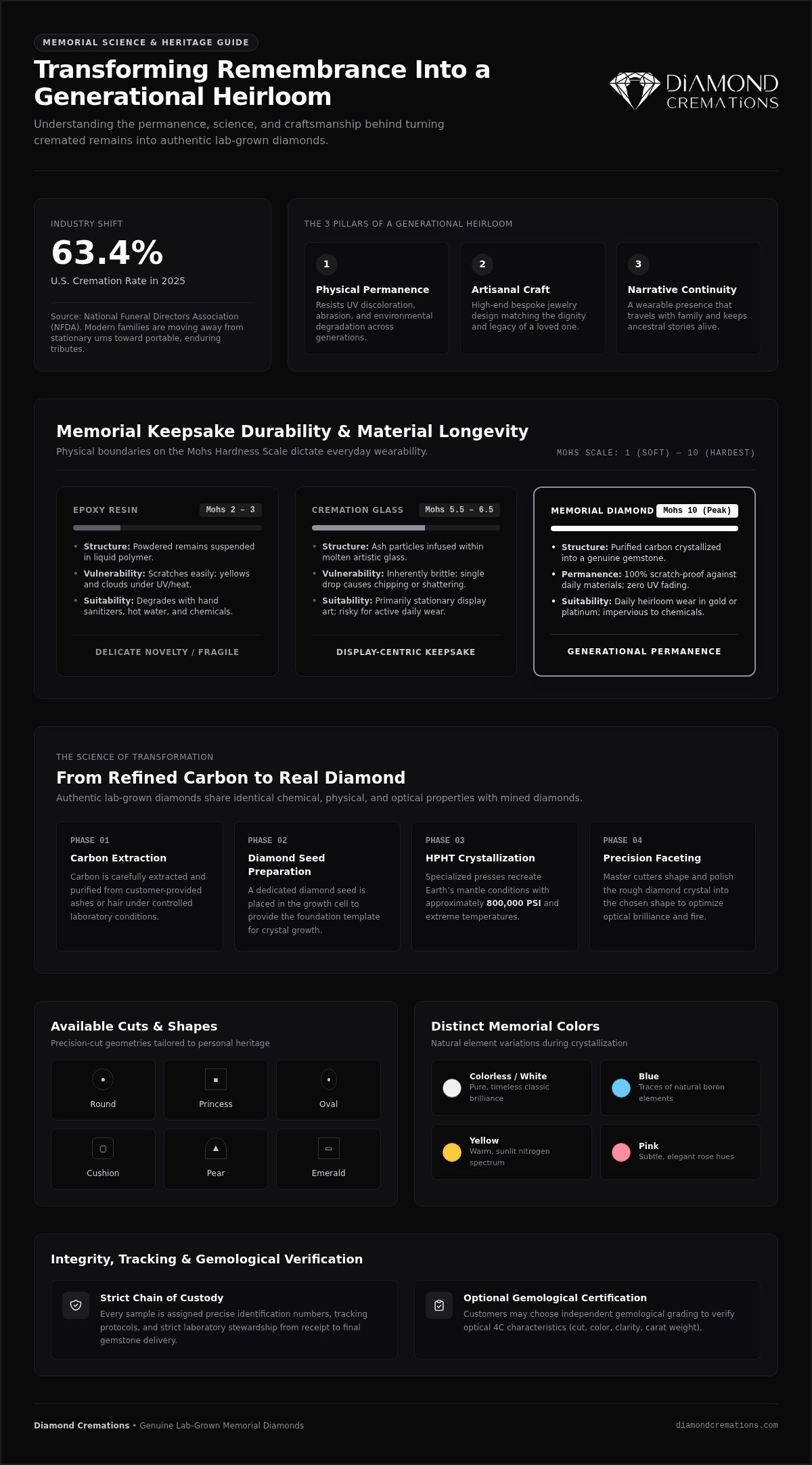
Not every memorial object qualifies as an heirloom. To survive decades of daily life and pass smoothly from parents to children, an object must meet distinct criteria:
- Physical permanence: The underlying material must resist environmental degradation, UV discoloration, and surface abrasion. True heirlooms do not warp or fade.
- Artisanal craftsmanship: High-end custom design elevates a tribute beyond a novelty trinket, matching the dignity of the person it represents.
- Narrative continuity: Wearable pieces invite conversation, allowing children and grandchildren to ask questions and keep ancestral histories alive.
True permanence ensures the object outlives its first custodian. By focusing on exceptional durability and thoughtful design, creating a family heirloom from ashes establishes a tangible touchstone that withstands daily wear while preserving love, lineage, and character for decades to come.
Comparing Memorial Keepsakes: Glass, Resin, and Memorial Diamonds
Selecting the right medium is the most consequential decision when creating a family heirloom from ashes. Today, options generally fall into three categories: artistic glass, cast resin, and authentic memorial diamonds. While each path incorporates remains, their physical durability and generational lifespans differ substantially.
Cremation glass captures ash particles suspended within molten glass, creating vibrant, swirling designs. Resin keepsakes blend powdered remains into liquid epoxy polymers, offering an accessible method for casting small charms. In contrast, memorial diamonds purify extracted carbon to crystallize genuine gemstones that share the exact physical, chemical, and optical properties of mined stones.
Material Durability and Generational Longevity
The longevity of an heirloom depends directly on material hardness. The Mohs hardness scale illustrates these stark physical boundaries:
- Epoxy resin (Mohs 2 to 3): Soft and susceptible to surface scratching. Over time, UV light exposure and ambient heat can cause resin to turn yellow, cloud, or become brittle.
- Cremation glass (Mohs 5.5 to 6.5): Harder than resin, yet inherently brittle. A single drop onto tile or stone can cause irreversible chipping or shattering.
- Memorial diamonds (Mohs 10): The hardest known mineral on Earth. Diamonds are completely scratch-proof against everyday materials and impervious to chemical decay, moisture, and ultraviolet discoloration.
Everyday Wear Versus Display-Only Keepsakes
Daily wear quickly exposes structural weaknesses. Resin pieces require constant caution, as household chemicals, hand sanitizers, and hot water can degrade polymer bonds. Glass memorials primarily serve as stationary display art, remaining vulnerable to accidental household falls.
A true heirloom shouldn't live behind protective glass or demand timid handling. Set into resilient precious metals like gold or platinum, memorial diamonds withstand daily life, whether doing dishes, gardening, or traveling. For families seeking lasting permanence when creating a family heirloom from ashes, exploring custom memorial diamonds transforms refined carbon into a resilient piece of fine jewelry you can wear with complete confidence every day.
The Science of Transformation: How Remains Become Genuine Diamonds
Turning cremated remains into a gemstone is not a matter of simply compressing ash. Cremated remains consist largely of bone minerals like calcium phosphate, alongside trace elements and trapped carbon. Creating a family heirloom from ashes through diamond synthesis relies on precise chemistry and high-pressure physics, isolating that elemental carbon and recreating the deep-earth environment where diamonds naturally form.
Under the Federal Trade Commission definitions in 16 CFR Part 23, laboratory-grown diamonds are diamonds. They share the identical crystalline lattice, optical dispersion, chemical composition, and physical hardness of mined gemstones. They are neither imitations nor simulants; they are authentic stones grown under controlled conditions.
Carbon Extraction and Elemental Purification
The transformation begins in the laboratory. Specialists treat the provided ashes through chemical and thermal processes to extract the organic carbon from the surrounding mineral matrix. Ashes or hair can both serve as viable sources, as hair contains concentrated keratin carbon that refines cleanly. This extracted carbon is purified into fine graphite powder, preparing the elemental building blocks needed for crystallization.
The High Pressure High Temperature (HPHT) Growing Process
To crystallize purified carbon, laboratories use High Pressure High Temperature (HPHT) presses. The journey from carbon powder to crystal involves several deliberate stages:
- Growth cell assembly: The purified carbon is placed inside a specialized core containing a solvent metal catalyst and a tiny diamond seed crystal. This seed acts as a foundational blueprint, though it does not originate from the loved one.
- Extreme simulation: Massive hydraulic presses generate pressures of approximately 800,000 PSI alongside temperatures exceeding 2,000 degrees Fahrenheit, reproducing the conditions of the upper mantle.
- Precipitation and crystallization: Under these forces, the carbon dissolves into the molten metal flux and steadily precipitates onto the seed crystal, expanding atom by atom into an uncut rough diamond.
Gemological Authenticity and Master Cutting
Once growth finishes, the raw stone is extracted from the growth cell. Master lapidaries inspect the rough gem's crystal planes, planning facet placement to achieve optimal light refraction, fire, and brilliance. Skilled cutters hand-shape the rough crystal into standard faceted shapes. When creating a family heirloom from ashes, reading about choosing the perfect memorial diamond shape helps you evaluate which geometry best captures light and suits your setting.
Personalizing Your Heirloom: Shapes, Colors, and Jewelry Settings
Personalization transforms a gemstone into an intimate narrative. When creating a family heirloom from ashes, tailoring each facet, hue, and mount ensures the finished piece honors your loved one's presence. Rather than relying on generic designs, bespoke selections honor the individuality of your shared history and provide an enduring touchstone for your family.
Selecting Diamond Cuts and Geometries
The architecture of a cut shapes how light moves through the crystal and how the gem sits against the skin. Several classic geometries offer lasting elegance across generations:
- Round brilliant: The classic benchmark, engineered with 58 facets to maximize fire and scintillation.
- Princess and cushion: Princess cuts deliver clean, contemporary geometry, whereas cushion cuts feature softly rounded corners that echo antique styling.
- Emerald: A step cut defined by clean parallel lines and an open table, emphasizing interior clarity and quiet sophistication.
- Oval and pear: Elongated shapes that create a graceful line on the hand or rest naturally as a pendant, blending brilliance with a modern silhouette.
Understanding Natural Variations in Diamond Color
Color emerges through precise elemental controls during crystallization. Available colors include colorless/white, serene blue, vibrant yellow, and delicate pink hues:
- Trace amounts of boron introduced to the growth cell yield cool blue tones.
- Nitrogen within the lattice produces rich, warm yellow stones.
- Achieving pristine colorless diamonds requires extracting virtually all nitrogen from the chamber to produce clear transparency.
Because every crystal forms individually under high pressure, subtle organic color nuances naturally appear across stones. These variations ensure no two gems are ever completely identical.
Custom Fine Jewelry Settings for Family Pieces
An heirloom gemstone requires an equally durable mount to endure across lifetimes. Setting a stone in precious metals like 14k or 18k gold or hypoallergenic platinum ensures the piece resists daily wear without corroding. Pendants keep a loved one's presence close to the chest, while rings featuring reinforced prong or protective bezel settings safeguard stone edges against impact.
Carefully constructed precious metal mountings allow rings and pendants to withstand frequent wear and eventual resizing. When designing with structural longevity in mind, creating a family heirloom from ashes delivers a durable piece of fine jewelry ready to be treasured by future generations.
Custody, Verification, and Stewarding an Heirloom for the Future
Trust forms the foundation of any memorial tribute. Entrusting a loved one's remains requires transparent processes, clear documentation, and steady professional stewardship. When families undertake creating a family heirloom from ashes, they want assurance that every step of the journey is carried out with dignity and precision.
Creating a gemstone is only the beginning. Ensuring that the resulting piece remains an understood, protected family heirloom requires intentional preservation practices, gemological verification, and thoughtful provenance tracking for the generations who will eventually inherit it.
Chain of Custody and Transparent Handling
A rigorous chain of custody safeguards remains from the moment they leave your home. Dedicated tracking systems assign unique identification numbers to every intake, following the material through carbon extraction, graphite purification, and high-pressure synthesis. This continuous documentation ensures that client-provided carbon is scrupulously monitored and isolated throughout every technical phase, providing quiet confidence to families nationwide.
Independent Certification and Gemological Reports
Many families choose to validate their diamond through an independent gemological evaluation. Clients can choose optional certification depending on their individual preferences and the specific diamond selected:
- Objective evaluation: Independent institutions such as the Gemological Institute of America (GIA) or the International Gemological Institute (IGI) assess the cut quality, clarity grade, color profile, and exact carat weight.
- Distinction of scope: Gemological reports verify that the specimen is a genuine laboratory-grown diamond. They assess physical and optical attributes; they do not establish biological donor identity or origin.
Passing Down the Legacy: Preservation and Documentation
A family heirloom derives its emotional weight from the stories surrounding it. Without deliberate context, future generations may appreciate a ring or pendant for its beauty without understanding whose life it represents. Stewardship involves three essential habits:
- Create a provenance envelope: Keep a dedicated archive containing the original receipt, any gemological reports, and a handwritten letter detailing the loved one's life, values, and memories.
- Schedule routine inspections: Have a bench jeweler inspect settings and prongs every two to three years to ensure precious metals haven't bent or worn thin from daily activity.
- Practice attentive maintenance: Clean fine jewelry using gentle warm water and mild soap, storing pieces in lined compartments to prevent settings from abrading against other items.
Through disciplined chain-of-custody protocols, formal gemological verification, and careful family documentation, creating a family heirloom from ashes establishes a protected legacy built to endure for centuries. Families can explore memorial diamond options to understand the full path of turning memory into an enduring tribute.
Crafting an Enduring Legacy for Generations to Come
Choosing an heirloom is an act of deep remembrance and intentional stewardship. By transforming purified carbon into an authentic lab-grown diamond, you give memory an indestructible form that matches the chemical, optical, and physical brilliance of mined stones. When creating a family heirloom from ashes, you leave behind the vulnerability of fragile keepsakes in favor of an artifact built to outlast lifetimes.
Every step honors your loved one through rigorous chain-of-custody tracking that protects customer-provided material with transparent care. Combined with bespoke customization across diamond cuts, distinct hues, and precious metal settings, you create a deeply personal tribute tailored to your family heritage.
You can move forward with quiet confidence, knowing that your shared story will remain close at hand and beautifully preserved for every generation to come.
Frequently Asked Questions
Can you create an authentic diamond from both ashes and hair?
Yes. Technicians can extract and purify carbon from human or pet cremated ashes, hair clippings, or a combination of both. Hair contains a high concentration of carbon, making it a viable standalone source or supplement. The extracted carbon is refined into graphite powder before undergoing high-pressure crystallization. This flexibility gives families meaningful options regardless of whether they have ashes, hair, or both.
Are memorial diamonds real diamonds in terms of composition and hardness?
Yes, they are authentic diamonds in every gemological sense. Under Federal Trade Commission guidelines, lab-grown diamonds share the identical chemical, optical, and physical properties as mined stones. They consist of pure carbon crystallized in an isometric structure, scoring a 10 on the Mohs hardness scale. They are genuine gemstones, not simulants or cubic zirconia, ensuring lasting structural permanence for generations.
How much material is needed to create a memorial diamond heirloom?
The required volume of ashes or hair depends on the diamond specifications and the specific carbon concentration present in the provided sample. Because ash composition varies significantly based on individual bone density and cremation variables, laboratories evaluate samples during initial intake. When creating a family heirloom from ashes, your provider will guide you through collection requirements using a secure collection kit tailored to your order.
Can I choose the specific cut and color for a family heirloom diamond?
Yes, families enjoy broad customization options for their stones. Memorial diamonds can be grown in brilliant colorless/white, serene blue, vibrant yellow, or delicate pink tones. After crystallization, master cutters shape the rough crystal into traditional shapes such as round, princess, oval, cushion, pear, or emerald cuts. These bespoke choices let you reflect personal heritage and aesthetic preferences in every detail.
How are cremated remains safely tracked during the creation process?
Reputable providers maintain strict chain-of-custody protocols throughout every step of synthesis. When remains arrive at the laboratory, they receive a unique identification code that tracks them through carbon extraction, purification, and crystallization. Detailed documentation accompanies the customer-provided material continuously, preventing cross-contamination and ensuring complete accountability until the finished heirloom is safely delivered into your hands.
Is gemological certification available for memorial diamond heirlooms?
Independent gemological certification is available depending on customer preferences and the diamond selected. Leading laboratories like the GIA or IGI evaluate the finished stone, providing a report verifying cut, color, clarity, and carat weight. While these certificates confirm the gemstone is an authentic laboratory-grown diamond, gemological testing assesses the physical diamond itself rather than establishing biological identity or donor origin.
What types of jewelry settings are best for preserving an heirloom across generations?
Protective settings made from precious metals provide the best security for long-term wear. Platinum and 14k or 18k gold offer superior tensile strength without degrading or reacting with skin. For rings, bezel settings or sturdy multi-prong configurations protect facet edges from daily impacts. When creating a family heirloom from ashes, pairing durable settings with pendants or rings keeps the stone secure for centuries. For those wearing a pendant daily, choosing a reliable chain or extender is equally important to safely support the piece—you can find out more about selecting the right hardware for heavier heirloom jewelry.