


Explaining Memorial Diamonds: A Gentle, Clear Guide
If you’re wondering how to explain a memorial diamond to others, a few clear, personal words can be enough. You can share the science, the meaning, or only what feels comfortable. You don’t have to defend a choice that’s personal to you.
It’s understandable to want your explanation to be accurate while still sounding natural. A memorial diamond is a real lab-grown diamond created using carbon extracted and purified from ashes or hair provided for diamond growth. Specialized equipment recreates the high-pressure, high-temperature conditions needed for diamond growth. You can explain the process simply, without making the conversation feel clinical or sharing more than you wish.
This guide offers ways to describe what a memorial diamond is, how it’s made, and what it means to you. You’ll also find calm responses to common questions and ways to set a boundary when a conversation feels too personal. Choose words that feel true to you, and share only as much as you’re ready to share.
Key Takeaways
- Explain a memorial diamond with a brief description that feels natural and true to you.
- Choose how much scientific detail to share, from a simple overview to a clearer explanation of the diamond-making process.
- Prepare calm, balanced responses to questions about authenticity, creation, and certification.
- Adapt your explanation for family, friends, or casual acquaintances without sharing more than you’re comfortable with.
- You decide when to share your choice. Other people’s reactions don’t define what it means to you.
How to Explain a Memorial Diamond in One Clear, Personal Introduction
Talking about a memorial choice can feel personal, especially when you’re unsure how someone will respond. You’re in control of what you share. A clear explanation gives the listener context without making private details part of the conversation.
A memorial diamond is a genuine lab-grown diamond created using carbon extracted and purified from ashes or hair provided for diamond growth. It has the fundamental properties of a lab-grown diamond. The meaning it holds is personal to its owner. For a neutral overview of the concept, see Memorial diamonds.
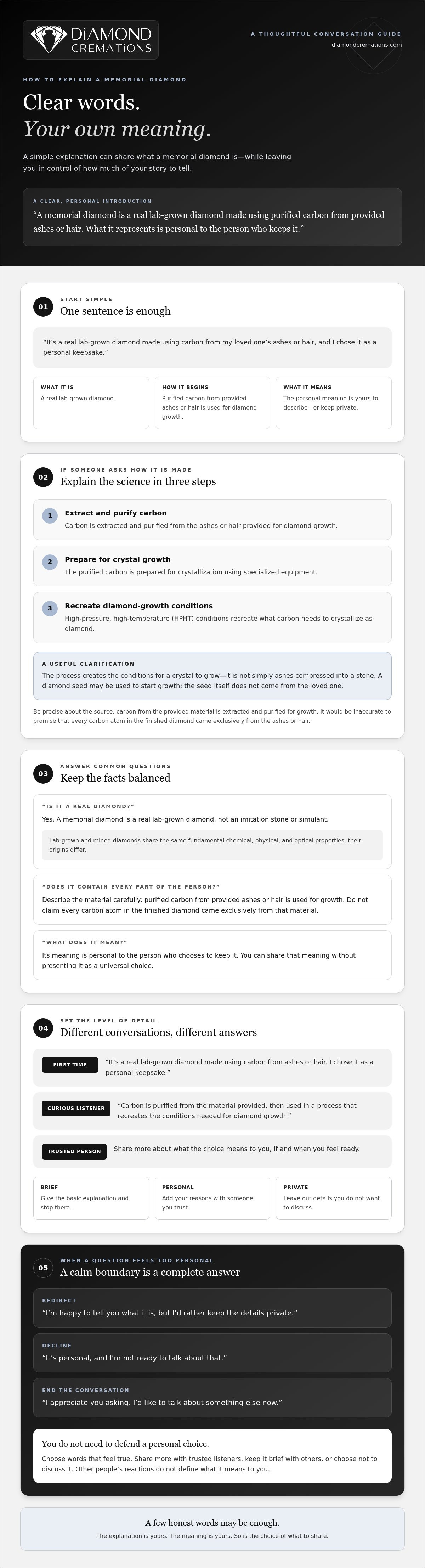
A quotable definition: “A memorial diamond is a real lab-grown diamond made using purified carbon from provided ashes or hair. What it represents is personal to the person who keeps it.” This separates how the diamond is created from the meaning you choose to give it. It’s one way to remember someone, not a required or universal choice.
A simple explanation for someone hearing about it for the first time
For a first conversation, you might say: “It’s a real lab-grown diamond made using carbon from my loved one’s ashes or hair, and I chose it as a personal keepsake.” Adapt the wording to your relationship and comfort level. You can stop after the basic explanation. You don’t need to add a story or convince anyone that your choice is right for them.
Decide how much of your story you want to share
The basic explanation and the personal details are separate. Keep a casual conversation brief, then share more about your reasons with someone you trust if and when you feel ready. You might leave out details about grief, the material provided, or family discussions. There’s no single correct amount to disclose.
If a question feels too personal, pause before answering. A simple boundary can keep the exchange respectful:
- To redirect: “I’m happy to tell you what it is, but I’d rather keep the details private.”
- To decline: “It’s personal, and I’m not ready to talk about that.”
- To end the conversation: “I appreciate you asking. I’d like to talk about something else now.”
Learning how to explain a memorial diamond to others doesn’t mean preparing a defense. A few honest words may be enough. You can share more with trusted listeners, keep things brief with others, or choose not to discuss it.
How a Memorial Diamond Is Made: Explain the Science Without Overcomplicating It
Once you’ve shared what the diamond means to you, someone may ask how it’s made. You don’t need to describe every laboratory step. The clearest explanation follows the basic sequence: carbon is extracted and purified from the ashes or hair provided for diamond growth, then prepared for crystallization.
A plain-language version of the diamond-growth process
Memorial diamonds are grown using high-pressure, high-temperature (HPHT) conditions. Specialized equipment recreates the pressure and heat needed for carbon to crystallize as diamond. Think of it as creating the conditions for a crystal to grow, not simply compressing ashes into a stone. A diamond seed may be used to start growth, but the seed itself doesn’t come from the loved one.
For a deeper, critical discussion, McGill University’s overview of the science of creating diamonds from remains can help readers understand the broader process. In conversation, you can keep it simpler: “Carbon is purified from the material provided, then used in a process that recreates the conditions needed for diamond growth.”
Be precise about the source of the carbon without overstating it. Carbon from the provided material is extracted and purified for diamond growth, but it would be inaccurate to promise that every carbon atom in the finished diamond came exclusively from the ashes or hair.
What “real lab-grown diamond” means
A memorial diamond is a lab-grown diamond, not an imitation stone or simulant. Lab-grown and mined diamonds share the same fundamental chemical, physical, and optical properties; their origins differ. This describes the diamond’s material properties. It doesn’t mean the finished stone contains someone’s identity or spirit.
A careful one-sentence explanation: “It’s a real lab-grown diamond created through a specialized growth process using purified carbon from provided ashes or hair. Its personal meaning comes from the person who chooses to keep it.”
This distinction can help you answer questions without turning a personal conversation into a technical debate. If you’d like to learn about memorial diamond options at your own pace, you can explore Diamond Cremations.
How to Answer Questions About Memorial Diamonds Without Overclaiming
Questions may come from curiosity, concern, or simple unfamiliarity. A calm, factual answer can help without turning your personal choice into a debate. Respond to the question asked, share only what you know, and leave the meaning of the diamond yours.
Responding when someone asks whether it is a real diamond
You can say that a memorial diamond is a genuine lab-grown diamond with the same fundamental chemical, physical, and optical properties as a mined diamond. Its origin is different; it isn’t an imitation stone. You don’t need another person’s agreement to value it. To shift from the science to your reason for choosing it, add: “It’s a personal way I chose to remember them.”
Explaining certification and material identification accurately
Certification assesses characteristics of a diamond. It doesn’t independently verify whose ashes or hair supplied carbon for its growth. Certification may be available depending on customer preference and the selected diamond, but it isn’t automatically included with every diamond. Keeping these points distinct helps you answer honestly without suggesting a report proves biological identity.
Adapt these responses to your own words and the level of detail you want to share:
| Common question | A concise, accurate response |
|---|---|
| “Is it a real diamond?” | “Yes. It’s a genuine lab-grown diamond. Its origin is different from a mined diamond, but it shares the same fundamental properties.” |
| “How is it made?” | “Carbon is extracted and purified from provided ashes or hair, then used for diamond growth under specialized conditions.” |
| “Is all the carbon from your loved one?” | “Carbon from the provided material is prepared for growth, but I can’t claim every carbon atom in the finished diamond came exclusively from it.” |
| “Does certification prove whose material it came from?” | “No. Certification assesses the diamond’s characteristics; it doesn’t establish the identity of the person or pet connected to the material.” |
| “Why did you choose this?” | “It felt like a meaningful way for me to remember them.” |
When considering how to explain a memorial diamond to others, remember that accuracy doesn’t require answering every follow-up. If you’re unsure about a process detail, it’s fine to say you’d rather check than guess. If the conversation becomes too personal, return to what feels comfortable sharing.
What to Say: Conversation Scripts for Family, Friends, and Curious Listeners
A useful script isn’t something you have to recite word for word. Think of it as a structure you can adjust to the person, the moment, and your comfort level. This five-step method can help you decide what to say without feeling pulled into a debate.
- 1. Choose the listener. Consider how close you are and whether this feels like a private or casual conversation.
- 2. Choose the detail. Decide whether to share only what the diamond is, or include more about its creation and your reasons.
- 3. Explain simply. Use familiar language: “It’s a real lab-grown diamond made using purified carbon from provided ashes or hair.”
- 4. Share the meaning. Add a personal sentence if you want, such as, “I chose it as a way to remember them.”
- 5. Set a boundary. If a question feels too personal, say, “I’d rather keep that part private.”
A short script for everyday conversations
For a friend or someone who asks casually, you might say: “It’s a memorial diamond made using carbon from my loved one’s ashes or hair. I chose it as a personal keepsake.” If the diamond is connected to a pet, adjust the wording: “It’s a way I chose to remember my dog.” Make the final sentence your own. There’s no single expected way to feel or explain your choice.
Prefer less detail? Try: “It’s a personal memorial, and I’m glad I have it.” You can leave it there.
A fuller explanation for someone you trust
With close family or a trusted friend, you may want to say a little more: “Carbon is extracted and purified from the ashes or hair provided for diamond growth. It’s then used in a process that creates a genuine lab-grown diamond. I chose this because [add your own reason, memory, or connection].” Share only the parts that feel right to you.
If the conversation turns into repeated challenges, answer once and gently redirect: “I understand you have questions. I’ve shared what I’m comfortable sharing, and I’d like to leave it there.” You can be open without debating whether your choice is right for everyone.
Finding how to explain a memorial diamond to others is less about having perfect words and more about choosing words that feel honest. If you’re ready to explore the possibilities, take a look at the available memorial diamond options.
How to Share the Meaning of a Memorial Diamond and Choose Your Next Step
You decide whether to talk about your memorial diamond, when to mention it, and who you want to tell. You might share the choice with a trusted family member, wait until someone asks, or keep it private. There’s no obligation to announce it or explain it to everyone. Readiness can change, too. You can say more later, or not at all.
It may help to keep one sentence ready for unexpected questions: “It’s a personal way I chose to remember someone I love, and I’d rather not go into all the details right now.” A prepared response can help protect your privacy without making you feel you need to make something up or respond immediately.
When someone responds with uncertainty or a different opinion
People may see memorial choices differently. You can acknowledge that without arguing or asking them to agree: “I understand this may not be the choice you’d make. It feels meaningful to me, and I’m comfortable with my decision.” Their reaction is one perspective, not a measure of what the diamond means to you.
If the exchange starts to feel uncomfortable, close it kindly: “I appreciate you listening. I’d like to leave it there for now.” You can change the subject, step away, or return to the conversation another time if that feels right. There’s no single response that suits every relationship.
Explore the memorial choice when you feel ready
Learning how to explain a memorial diamond to others can also give you space to consider what the choice means privately. If you’re still exploring, there’s no need to make a decision on someone else’s schedule. Diamond Cremations is one possible source of information as you consider whether a memorial diamond feels right for you.
Customers can personalize diamond characteristics and jewelry, with specific options depending on what’s currently available. If you’re considering shape, the memorial diamond shape guide offers a place to begin exploring that detail. Take your time and focus on what feels meaningful to you.
Carry the Conversation Forward at Your Own Pace
Knowing how to explain a memorial diamond to others can make a personal conversation feel more manageable. A brief, accurate description is often enough: a memorial diamond is lab-grown using purified carbon from provided ashes or hair. You can explain the science simply, share what the keepsake means to you, and leave private details private.
Questions don’t require a defense. Certification, when chosen for a diamond, assesses its characteristics; it doesn’t establish whose material supplied the carbon. Another person’s reaction doesn’t decide the value your memorial holds for you. Choose when to share, with whom, and how much.
Diamond Cremations creates certified memorial diamonds from the cremated ashes or hair of loved ones and pets. The service includes secure collection, personalized concierge service, and professional diamond certification.
There’s no need to rush the conversation or the decision. Let your words, and your next step, feel like your own.
Frequently Asked Questions
How do I explain a memorial diamond in simple terms?
A memorial diamond is a genuine lab-grown diamond created using carbon extracted and purified from provided ashes or hair. Its owner may value it as a personal way to remember someone. If you’re deciding how to explain a memorial diamond to others, keep it simple: “It’s a lab-grown diamond made using carbon from my loved one’s ashes or hair.” Share more only if you feel comfortable. The stone doesn’t contain someone’s identity or spirit.
Is a memorial diamond a real diamond?
Yes. A memorial diamond is a real lab-grown diamond, not a simulant or imitation stone. Lab-grown and mined diamonds share the same fundamental chemical, physical, and optical properties. The distinction is their origin and how they’re grown. That factual description is separate from the personal meaning you give the diamond. You can explain what it means to you, but you don’t need another person to share your interpretation for it to matter.
What should I say if someone asks how a memorial diamond is made?
You can say that carbon is extracted and purified from provided ashes or hair, then prepared for diamond growth. Specialized equipment recreates the high-pressure, high-temperature conditions needed for carbon to crystallize as diamond. A diamond seed may be used to initiate growth, but it doesn’t come from the loved one. Avoid promising that every carbon atom in the finished diamond came exclusively from the provided material.
Do I have to tell people that my diamond is a memorial diamond?
No. Whether to share that your diamond is a memorial is your choice, and you can decide differently in different relationships. If you prefer privacy, you might say, “It’s a personal piece, and I’d rather not discuss the details.” You can share more later if you choose. Keeping the story private doesn’t diminish the remembrance, and you don’t owe anyone an explanation or justification.
What if someone says a memorial diamond is not real or questions my choice?
You can respond calmly: “It’s a genuine lab-grown diamond, and I chose it as a personal way to remember someone.” If you wish, briefly explain that lab-grown diamonds share the fundamental properties of mined diamonds. You don’t have to turn the exchange into a debate or persuade someone to agree. Redirect the conversation or end it with, “I’ve shared what I’m comfortable sharing.”
Does a diamond certificate prove whose ashes or hair were used?
No. A diamond certificate assesses characteristics of the diamond; it doesn’t establish the identity of the person or pet whose material supplied carbon. Gemological grading and material identification are separate matters. If you want to understand how a provider identifies, tracks, handles, and documents customer-provided material, ask about its stated procedures directly. Don’t assume a diamond certificate alone proves biological origin.
How can I explain a memorial diamond made from a pet’s ashes?
You can explain it in the same straightforward way: “It’s a genuine lab-grown diamond created using carbon extracted and purified from my pet’s provided ashes or hair.” If it feels right, add what your companion meant to you, such as, “I chose it as a way to remember the years we shared.” You can also keep the personal details private. A memorial diamond is one remembrance choice, not the only meaningful way to honor a pet.