


Memorial Diamond vs. Traditional Headstone: Which Memorial Feels Right for You?
A memorial can be a place to return to or something you carry with you. The choice in a memorial diamond vs traditional headstone is not only about form; it’s about how you want remembrance to fit into daily life. A headstone offers a shared, physical place to visit, while a memorial diamond can be a personal keepsake that stays close.
You may be wondering whether a wearable memorial can serve the same purpose as a graveside marker, or how to make a choice when family members want different things. There’s no single right answer. Consider who will use or visit the memorial, what kind of remembrance feels meaningful, and whether a personal keepsake or shared place better reflects your wishes.
This comparison covers practical and personal differences, including physical form, personalization, and everyday access. Use it to weigh each option without pressure and decide whether a memorial diamond, a headstone, or both may best honor your loved one.
Key Takeaways
- The memorial diamond vs traditional headstone comparison can help clarify whether your family values a shared place to visit, a personal keepsake, or both.
- Consider who will use or visit the memorial and how relatives with different preferences can take part in remembrance.
- Compare personalization and everyday access to see which form fits your family’s remembrance practices.
- A diamond and a headstone can serve different purposes, so choosing one doesn’t necessarily rule out the other.
- Diamond Cremations creates genuine lab-grown memorial diamonds using carbon extracted and purified from provided ashes or hair.
Memorial diamond vs. traditional headstone: two different ways to remember
Choosing a memorial is deeply personal, and there’s no universal right answer. Families may value a place they can visit, a keepsake they can carry, or a combination of the two. A traditional headstone is a fixed marker associated with a burial place. A memorial diamond is a personal keepsake created using purified carbon extracted from provided ashes or hair.
These options differ in where and how remembrance happens, not in how much a loved one matters. A headstone can provide a shared destination for relatives and friends. A diamond can offer a personal reminder during everyday moments, including when someone can’t visit a particular location. One does not have to replace the other.
A headstone anchors remembrance to a particular place; a memorial diamond offers a portable way to keep remembrance close. That distinction can help families discuss what they want a memorial to make possible without treating either choice as more meaningful. For an overview of the history and science, see the Memorial diamond Wikipedia article.
What does a traditional headstone offer?
A headstone is a physical marker at a burial place, giving family and friends a location where they can pause, reflect, or gather. Its presence can make remembrance tangible and shared. This can matter to relatives who value visiting a specific place, though not everyone has access to or prefers a cemetery setting.
Headstones can also carry personal details. An inscription might include a name, dates, or a brief message, while visual elements and finishes can reflect individual tastes or family traditions. The result is a visible marker at a particular location, though each visitor may relate to it in a different way.
What does a memorial diamond offer?
A memorial diamond is a wearable or otherwise personal keepsake, rather than a marker fixed at a graveside. Carbon is extracted and purified from provided ashes or hair, then used for diamond growth. Memorial diamonds are real lab-grown diamonds. The overview of memorial diamonds also describes their production and distinguishing features.
Its portability can make remembrance part of daily life. Someone might wear a pendant, keep a ring nearby, or choose to hold the diamond at a meaningful moment. This personal connection doesn’t have to replace family or community remembrance. One relative may value a shared site, while another prefers a keepsake they can carry.
In a memorial diamond vs traditional headstone decision, the useful question isn’t which is more permanent or important. It’s which form supports the ways your family wants to remember. Some families choose one; others find that a fixed marker and a personal keepsake serve distinct roles. Both can be part of a considered tribute.
How memorial diamonds and traditional headstones differ in form and meaning
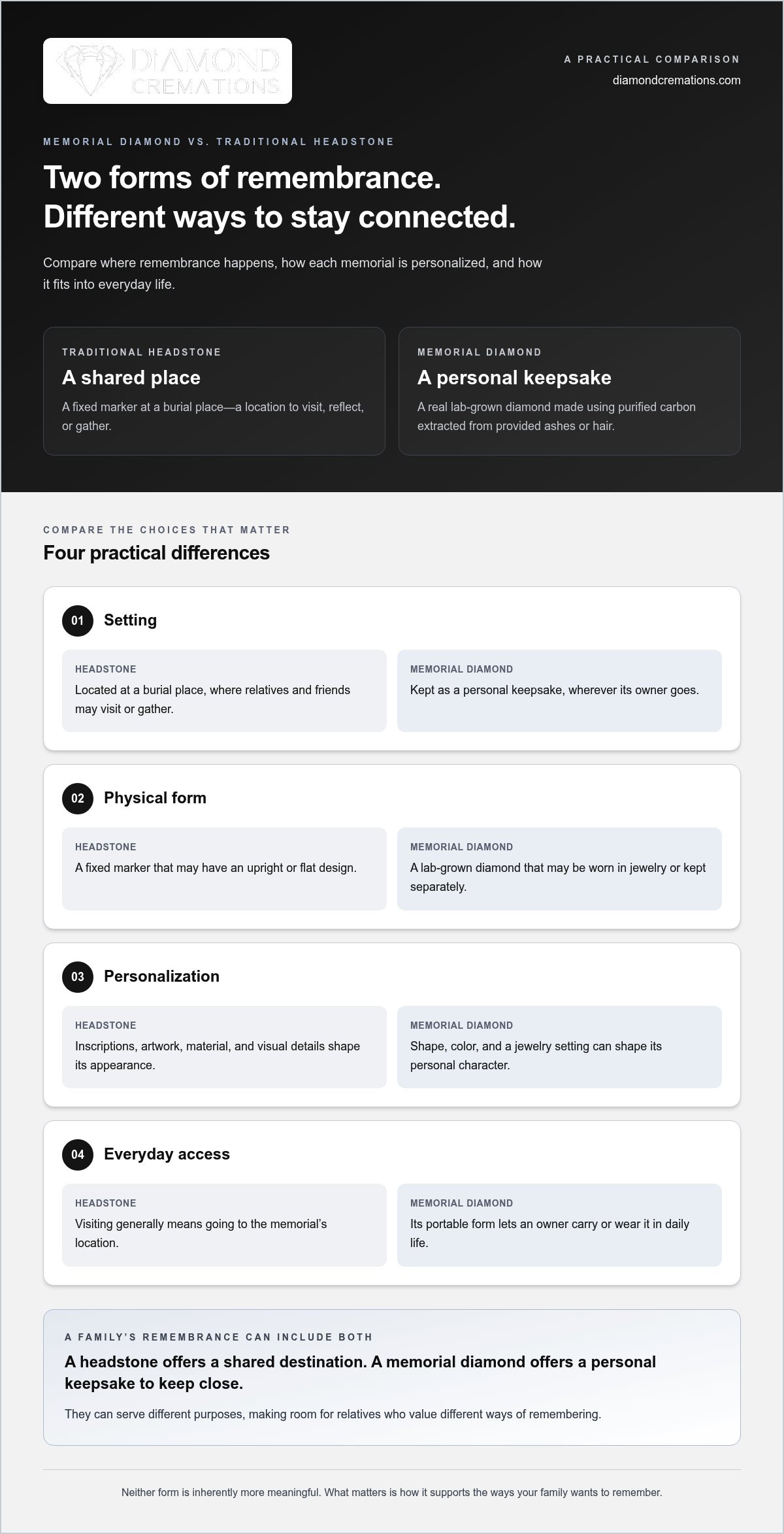
Comparing both memorials across the same practical dimensions can make the decision easier. A headstone is designed for a particular site; a memorial diamond is a personal object that can be kept close. Neither form carries more emotional weight by itself. Its meaning comes from how you and your family choose to use it.
| Consideration | Traditional headstone | Memorial diamond |
|---|---|---|
| Setting | Located at a burial place, where visitors may gather or reflect. | Kept as a personal keepsake, wherever its owner goes. |
| Physical form | A fixed marker, with forms that may include upright or flat designs. | A lab-grown diamond that may be worn in jewelry or kept separately. |
| Personalization | Inscriptions, artwork, material, and visual details can shape its appearance. | Choices may include diamond shape and color, along with a jewelry setting. |
| Everyday accessibility | Visiting generally means going to the memorial’s location. | Its portable form allows an owner to carry or wear it in daily life. |
Place-based remembrance versus a personal keepsake
A marked location can offer relatives a shared destination for anniversaries, quiet visits, or time together. That can be meaningful for family members who want a tangible place to return to. Headstones and markers come in different forms; VA.gov’s overview of headstone types illustrates some of the options available through the U.S. Department of Veterans Affairs.
A diamond offers a different kind of access. Someone might wear it during an ordinary day or keep it nearby at home. Relatives don’t need to want the same thing: one may value visiting a site, while another may prefer a private keepsake. A family can make room for both preferences.
Personalization, permanence, and everyday use
Headstone personalization is expressed on a visible surface through words and design. A diamond’s character is shaped by its cut, color, and setting. Diamond Cremations offers personalized memorial-diamond choices, including available shapes, colors, and jewelry settings. Each form offers its own kind of permanence: one remains fixed in a place, while the other is a personal object that can be kept close.
A headstone makes remembrance accessible at a designated place, while a memorial diamond makes it portable; both can be personalized, and neither is inherently more meaningful. This distinction is central to the memorial diamond vs traditional headstone comparison. If a personal keepsake feels like one part of your family’s remembrance, explore memorial diamond options at your own pace.
Memorial diamond vs. headstone: compare the choices that matter to your family
Once you’ve considered the difference in form, bring the decision back to your family’s everyday preferences. Who would visit a memorial? Who would want to keep one close? How might relatives take part in different ways? The memorial diamond vs traditional headstone choice becomes clearer when you compare what each option makes possible for the people who will remember.
| Memorial | May suit families who value | A practical consideration |
|---|---|---|
| Traditional headstone | A visible place connected to a burial location, with names, dates, inscriptions, or other design details. | Visits are tied to the memorial’s location, and cemetery-specific requirements may affect its design. |
| Memorial diamond | A personal keepsake that can be carried or incorporated into memorial jewelry. | It offers an individual way to remember, rather than one shared location for family visits. |
| Both | Different forms of remembrance for relatives with different preferences. | The family can consider how each memorial would be used and what role it would have. |
When a headstone may better fit remembrance preferences
A headstone may feel like a natural fit if relatives want a visible marker and a shared destination connected to a burial place. Family members can gather there or visit separately, and the marker can preserve a name, dates, and personal design details. If you’re considering this option, keep the cemetery’s requirements in mind as you compare designs, since they may affect what can be selected.
When a memorial diamond may better fit remembrance preferences
A memorial diamond may suit someone who values carrying a personal reminder through ordinary routines. It can be incorporated into memorial jewelry, allowing its owner to choose when and how to wear or keep it close. Personalization can include a diamond shape and a jewelry setting. This approach doesn’t need to replace a shared family memorial; relatives can take part in remembrance in different ways.
One family member may hope to visit a marked place, while another prefers a keepsake that travels with them. Rather than expecting everyone to feel the same, discuss what each relative would actually use and value. The answers can help clarify whether one form is enough or whether both could serve distinct purposes.
To make the conversation concrete, each person can consider three questions: Is a shared destination important? Would a portable keepsake feel meaningful in everyday life? Which personal details matter most, such as an inscription, a chosen diamond shape, or a jewelry setting? There’s no need to settle the choice in one conversation. A thoughtful decision can respect different relationships with remembrance.
How to choose between a memorial diamond and a traditional headstone
There’s no need to decide by comparing which memorial is “better.” A more helpful approach is to identify what remembrance should look like for your family, then consider which form supports those priorities. These questions can guide a conversation about the memorial diamond vs traditional headstone choice without asking everyone to feel the same way.
Four questions to clarify what matters most
Take time with each question. Family members can answer individually before discussing their thoughts together. Different responses can reveal what matters most; they don’t mean anyone is remembering incorrectly.
- Would a shared physical location be meaningful? Consider whether relatives want a specific place to visit, reflect, or gather. If so, a headstone connected to a burial location may align with that preference. If visiting a particular site isn’t central to your family’s remembrance, consider other ways to create a lasting connection.
- Would keeping a personal memorial nearby feel meaningful? Think about whether you’d value a keepsake that can accompany someone through daily routines. A memorial diamond can be incorporated into jewelry or kept as a personal object. This may appeal to someone who wants a reminder close at hand, without replacing shared family traditions.
- How would different relatives like to participate? Consider who might visit a memorial, who might wear or keep a keepsake, and whether relatives have different remembrance practices. A conversation can make room for those differences. No one needs to adopt another person’s preferred way of remembering for the family to honor the same loved one.
- Which personal details feel appropriate? A headstone can carry a name, dates, an inscription, or visual details. For a diamond, preferences may include its shape, color, and jewelry setting. Reflect on details that feel connected to your loved one, and keep any cemetery-specific requirements in mind if you’re considering a headstone.
Can a memorial diamond and headstone work together?
Yes. One can provide a shared place for remembrance while the other offers a personal keepsake. A family might choose a headstone for relatives who value visiting a marked location, while one or more family members keep a diamond close. This combination can make sense when the options meet different needs.
Choosing both is an option, not an expectation. Some families may prefer one form; others may find that each has a distinct role. If opinions differ, give the conversation time and focus on what each person hopes the memorial will make possible. You don’t have to settle every detail at once. The aim is a considered, respectful decision, not a rushed one.
Once you’ve clarified what matters, you can explore memorial-diamond choices that reflect your preferences for a personal keepsake.
How Diamond Cremations makes a memorial diamond a personal remembrance
For families drawn to a keepsake, Diamond Cremations provides personalized concierge service throughout the United States. Careful handling is central to the process. Customer-provided material is identified, tracked, handled, and documented as it moves through the work involved in creating a memorial diamond.
A clear, careful path from provided material to diamond
Carbon is extracted and purified from the provided material for diamond growth. The purified carbon is prepared using specialized equipment that recreates the high-pressure, high-temperature conditions required for diamond crystallization. A diamond seed may be used to initiate growth; it does not come from the loved one. These technical steps are distinct from material tracking: a gemological report describes the diamond’s characteristics, while identification and documentation relate to the customer-provided material.
Certification is available according to customer preferences and the selected diamond. It grades the diamond, rather than establishing the identity of the person or pet associated with the provided material. Keeping those roles distinct helps families understand what each record can and can’t tell them.
Personalizing a memorial diamond
Personalization is most useful when it reflects how the keepsake will be remembered and used. Someone choosing a piece for everyday wear may consider how the finished jewelry will feel as a personal object; another family may prefer a design for occasional use or safekeeping. Diamond Cremations offers personalized choices, with concierge support to help customers consider what feels appropriate.
Shape can also influence the character of a finished diamond. Rather than choosing solely by appearance, consider which form feels fitting for the person or pet being remembered and how it will sit in its intended setting. The memorial diamond shape guide can help you reflect on that design decision.
A memorial diamond and a headstone can hold different roles within a family’s remembrance. If a personal keepsake feels right, take the time you need to consider its purpose and the choices that will make it meaningful to you.
Choose a remembrance that feels true to your family
The memorial you choose doesn’t need to express every relationship or hold every memory in the same way. It can be one thoughtful part of how your family continues to remember. Give yourselves room to reflect, revisit the conversation, and make a considered choice rather than rushing.
If a personal keepsake feels like a meaningful next step, explore what a memorial diamond might look like for you. The memorial diamond vs traditional headstone decision is ultimately about what best supports your family’s way of remembering, whether that means choosing one form or allowing two to complement each other.
There’s no single right way to honor someone you love. Take the next step at your own pace and choose the remembrance that feels right for you.
Frequently Asked Questions
Can a memorial diamond and a traditional headstone be used together?
Yes. A family might choose both if different relatives value different ways of remembering. For instance, one person could keep a diamond in a piece of jewelry, while others maintain a tradition of visiting the gravesite. Before deciding, talk about who would use each memorial and what role it would have over time. There’s no requirement that every relative participate in the same way.
Is a memorial diamond a real diamond?
Yes. A memorial diamond is a real lab-grown diamond, not a look-alike stone. It has the same fundamental chemical, physical, and optical properties as a mined diamond. If you’re considering one for jewelry, think about how it will be worn or kept and what setting suits that use. Those choices can help you assess the diamond as both a personal memorial and a piece of jewelry.
Can a memorial diamond replace a traditional headstone?
A family can choose a diamond as its memorial, but it won’t function as a marker at a gravesite. If relatives want a named marker where they can gather, a diamond alone won’t provide that. Consider the purpose you want fulfilled: a personal tribute, a graveside marker, or both. That practical distinction can help clarify the memorial diamond vs traditional headstone decision.
Can a headstone be personalized like a memorial diamond?
Yes, though the available forms of expression differ. Families can select wording and visual details for a headstone, while a memorial diamond’s appearance and setting offer another kind of customization. If you’re considering an inscription, think about what will remain meaningful to relatives over time, such as a name, a chosen phrase, or a detail that reflects the person’s life.
Does certification prove that a memorial diamond came from a specific loved one?
No. A gemological report evaluates the diamond, not the identity of the person or pet associated with it. Treat those as separate questions when reviewing documentation: one concerns the gemstone’s graded characteristics, and the other concerns the handling records for the material provided. Understanding that distinction helps set clear expectations about what certification can establish.
Can a memorial diamond be made from pet ashes or hair?
Yes. Diamond Cremations creates memorial diamonds for people honoring a pet. Before choosing a keepsake, consider who in the household feels connected to the idea and how they might want to remember the animal. One person may prefer memorial jewelry, while another may find a different family remembrance more fitting. There’s room for varied preferences.
How should a family decide between a memorial diamond and a headstone?
Start by identifying what the family wants the memorial to make possible, then discuss individual preferences without rushing toward consensus. It may help to picture a meaningful occasion, such as an anniversary or a family gathering, and ask what form of remembrance would feel comfortable then. The decision can reflect one person’s wishes, several relatives’ needs, or a combination of memorials.