


Passing Down a Memorial Diamond: The Complete Multi-Generational Heirloom Guide
A diamond can endure for centuries, but its story can be lost in a single generation. Successfully passing down a memorial diamond requires more than simply placing an heirloom into a relative's hands; it calls for thoughtful intention. You transformed purified carbon from a loved one into a genuine, lasting gem to keep their memory close. Yet, discussing future inheritance, legal estate designations, and formal appraisals with family members can feel surprisingly uncomfortable. You might also worry that future generations won't fully grasp the diamond's origin or profound personal significance.
You shouldn't have to carry that uncertainty alone. In this guide, you will discover how to preserve clear provenance records, integrate fine memorial jewelry into your estate plan, and select durable settings that withstand daily wear. We'll examine practical documentation tools, gentle conversation strategies, and protective heirloom practices so your family's legacy remains cherished and understood for decades to come.
Key Takeaways
- Understand why the exceptional physical durability of lab-grown diamonds makes them an enduring medium for multi-generational remembrance.
- Discover how to build a complete heirloom documentation archive to preserve the personal memory and gemological details behind your piece.
- Learn proactive strategies for passing down a memorial diamond through clear legal estate planning and comfortable family conversations.
- Master essential maintenance, appraisal updates, and resetting guidelines to keep your cherished jewelry secure across decades of wear.
- Explore bespoke cut, color, and setting possibilities with Diamond Cremations to create a personalized tribute meant to last for generations.
Understanding the Memorial Diamond as a Generational Heirloom
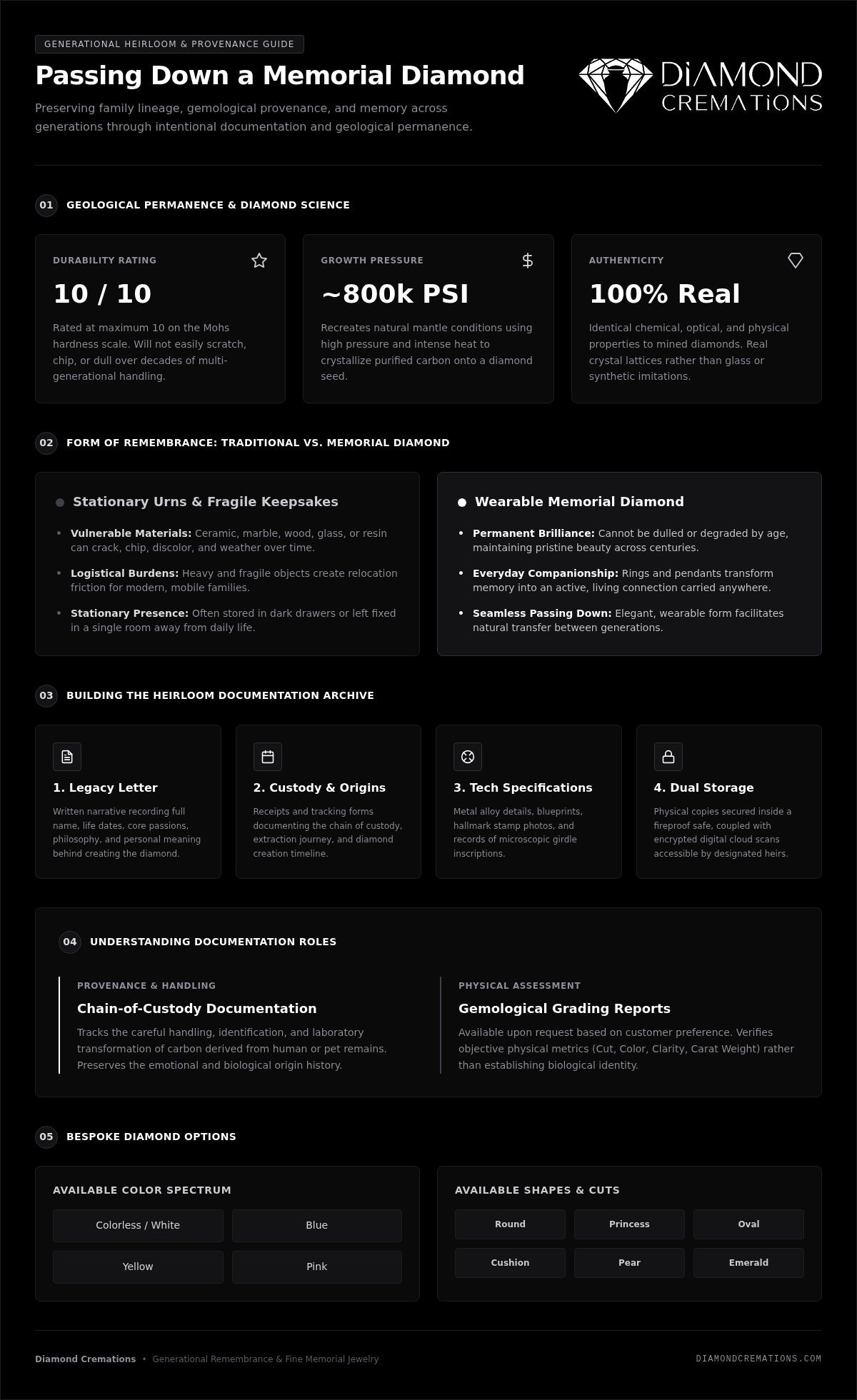
An heirloom should outlast the hands that first hold it. While traditional keepsakes often fade, a memorial diamond serves as an enduring physical celebration of personal lineage. Cultivated from purified carbon extracted from human or pet ashes or hair, these stones possess the exact chemical, optical, and physical properties of mined diamonds. Rated at a maximum 10 on the Mohs hardness scale, a diamond cannot be easily scratched, chipped, or dulled by time. This geological permanence ensures that passing down a memorial diamond transfers a pristine tribute to the next generation, completely unchanged by decades of handling.
Unlike fragile glass or resin keepsakes that can crack, discolor, and degrade over time, a genuine diamond remains permanently brilliant. It offers a tangible center of family history that relatives can carry into everyday life, rather than tucking it away in a dark drawer.
The Enduring Permanence of Lab-Grown Memorial Diamonds
Creating these stones requires replicating the earth's natural geological mantle. Specialized equipment subjects purified carbon to high-pressure/high-temperature (HPHT) conditions, often reaching roughly 800,000 PSI alongside intense heat, allowing crystalline carbon to grow upon a diamond seed. This process forms authentic diamond crystal lattices rather than synthetic imitations. For living relatives, knowing this physical integrity cannot erode brings steady comfort. The stone will not wear away with use, giving heirs a permanent marker of their family roots that survives across generations.
Moving Beyond the Traditional Urn
Stationary urns carry distinct emotional and logistical hurdles for evolving families:
- Vulnerability and decay: Ceramic, marble, and wood can shatter during moves or weather poorly over time.
- Inheritance disputes: Dividing a single urn among multiple adult children often creates awkward emotional friction.
- Lack of mobility: Modern families frequently relocate across states, making heavy, static memorial objects burdensome to transport safely.
Wearable heirlooms resolve these boundaries. Choosing rings or pendants transforms memory into an active, everyday companion. Passing down a memorial diamond offers a portable, intimate experience, allowing subsequent generations to maintain a living connection wherever their personal journeys take them.
How to Document Provenance and Personal History for Your Heirs
A diamond's brilliance endures effortlessly, but the memories woven into it depend on human care. When passing down a memorial diamond, you aren't simply bequeathing fine jewelry. You are transferring a profound family chapter. Without clear provenance records, grandchildren or great-grandchildren might eventually admire the gem while losing touch with whose life it honors. Establishing a structured heirloom kit bridges that gap permanently.
Every complete preservation kit should include four foundational elements:
- A personalized legacy letter: A written narrative connecting the stone to the individual or pet it commemorates.
- Origin and laboratory records: Receipts and tracking records confirming the creation details.
- Technical jewelry specifications: Details regarding the precious metal alloy, ring size, and setting craftsmanship.
- Secure physical and cloud storage: Original documents kept in a fireproof home safe, backed up by encrypted digital scans shared with designated heirs.
Writing the Legacy Letter to Accompany the Diamond
Your legacy letter transforms a sparkling jewel into an intimate family chronicle. Write directly to future generations. Record the loved one's full name, significant life dates, core passions, and personal philosophy. Describe why you chose to create a diamond from their ashes or hair, framing the decision around celebration, continuity, and joy. This context turns an object of remembrance into an empowering source of family pride.
Archiving Gemological and Chain of Custody Records
Proper record-keeping also demands technical clarity. Distinguish between chain-of-custody documentation and optional independent gemological grading reports. While a gemological certificate verifies cut, color, clarity, and carat weight, it does not confirm biological identity; your laboratory receipts and custody forms preserve that origin timeline.
Include high-resolution photographs of hallmark stamps inside the band, design blueprints, and any microscopic laser inscriptions along the diamond's girdle. When curating these physical records, you can collaborate with the dedicated team at Diamond Cremations to ensure you have complete documentation for your custom setting and origin history. This paperwork ensures that passing down a memorial diamond carries both irrefutable pedigree and deep personal meaning.
Navigating Estate Planning, Wills, and Family Conversations
Tangible keepsakes often carry the deepest sentimental weight in an estate. Yet, without clear instructions, even the most cherished jewelry can become a source of confusion during probate. Successfully passing down a memorial diamond requires pairing legal precision with thoughtful, early communication. By addressing both the legal standing and the emotional resonance of the piece today, you protect your family from misunderstandings later.
To avoid family disagreements and ensure the stone reaches its intended caretaker, consider these proactive measures:
- Use a personal property memorandum: In states that recognize them, an itemized memorandum linked to your formal will allows you to name specific recipients for individual pieces of jewelry without revising the entire will.
- Draft specific bequests: Rather than letting fine jewelry fall into a generic residuary estate clause, clearly specify the memorial diamond, its physical setting, and its intended heir in your legal documents.
- Explore shared stewardship: If multiple heirs share an equal bond with the person honored, consider multi-stone settings created during initial growth or establish a planned family rotation for significant life milestones.
Legal Mechanisms for Passing Down Tangible Keepsakes
Estate administration treats fine jewelry as tangible personal property. If left unspecified, these pieces automatically pass into the residuary estate, leaving executors with the difficult task of dividing sentimental assets among surviving relatives. While an informal side letter expresses your wishes, it often lacks legal weight in court. Consulting a licensed estate planning attorney ensures your specific bequest is properly integrated into your will or living trust, preventing potential estate disputes and protecting your wishes.
Fostering Open Conversations Across Generations
Legal documents confirm distribution, but early conversations build understanding. Talk with your intended heir to confirm their comfort and readiness to receive the jewelry. Some relatives may appreciate wearing the diamond daily, while others might prefer reserving it for special occasions. Framing the stone as an enduring celebration of family history helps normalize the concept, transforming what could feel intimidating into a shared, treasured honor. Transparent family discussions remove ambiguity, ensuring that passing down a memorial diamond brings lasting peace and shared pride to everyone involved.
Caring for, Appraising, and Re-Setting an Inherited Memorial Diamond
A diamond's crystalline lattice lasts indefinitely, but the jewelry setting that cradles it requires ongoing stewardship. Precious metals soften, prongs shift, and daily contact leaves microscopic residue over decades of use. Passing down a memorial diamond means equipping heirs with practical habits to preserve both the setting's structural integrity and its insured value. Thoughtful care ensures the piece remains as radiant for future generations as it was on its first day.
Routine Maintenance, Inspection, and Insurance
Schedule a visit with a professional jeweler every two years to inspect prong tension, bezel edges, and clasps. A jeweler can perform safe ultrasonic cleanings and detect minute metal fatigue before a stone becomes loose. Between professional cleanings, heirs can maintain brilliance at home using warm water, mild soap, and a soft-bristled brush. Store the piece individually in a fabric-lined jewelry box to prevent hard contact against other stones.
Securing adequate coverage is equally vital. Standard homeowner policies frequently set strict payout limits on fine jewelry. Adding a scheduled personal property rider ensures dedicated protection based on a current replacement-value appraisal. Obtaining an updated written appraisal every three to five years accounts for shifting precious metal markets, protecting the family's physical keepsake alongside its emotional history.
Re-Setting and Personalizing for New Generations
Heirs sometimes hesitate to wear an inherited piece because the original mounting doesn't match their personal taste or lifestyle. Changing a setting does not diminish the tribute; it breathes fresh vitality into it. Classic memorial diamond shapes adapt seamlessly from traditional rings into sleek pendants, protective bezels, or minimalist bands.
When altering the piece, collaborate with master jewelers experienced in custom heirlooms. Skilled artisans can often melt down original gold or platinum bands to incorporate the metal directly into the new design, retaining every physical element of the original piece. If heirs wish to expand the design into a multi-stone ring or incorporate accent gems, loose stone specialists such as Superlight Diamonds provide diamonds that can pair alongside the centerpiece. When passing down a memorial diamond, adapting its presentation honors the person who came before while allowing the new caretaker to wear their story forward with comfort.
Beginning Your Heirloom Journey with Diamond Cremations
Crafting an enduring keepsake bridges today's cherished memories with the story future descendants will inherit. When planning on passing down a memorial diamond, partnering with an experienced specialist ensures that sentiment and technical precision are equally honored. Diamond Cremations walks beside families as a steady guide throughout this bespoke process. Purified carbon extracted from human or pet ashes or hair is transformed into a genuine lab-grown diamond through meticulous HPHT crystallization. Every step follows a documented chain of custody, ensuring verified tracking from the safe receipt of material to the completed piece.
Personalization allows you to capture your loved one's presence with grace. Diamond Cremations offers stones across various carat weights, available in timeless colorless, serene blue, warm yellow, and gentle pink hues.
Selecting Cuts and Settings Built to Last Generations
Passing down a memorial diamond requires planning for physical longevity. Classic silhouettes like round, princess, oval, cushion, pear, and emerald cuts offer timeless elegance that transcends passing trends. For jewelry intended for multi-generational wear, protective mountings make all the difference. Protective bezel settings encase the gem's perimeter in solid metal, while robust six-prong mountings hold stones securely against daily activity. Pairing these cuts with noble metals like platinum or high-karat gold ensures the mounting resists thinning and structural fatigue over decades.
The Dedicated Concierge Experience
Creating a generational legacy shouldn't feel like a detached retail transaction. Diamond Cremations pairs every client with a dedicated concierge across the United States to provide personalized support during every phase. You receive regular milestone updates as the carbon is prepared, crystallized under high heat and pressure, and masterfully faceted. Upon completion, clients may also request optional professional gemological certification to document the 4Cs of their stone. When you're ready to create an enduring physical tribute for your family line, begin your journey with Diamond Cremations.
Carrying Your Family Story Forward
Passing down a memorial diamond transforms quiet remembrance into an enduring family tradition. Because these authentic lab-grown stones share the identical chemical, physical, and optical brilliance of mined diamonds, their structural integrity and luster remain completely undimmed across centuries. By establishing an organized provenance kit, naming specific bequests in your estate documents, and selecting bespoke fine jewelry settings crafted in enduring platinum and gold, you provide future heirs with both an exquisite keepsake and an unbroken narrative of personal heritage.
A thoughtfully planned heirloom bridges your present memories with the lives of future descendants. With personalized concierge guidance and a documented chain of custody nationwide, embarking on this path gives you steady confidence throughout each step of creation. You aren't simply protecting fine jewelry; you're preserving an enduring connection that continues to inspire your family for years to come.
Frequently Asked Questions
Is a memorial diamond durable enough to be passed down through multiple generations?
Yes, absolutely. Memorial diamonds are genuine lab-grown diamonds featuring a crystal lattice rated 10 on the Mohs hardness scale. Because they have identical physical, chemical, and optical traits to mined diamonds, they resist scratching, chipping, and environmental erosion. With routine inspections of the setting's prongs and gentle cleanings, your stone remains structurally sound across centuries. Passing down a memorial diamond ensures future generations receive a gem that retains its original brilliance indefinitely.
Can an heir re-set a memorial diamond into a new piece of jewelry later?
Yes, heirs can easily re-set or resize an inherited memorial stone. Lab-grown diamonds possess the exact thermal resistance and structural durability of mined gems, allowing experienced bench jewelers to safely unseat and reset them into modern mountings. Whether transitioning a solitaire ring into an everyday pendant or updating a vintage halo to minimalist bezel prongs, altering the jewelry allows the next generation to wear and celebrate the tribute according to their lifestyle.
How should I legally designate a memorial diamond in my will or estate plan?
You should explicitly name the piece in a specific bequest within your will or living trust. Rather than letting fine jewelry slip into a broad residuary clause, clearly describe the memorial diamond alongside its setting, hallmark stamps, and assigned recipient. In many jurisdictions, you can also link a signed personal property memorandum to your will. Consulting a qualified estate planning attorney ensures your wishes remain legally binding and avoids probate disputes.
What paperwork and documentation should accompany an inherited memorial diamond?
An heirloom archive should include the original chain of custody records, setting specifications, recent insurance appraisals, and any optional gemological grading certificates. Most importantly, it should contain a heartfelt legacy letter explaining who the diamond honors and why it was created. Storing these documents in a fireproof safe alongside shared digital scans guarantees that future heirs fully understand both the emotional significance and the physical pedigree of the piece.
Does gemological certification prove the biological identity of the loved one?
No, gemological grading reports don't verify biological identity. Independent gemological laboratories evaluate physical stone characteristics like carat weight, color, clarity, and cut proportions. Instead, custody documentation, laboratory invoices, and company verification certificates document that the stone was created using purified carbon extracted from your loved one's remains. Keeping your initial production paperwork intact provides the necessary proof of origin for your descendants.
Can memorial diamonds be insured like traditional natural or lab-grown jewelry?
Yes, insurance providers cover memorial diamond jewelry just like any fine lab-grown or mined piece. Because standard homeowners or renters policies often feature strict sub-limits on personal valuables, you should secure a scheduled personal property rider. This dedicated endorsement requires an independent written appraisal detailing the replacement value of the diamond and setting. Re-evaluating the piece every three to five years accounts for precious metal fluctuations and ensures comprehensive protection.
How do I talk to my family about who will inherit the memorial diamond?
Approach the conversation openly during a quiet family gathering rather than waiting for an urgent moment. Explain the meaning behind the jewelry, share its history, and ask family members how they feel about wearing or caring for it. Open discussions remove guesswork, eliminate resentment between siblings, and confirm the recipient's comfort. Passing down a memorial diamond should feel like a shared honor that unites relatives around lasting heritage.