


What to Do With My Husband’s Ashes: A Legacy Guide
What if the final tribute to your husband wasn't a place you visited, but a legacy you carried with you? Deciding what to do with my husband's ashes is one of the most personal and difficult choices you'll ever face. It's a moment where you seek a balance between deep respect and a desire for something that truly captures his spirit. You likely feel the weight of this decision, wanting to move away from impersonal, traditional options toward something that feels as unique as the life he lived.
Finding a memorial that offers both permanence and beauty can provide a profound sense of peace. You deserve a tribute that doesn't just sit in the background but serves as a handcrafted circle of love. In this guide, we'll explore a range of meaningful paths, from the environmental considerations of scattering in a national park to the sophisticated process of creating a certified memorial diamond. You'll discover how to transform a time of loss into a lasting legacy that can be cherished for generations to come.
Key Takeaways
- Shift the focus from traditional mourning to the creation of a lasting legacy that honors your husband's unique character.
- Evaluate natural tributes like scattering at sea or living memorials for a connection to the environment he loved.
- Consider artistic keepsakes, such as memorial glass or custom portraits, to transform remains into tangible pieces of art.
- Learn how the HPHT process creates a real lab-grown diamond, providing a permanent and beautiful solution for what to do with my husband's ashes.
- Choose a memorial based on whether you desire a fixed site of remembrance or a portable heirloom to be passed down through generations.
Navigating the Choice: Meaningful Ways to Honor a Husband’s Memory
The decision of what to do with my husband's ashes is a journey that begins with a single, profound realization. His life was not a series of dates on a stone. It was a collection of moments, laughter, and shared dreams. Choosing a tribute that matches this significance requires moving beyond the immediate weight of grief toward a sense of enduring honor. Today, many spouses are shifting away from traditional, impersonal mourning. They choose instead to create a legacy that reflects the specific character and vibrancy of the person they lost.
You have several paths to consider as you reflect on his personality and the life you built together. These generally fall into three distinct categories:
- Nature-based tributes that return him to the elements he loved, such as the sea or a forest.
- Artistic memorials that celebrate his creative spirit through custom glass or painted portraits.
- Permanent heirlooms that provide a physical connection you can keep and pass down through generations.
The Emotional Journey of Cremation Keepsakes
For many, a traditional urn on a mantle feels static and distant. It's a reminder of absence rather than a celebration of presence. This is why the search for a meaningful keepsake often leads to more tangible, interactive options. There's a specific kind of comfort found in holding a physical reminder of a shared life. We view this as a hopeful transformation. It's the process of taking something somber and turning it into a beautiful, artisanal object that invites reflection. These keepsakes serve as a handcrafted circle of love, keeping the memory close in a way that feels natural and supportive.
Traditional vs. Modern Memorialization
The world has become more mobile. Traditional burial often feels like a tether to a single location that may not be accessible in the years to come. With the U.S. cremation rate projected to exceed 63% in 2026, more families are embracing the flexibility that follows the cremation process and options available today. This shift allows for a more personalized approach that prioritizes your husband's unique personality. You aren't limited by geography or cemetery regulations.
Modern memorials have evolved significantly. High-tech precision now meets deep emotional intelligence, allowing for the creation of bespoke items like memorial diamonds or hand-blown glass. These options provide a sense of permanence that scattering or standard urns cannot match. They ensure that as you move through different stages of life, his legacy remains a constant, beautiful part of your journey. This transition from a physical presence to an enduring legacy is a steady way to find peace.
Nature and Tradition: Scattering and Living Memorials
For a husband who found his greatest peace in the outdoors, returning his remains to the earth can be a deeply resonant choice. You might be wondering what to do with my husband's ashes if he was a man of the sea or a lover of the deep woods. Scattering at sea offers a sense of boundless freedom, especially for those who lived for the rhythm of the waves. According to EPA regulations, this must occur at least three nautical miles from shore using fully biodegradable materials. You're also required to notify the EPA within 30 days of the event. For a more structured aquatic tribute, eternal reefs incorporate remains into artificial structures that support new marine life, turning a memorial into a sanctuary.
Scattering Ceremonies as a Final Farewell
A scattering ceremony provides a dedicated moment for family to gather and find closure. If he had a favorite trail or peak, you might consider a national park. These locations require a Special Use Permit and usually mandate that scattering happens in undeveloped areas away from public roads. For instance, as of August 2026, the permit fee for Arches National Park is $185. It's vital to follow official guidance on cremated remains to ensure the ceremony respects both the land and local regulations. While these events are beautiful, they are ephemeral. Many spouses find that while scattering feels right for his spirit, they still crave a physical anchor to hold onto.
Living Tributes and Green Memorials
Living memorials offer a different kind of continuity. By using a bio-urn, you can nourish a memorial tree or a dedicated garden space. This transforms the remains into a growing monument that changes with the seasons. It's a quiet, living testament to his strength. However, it's important to think about the future. A tree is a beautiful monument, but it's one that stays rooted in a single location. If you move homes, that living tribute remains behind. This is why some families choose to keep a small portion of remains to create custom memorial diamonds, ensuring a part of him stays with you wherever life leads. This allows you to balance the beauty of a natural return with the security of a permanent, portable legacy.
Artistic Tributes: Transforming Ashes into Tangible Keepsakes
Deciding what to do with my husband's ashes often involves finding a medium that honors his creative spark. If he was a man who appreciated the finer details of life, an artistic tribute might feel more appropriate than a traditional urn. Art allows us to move beyond the physical absence. It helps us find beauty in the ordinary. Integrating remains into a piece of fine art transforms a somber reality into a vibrant presence within your home. It's a way to keep his memory visible in a way that feels sophisticated and personal. These objects don't just sit on a shelf; they invite conversation and reflection.
The Craftsmanship of Memorial Glass and Art
Skilled artisans can swirl a small portion of carbon into molten glass, creating ethereal patterns within hand-blown orbs, hearts, or abstract sculptures. Each piece is unique. The carbon often appears as delicate white streaks or tiny, suspended bubbles, caught forever in a clear or colored medium. This process is deeply artisanal, requiring a high level of precision and respect for the material. Similarly, memorial paintings offer a bespoke presence. Some artists mix a small amount of ashes into oil or acrylic paints, creating a custom canvas that holds a part of his story in every brushstroke. This approach aligns with modern trends for ashes, where the focus is on personal resonance rather than mere tradition. Selecting an artist whose style matches his own aesthetic ensures the final piece feels like a true reflection of his life.
Auditory and Unique Commemorations
For the music lover or audiophile, auditory memorials provide a multi-sensory connection to the past. A unique path involves pressing remains into a playable vinyl record. This can include his favorite music, a recording of his voice, or even a silent track that carries his physical presence. It's a powerful way to interact with memory. You don't just look at the record; you listen to it. These options are part of a broader movement toward highly personalized, multi-sensory remembrance. Yet, when considering what to do with my husband's ashes, you must also think about durability and the passage of time. Glass can break. Records can wear down or scratch. While these artistic tributes are beautiful for daily life and provide immediate comfort, they may lack the absolute permanence and portability of other artisanal transformations that can be passed down as family heirlooms.
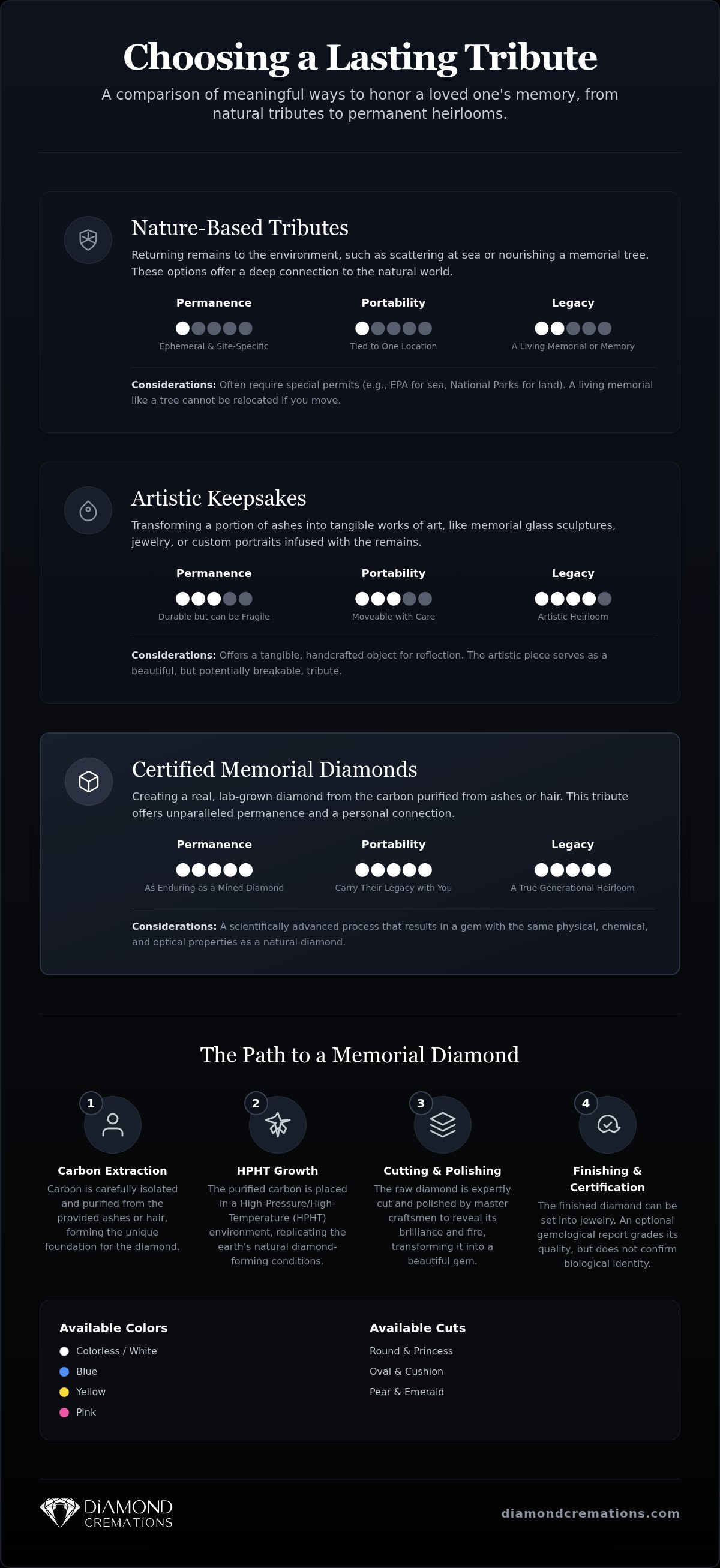
The Path of Permanence: Turning Ashes into Certified Memorial Diamonds
For those seeking an unbreakable bond, a memorial diamond offers a level of permanence that other tributes can't match. It's a real lab-grown diamond created from the carbon extracted from a loved one. Unlike scattering or living memorials, this is a handcrafted circle of love you can keep with you forever. It's a profound and lasting answer to the question of what to do with my husband's ashes. Every stone represents a transition from a physical presence to an enduring legacy. This choice allows you to hold a piece of his story in the palm of your hand, creating a heritage that can be passed down through generations.
The transformation relies on HPHT (High-Pressure/High-Temperature) technology. This artisanal process replicates the natural conditions found deep within the earth's mantle. By applying approximately 800,000 PSI, the purified carbon is transformed into a diamond structure over several months. While carbon is purified from the remains, a diamond seed may be used to initiate the growth process. It's important to understand that these are real diamonds with the same chemical, physical, and optical properties as mined stones. They aren't simulants, imitations, or synthetic substitutes. They're a testament to an eternal legacy, forged through scientific precision and deep care.
Artisanal Personalization: Colors and Shapes
You have the opportunity to design a tribute that reflects his specific character. The diamonds are available in colorless, blue, yellow, and pink hues. You might choose a classic round cut for a man of traditional strength or a sophisticated emerald cut for one with a refined aesthetic. Other approved shapes include princess, oval, cushion, and pear cuts. Each cut interacts with light differently, creating a unique brilliance. For more detail on these choices, you can read our guide on Choosing the Perfect Memorial Diamond Shape. This level of customization ensures the final diamond feels personal to his life and style.
The Integrity of the Process: Certification and Security
Trust is built through transparency and rigorous standards. The collection process is handled with the utmost dignity, ensuring that the remains are secure from the moment they leave your hands. For added peace of mind, gemological reports from organizations like GIA or IGI are available as an option. These reports grade the diamond's quality, including its cut, color, and clarity. These certificates grade the physical attributes of the stone rather than establishing biological identity or proving the source of the carbon. This ensures you have a certified record of the diamond's value as a high-quality, lab-grown gemstone that meets international standards.
Choosing a Legacy That Reflects His Life
Selecting the final form for your husband's remains is a journey that requires both time and reflection. It's a transition from a physical presence to an enduring legacy. As you reflect on what to do with my husband's ashes, the most important factor is the specific character of the man he was. Was he a traveler who felt most at home in the open air, or a man of quiet strength who valued the permanence of family bonds? The answer to that question often points toward the most fitting memorial. Whether you choose a nature-based return or a permanent heirloom, the choice should resonate with the life he lived and the love you shared.
Finding a tribute that brings a profound sense of peace is the ultimate goal of this process. You aren't just choosing a destination for his remains; you're deciding how his story will be told in the years to come. This decision involves balancing your current need for comfort with your long-term desire for a lasting heritage. By focusing on his passions and your shared values, you can find a path that feels personal, respectful, and deeply meaningful.
A Framework for Decision-Making
Selecting a final tribute can feel overwhelming, but a simple framework can provide clarity. The "Heirloom Test" asks whether you want this memorial to be cherished by future generations. While a living memorial is a beautiful, changing monument, a diamond is a portable legacy that can be passed down as a family treasure. The "Presence Test" focuses on your daily life. Do you prefer a memorial that you visit occasionally in a specific location, or one that is a constant, visible part of your day? Finally, reflect on the balance between a public memorial and a private tribute. You don't have to choose just one; many families scatter a portion of the ashes in a favorite park while keeping a small amount to create a bespoke, personal heirloom.
Taking the Next Step with Confidence
Moving at your own pace is essential. There is no "right" timeline for deciding what to do with my husband's ashes, and you should never feel pressured to rush the process. When you feel ready to explore the possibilities of a radiant, lasting tribute, a personalized concierge consultation can offer the support and transparency you deserve. This artisanal journey is about achieving a sense of peace through a beautiful, permanent reflection of the man you loved. A radiant diamond serves as a serene reminder of his life, ensuring his legacy remains as bright and enduring as the bond you shared.
Choosing a memorial is a deeply personal act of love. Whether his remains are returned to the earth or transformed into a handcrafted circle of love, the most important thing is that the tribute feels true to his spirit. By taking the time to consider these options, you're creating a legacy that honors his life and provides a source of comfort for generations to come.
Honoring a Life with Timeless Brilliance
Deciding what to do with my husband's ashes is a deeply personal choice that requires patience and reflection. Throughout this guide, we've explored how various tributes, from natural scattering to artisanal glass, offer different ways to honor a shared history. While nature-based options provide a sense of freedom, the creation of a memorial diamond offers a unique path of permanence. These real lab-grown diamonds serve as a handcrafted circle of love, ensuring his legacy remains a radiant part of your life for generations.
We understand the sensitivity of this journey and provide a personalized concierge service for every family. Our process is trusted nationwide for secure remains collection, and we offer professional diamond grading options to ensure the highest standards of quality. This transition is not just about a final destination; it's about finding a sense of peace through a tribute as enduring as your bond.
Take the time you need to find the memorial that feels right. You deserve a legacy that is as beautiful and unique as the life he lived.
Frequently Asked Questions
Is it possible to turn my husband’s ashes into a real diamond?
Yes, it's possible to transform remains into a real lab-grown diamond. This process involves purifying carbon from the ashes and placing it in a specialized environment where a diamond seed initiates the growth. These stones possess the exact same chemical, physical, and optical properties as diamonds mined from the earth. When considering what to do with my husband's ashes, this path offers a permanent and portable legacy that maintains its brilliance forever.
How much of my husband’s ashes are needed to create a memorial diamond?
Creating a single memorial diamond typically requires between 1/2 cup and 1 cup of ashes. If you choose to use hair instead, a small lock is usually sufficient for the carbon extraction process. This amount allows for the successful purification of carbon needed to grow the diamond. If you have a specific carat size or multiple diamonds in mind, a concierge consultation can help determine the correct volume required for your tribute.
Is it legal to scatter ashes in the United States?
Scattering is legal in the United States, but it is governed by specific federal and local regulations. For ocean scatterings, EPA rules require you to be at least three nautical miles from shore and use fully biodegradable materials. If you prefer a national park, you must obtain a Special Use Permit in advance. If you're deciding what to do with my husband's ashes, following these guidelines ensures your farewell is both respectful and compliant.
Can I use hair instead of ashes to create a memorial diamond?
Yes, hair is a perfectly viable source of carbon for the diamond growth process. Many spouses choose this option if they wish to keep the ashes intact in an urn or if they only have access to a lock of hair. The carbon is extracted and purified in the same manner as it would be from ashes. This flexibility allows you to create a beautiful, permanent heirloom regardless of the type of remains you have available.
What is the difference between a cremation diamond and a mined diamond?
The primary difference between a cremation diamond and a mined diamond is the origin of the carbon. A mined diamond forms over billions of years within the earth, while a cremation diamond is grown in a laboratory using carbon from a loved one. Technically, they are identical in every way, including their hardness and light refraction. They are real lab-grown diamonds, not simulants or imitations, providing the same enduring beauty as a traditional stone.
How long does the process of turning ashes into a diamond typically take?
The timeline for growing a memorial diamond is a deliberate and methodical process that respects the gravity of the transformation. Because we replicate the earth's natural conditions using approximately 800,000 PSI, the growth phase cannot be rushed. While the exact duration varies based on the desired size and color, the process typically spans several months. This steady pace ensures the structural integrity and artisanal quality of the final gemstone that serves as a permanent legacy.
Can I choose the color and shape of the memorial diamond?
You have full creative control over the aesthetic of the diamond to ensure it reflects his personality. We offer a sophisticated palette of colors, including colorless, blue, yellow, and pink. Additionally, you can select from several artisanal cuts such as round, princess, oval, cushion, pear, or emerald. This level of personalization allows you to create a bespoke piece of jewelry that serves as a true, radiant reflection of the man you loved.
Is a memorial diamond considered a certified gemstone?
Yes, a memorial diamond is a real gemstone that can be professionally certified. While certification is an available option rather than an automatic inclusion, you can request a gemological report from organizations like GIA or IGI. These reports provide an authoritative grade of the diamond's quality, including its cut and clarity. These gemological reports grade the stone's physical attributes rather than establishing a biological link to the remains or the specific person who supplied the carbon.