


What to Do With Your Wife's Ashes: Meaningful Ideas
You sit in the quiet of your living room, looking at a simple vessel that feels entirely too small to hold the woman who was your world. It's a heavy moment when you first ask yourself what to do with my wife's ashes, especially when a traditional urn feels like a static tribute to such a vibrant life. You aren't just looking for a place of rest; you're looking for a way to keep her light from fading.
With the U.S. cremation rate reaching 63% this year, more families are seeking meaningful alternatives to the mantle. It's natural to feel overwhelmed by the finality of cremation or to fear that scattering her remains might mean losing your physical connection to her. You deserve a way to honor her that feels as enduring as the love you shared. In this guide, you'll discover a range of respectful ways to preserve her memory, from traditional ceremonies in nature to the creation of a timeless memorial diamond. We'll explore how to navigate legal requirements for scattering, the options for splitting remains among family, and the science of transforming carbon into a brilliant, wearable tribute that stays by your side forever.
Key Takeaways
- Deciding what to do with my wife's ashes often begins with choosing between a stationary resting place or a portable tribute that allows her memory to travel with you.
- Learn how to plan a respectful scattering ceremony in a place of deep personal significance while navigating federal regulations for national parks and maritime locations.
- Explore the symbolism of living memorials, where specialized bio-urns help cultivate a tree or garden as a continuing, vibrant legacy.
- Discover how a portion of remains can be transformed into bespoke artistic keepsakes, such as hand-blown glass art or custom paintings, to maintain a presence in your home.
- Understand the sophisticated process of creating a memorial diamond, a genuine lab-grown stone that provides a permanent and wearable connection to the love you shared.
The First Step: Deciding Between a Stationary or Portable Memorial
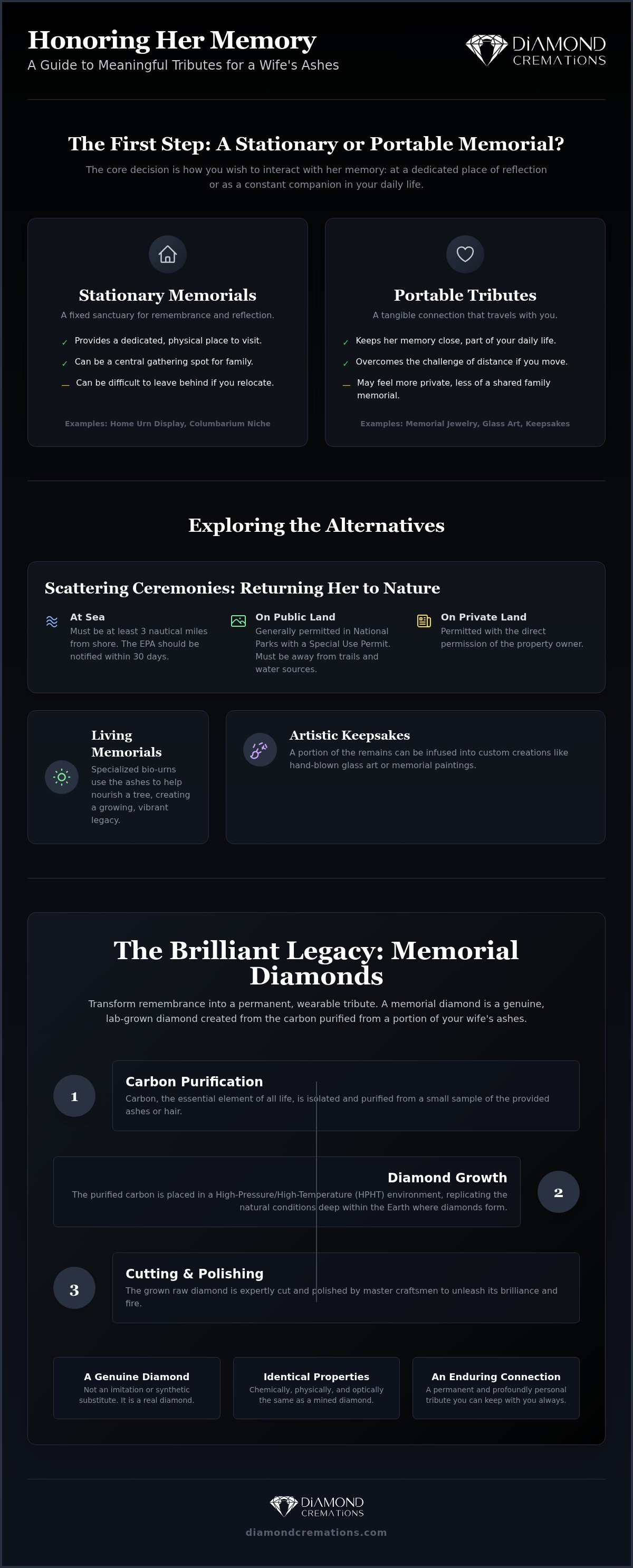
The weight of the decision rests in the balance between a destination and a presence. When you consider what to do with my wife's ashes, you're essentially deciding how you want to interact with her memory in the years to come. A stationary memorial, like a columbarium niche or a dedicated garden urn, provides a specific space for reflection. It's a sanctuary you visit when you need a moment of stillness. Conversely, a portable tribute allows her to remain a part of your daily rhythm, traveling with you wherever life leads.
Many husbands find peace in "splitting" the remains. This isn't an all-or-nothing choice. You might choose to scatter a portion at a site she loved while reserving the rest for a permanent, kept keepsake. This approach honors both her adventurous side and your need for a tangible connection. Since Cremation became the leading choice for final disposition in the U.S. in 2015, the options for these remains have expanded, allowing for highly personalized legacies that reflect a wife's unique personality.
Traditional Urns and Home Memorials
Selecting an urn is an exercise in curation. You're looking for a vessel that reflects her aesthetic, perhaps a sleek ceramic piece that blends with your decor or a hand-carved wooden box that feels warm and organic. Many create a "remembrance corner," a quiet space where her photo and favorite mementos sit alongside the urn. While this offers a beautiful anchor, it has limitations. In our mobile society, where families often move for work or retirement, a stationary memorial can become a source of concern. You don't want to feel as though you're leaving her behind if you relocate. If she was a homebody who loved the comfort of her own space, a beautiful home memorial often feels right, but consider how that legacy will be preserved if your living situation changes.
The Rise of Portable Tributes
A portable tribute solves the problem of distance. It transforms a memory from a place you visit into a companion you carry. There's a profound psychological comfort in knowing she is physically near. It's why many people are moving away from traditional vessels and toward more intimate options. When thinking about what to do with my wife's ashes, remember that her legacy doesn't have to be tied to a single coordinate on a map. Memorial jewelry, for instance, offers a way to integrate her presence into your life. Whether it's a ring or a pendant, these pieces serve as a modern alternative, ensuring her memory remains as mobile and vibrant as she was.
Scattering Ceremonies: Returning Her to the Places She Loved
For many, the act of scattering represents a profound transition from holding on to letting go. It is a way to return her remains to the elements of a landscape she cherished, whether that was the rhythmic pull of the tide or the quiet solitude of a mountain trail. When you are deciding what to do with my wife's ashes, a scattering ceremony can serve as a final shared journey, a destination event that allows family and friends to gather in a place that truly reflects her spirit.
Planning this event requires a balance of sentiment and logistics. On private land, you simply need the owner's permission. On public lands or at sea, however, specific federal and state regulations ensure the environment remains protected for future generations. This collective act of closure provides a sense of peace, knowing she has been returned to the world she loved so dearly.
Scattering at Sea or Waterways
The ocean offers a sense of boundlessness and eternity that few other places can match. If your wife found peace by the water, a maritime release is a beautiful tribute. To ensure a gentle transition, many choose biodegradable urns designed to dissolve slowly as they descend. It's important to follow the official rules for scattering ashes at sea, which require the ceremony to take place at least three nautical miles from shore. Federal law also mandates that the EPA be notified of the event within 30 days, a simple step that honors both her memory and the health of the sea.
Aerial and Public Land Scattering
If her heart belonged to the vast horizons of the American wilderness, scattering in a National Park might feel most appropriate. While generally permitted, this requires a Special Use Permit obtained in advance. Regulations typically require remains to be scattered at least 100 yards away from trails, roads, and water sources to maintain the "Leave No Trace" standard of these protected areas. For those who want a wider reach, professional aerial services can release remains from a small aircraft, casting them across a beloved mountain range or valley.
Because scattering leaves no physical marker, some families use GPS coordinates to log the exact location. This creates a digital site that you can revisit on anniversaries or share with distant family members. If the finality of scattering feels too distant, you might consider reserving a small portion to create custom memorial diamonds, allowing you to release her to the wind while still keeping a brilliant piece of her legacy close at hand.
Living Memorials: Cultivating New Life from Remembrance
The transition from loss to growth offers a powerful way to honor her. When you are considering what to do with my wife's ashes, you might find peace in a path that gives back to the earth. A living memorial transforms remains into a catalyst for new life, creating a legacy that grows more vibrant with each passing season. This choice resonates with a growing number of families. As of 2025, 61.4% of consumers have expressed interest in environmentally friendly funeral options, reflecting a shift toward tributes that heal the landscape.
It’s important to understand the science behind these memorials. Standard cremated remains possess a high pH level and sodium content that can be detrimental to plant health if placed directly in the soil. Modern "Bio-Urns" solve this by using specialized soil conditioners and organic materials that neutralize the pH. This ensures the remains can safely nourish a sapling or garden. It’s a scientifically grounded approach to ensuring her memorial flourishes for decades to come.
Memorial Trees and Forests
Choosing a tree species allows you to reflect her personality in the natural world. You might select a flowering dogwood for its delicate spring beauty or a sturdy oak to represent her enduring strength. Some families choose "Memory Forests," where the land is legally protected in her name. This ensures her tree remains part of a thriving, permanent ecosystem. These sites provide a physical space where future generations, including grandchildren who may never have met her, can connect with her through the rustle of leaves and the shade of a canopy she helped create.
Eternal Reefs and Marine Life
For a wife who felt most at home by the sea, an eternal reef offers a unique, restorative tribute. Her remains are incorporated into a pH-neutral concrete "reef ball," which is then placed on the ocean floor to become part of a permanent reef. These structures provide essential habitats for coral, fish, and other marine life, helping to restore damaged underwater ecosystems. It’s a tribute that actively heals the planet while honoring a life spent loving the water. While scattering at sea (discussed in the previous section) provides a sense of boundless release, a reef ball creates a lasting, underwater sanctuary that supports the cycle of life.
Whether through a forest or a reef, these green memorials offer a sense of continuity. They remind us that while the physical form changes, the impact on the world remains. These living legacies provide a place to visit, a life to nurture, and a way to ensure her presence continues to benefit the earth she loved.
Artistic and Creative Keepsakes for the Home
The transition from a public memorial to a private one often happens within the walls of your home. Deciding what to do with my wife's ashes can lead to a search for something that honors her aesthetic sense as much as her memory. Artistic keepsakes offer a way to weave her presence into your daily life through objects of beauty rather than symbols of grief. These pieces serve as quiet conversation starters. They allow you to share her story with visitors in a way that feels natural, moving the focus from the finality of loss to the permanence of her influence.
Memorial Glass and Sculpture
A small portion of remains can be transformed into hand-blown glass art. In this process, a master artisan swirls the ash into molten glass, creating intricate patterns that look like distant nebulae or spiraling currents. You can select colors that evoke her favorite shades or the specific blue of her eyes. These orbs, hearts, or abstract sculptures are best placed on a windowsill or a mantle where they can catch the sunlight. When the light passes through the glass, the piece takes on a radiant quality, serving as a bright reminder of the warmth she brought into the room. This method uses only a fraction of the remains, allowing you to combine it with other tributes if you wish.
Bespoke Keepsakes
For a wife who loved music or fine art, there are highly specialized ways to preserve her legacy. Some artisans can press a portion of remains into a functional vinyl record containing her favorite songs or a recording of her voice. Others mix the ash into oil paints or mixed-media portraits, creating a textured, physical connection to the artwork. When exploring what to do with my wife's ashes, you may find that these artistic options provide a sense of peace that traditional storage cannot.
The value of these handcrafted pieces lies in their uniqueness. Unlike mass-produced urns, these are bespoke works of mourning art that don't immediately look like a traditional memorial. It is vital to ensure the artist you choose follows respectful handling protocols for the remains. This artisanal approach prioritizes individual care over high-volume production. It ensures that the final tribute is as one-of-a-kind as she was, turning a difficult decision into a creative act of remembrance.
Transforming Remembrance into a Brilliant Legacy: Memorial Diamonds
While scattering or garden memorials offer a sense of peace, some husbands seek a tribute that is as enduring as the bond they shared. When you're deciding what to do with my wife's ashes, a memorial diamond offers a unique, brilliant legacy that defies the passage of time. This is a transformation rooted in sophisticated science. By extracting carbon from the remains and subjecting it to approximately 800,000 PSI within an HPHT (High-Pressure/High-Temperature) environment, the carbon is refined into a genuine diamond. These are real lab-grown diamonds with the same chemical, physical, and optical properties as mined stones. They represent a love that is unbreakable, forged through a process that replicates the earth's natural forces.
The ability to personalize the diamond allows you to reflect her unique character. You can choose a color that resonates with her personality, such as a serene blue, a warm yellow, a delicate pink, or a classic, colorless white. Because a diamond is the hardest substance on earth, it serves as the ultimate portable legacy. It's a presence you can keep by your side every day and eventually pass down through your family as a permanent heirloom of her life and your shared history.
The Craftsmanship of a Memorial Diamond
Creating a diamond from carbon is a patient and methodical process. It requires a delicate balance of precision and time to allow the carbon to crystallize properly. During this growth phase, a small diamond seed is used to initiate the crystallization. It's important to understand that while the carbon is purified from her remains, the seed provides the necessary foundation for the diamond to take shape. This artisanal journey ensures that each stone is as one-of-a-kind as the woman it honors.
Selecting the right cut is a vital part of this craftsmanship. You might choose a classic Round or Princess cut, or perhaps a more sophisticated cushion or emerald shape to match her style. Whether you prefer the brilliance of an Oval or the grace of a Pear cut, the shape of the diamond becomes a reflection of her aesthetic. This transition from remains to a radiant gemstone is a quiet, steady transformation that honors her memory with dignity and permanence.
Certification and Authenticity
Because these are genuine diamonds, they can be graded with the same rigor as any fine gemstone. You have the option to seek independent gemological grading through organizations like the GIA or IGI. These reports provide quality assurance regarding the diamond's cut, color, clarity, and carat weight. It's a transparent way to verify the excellence of the stone, though it's important to note that these reports grade the diamond's physical quality rather than its biological origin.
Once the diamond is grown and cut, setting it into a pendant or ring allows you to carry her presence with you. This choice moves beyond the traditional urn, offering a wearable connection that feels modern and deeply personal. It provides a sense of peace, knowing that a part of her legacy has been transformed into something as beautiful and lasting as a diamond, ensuring she is never left behind.
Creating a Legacy as Enduring as Her Love
Choosing what to do with my wife's ashes is a journey that moves from the heavy reality of loss toward the light of a lasting tribute. Whether you find peace in the quiet growth of a memorial forest or the radiant beauty of hand-blown glass, your decision is a final, meaningful act of devotion. You've explored how a stationary sanctuary provides a place to visit, while portable memorials allow her memory to remain a part of your daily life.
For those seeking the ultimate physical connection, a memorial diamond offers a brilliance that never fades. These real lab-grown diamonds are chemically identical to mined stones and are available in four radiant colors and six timeless shapes. Our personalized concierge service ensures her remains are handled with the highest level of security and respect throughout the transformation.
Take the time you need to find the path that feels most right. Her legacy is a story that continues through you, and whatever choice you make will be a beautiful reflection of the woman she was.
Frequently Asked Questions
Is it legal to scatter my wife's ashes in a National Park?
Scattering is generally permitted in most U.S. National Parks but requires a Special Use Permit obtained in advance. You must adhere to specific regulations, such as scattering at least 100 yards from trails, roads, and water sources. No permanent markers or monuments can be left behind. Since each park has its own specific conditions, it's vital to check with the park ranger's office before planning your ceremony to ensure a respectful event.
How much of the ashes are actually needed to create a memorial diamond?
Creating a memorial diamond requires only a small portion of the cremated remains. While the exact quantity can vary based on the desired carat weight, a modest amount is typically sufficient for the carbon extraction process. If you are unsure what to do with my wife's ashes and want to preserve the majority for a scattering ceremony, a memorial diamond remains a viable and respectful option that keeps her legacy close.
Can I turn my wife's hair into a diamond if I don't have her ashes?
Yes, hair is an excellent source of carbon for the diamond growth process. If you don't have access to cremated remains, or if you prefer to keep them intact, a small lock of hair can be used to create a genuine lab-grown diamond. The carbon extraction and purification steps are similar to those used for ashes, resulting in a stone that is chemically and physically identical to a mined diamond in every way.
Is a memorial diamond a real diamond or a simulant?
A memorial diamond is a 100% real diamond. It possesses the exact same chemical, physical, and optical properties as a diamond found in the earth. These are not simulants, imitations, or synthetic substitutes. They are grown in a laboratory environment that replicates the high-pressure, high-temperature conditions found deep within the mantle, utilizing approximately 800,000 PSI to transform carbon into a brilliant, lasting gemstone that serves as a permanent tribute to her life.
What happens to the ashes that aren't used in the diamond-making process?
Any portion of the remains that is not utilized during the carbon extraction and purification process is handled with the utmost dignity. We understand the sensitivity of this journey and ensure that unused material is managed according to your specific instructions. This allows you to maintain peace of mind knowing that her remains are treated with professional care, whether they are returned to you or managed through a respectful and transparent process.
Can I split my wife's ashes between a diamond and a scattering ceremony?
Splitting remains is a common and meaningful way to create multiple tributes. If you are deciding what to do with my wife's ashes, remember that only a small amount of carbon is needed for a memorial diamond. You can easily reserve the majority for a scattering ceremony or a living memorial. This approach allows you to return her to a place she loved while also keeping a tangible, wearable legacy with you at all times.
How do I know the diamond actually contains the carbon from my wife?
The process begins with the careful extraction and purification of carbon from the provided remains. While a diamond seed is used to initiate the growth, the carbon from her remains is integrated into the stone. You can opt for certification from the GIA or IGI. These reports grade the diamond's quality but do not establish biological identity or prove which person supplied the carbon, ensuring the stone meets the highest standards of craftsmanship.
What is the most durable way to keep her memory alive for future generations?
A memorial diamond is the most permanent and durable physical tribute available. As the hardest substance on earth, a diamond does not degrade or break over time, making it a symbol of unbreakable love. Unlike stationary urns or scattering sites that may become inaccessible, a diamond is a portable legacy that can be set into jewelry and passed down through generations as a timeless family heirloom that honors her unique spirit forever.