


10 Creative Ideas for Human Ashes: Unique Ways to Honor a Legacy in 2026
Beyond the Urn: Exploring Creative Ideas for Human Ashes in 2026
For generations, the urn has served as a dignified and cherished vessel for remembrance. It remains a meaningful and traditional choice for countless families. Today, however, many are also exploring additional or alternative ways to honor a loved one, seeking tributes that reflect a unique life, personality, or passion. These creative ideas for human ashes offer new avenues for creating a lasting legacy.
Choosing a memorial is a deeply personal decision. Some families find that dividing cremated remains allows them to create multiple tributes—perhaps keeping a portion in a family urn while using another to create a piece of art or a living memorial. The goal is to find a form of remembrance that feels authentic to the person being honored and to those who carry their memory forward.
These options generally fall into three broad categories: artistic tributes that can be displayed in the home, environmental memorials that connect a legacy to the natural world, and wearable keepsakes that provide a close, tangible connection. This guide explores ten distinct ideas, offering clarity on the processes and considerations for each.
Reflecting a Unique Life Through a Personal Tribute
The most meaningful tributes often connect directly to a loved one's passions. A memorial can be a reflection of their love for music, their connection to the ocean, their appreciation for art, or their timeless style. When considering these alternatives, families often look for permanence and a way to integrate a loved one's memory into their daily lives. The right choice is the one that resonates most deeply with the story you wish to tell for generations to come.
Common Questions About Non-Traditional Memorials
As families explore these options, a few questions often arise. Generally, using cremated remains for artistic and personal memorials is legal, but specific regulations can apply to scattering or environmental placement. The amount of remains needed varies significantly from one process to another; some require only a symbolic amount, while others may use more. It is almost always possible to divide remains among several different memorial options, allowing multiple family members to share in honoring a legacy in a way that is personal to them.
Artistic and Visual Tributes: Infusing Memories into Daily Life
Artistic memorials transform cremated remains into beautiful, tangible objects. These tributes serve as a focal point for remembrance within a home, turning a memory into a permanent piece of art that can be seen and appreciated every day.
1. Memorial Glass Art
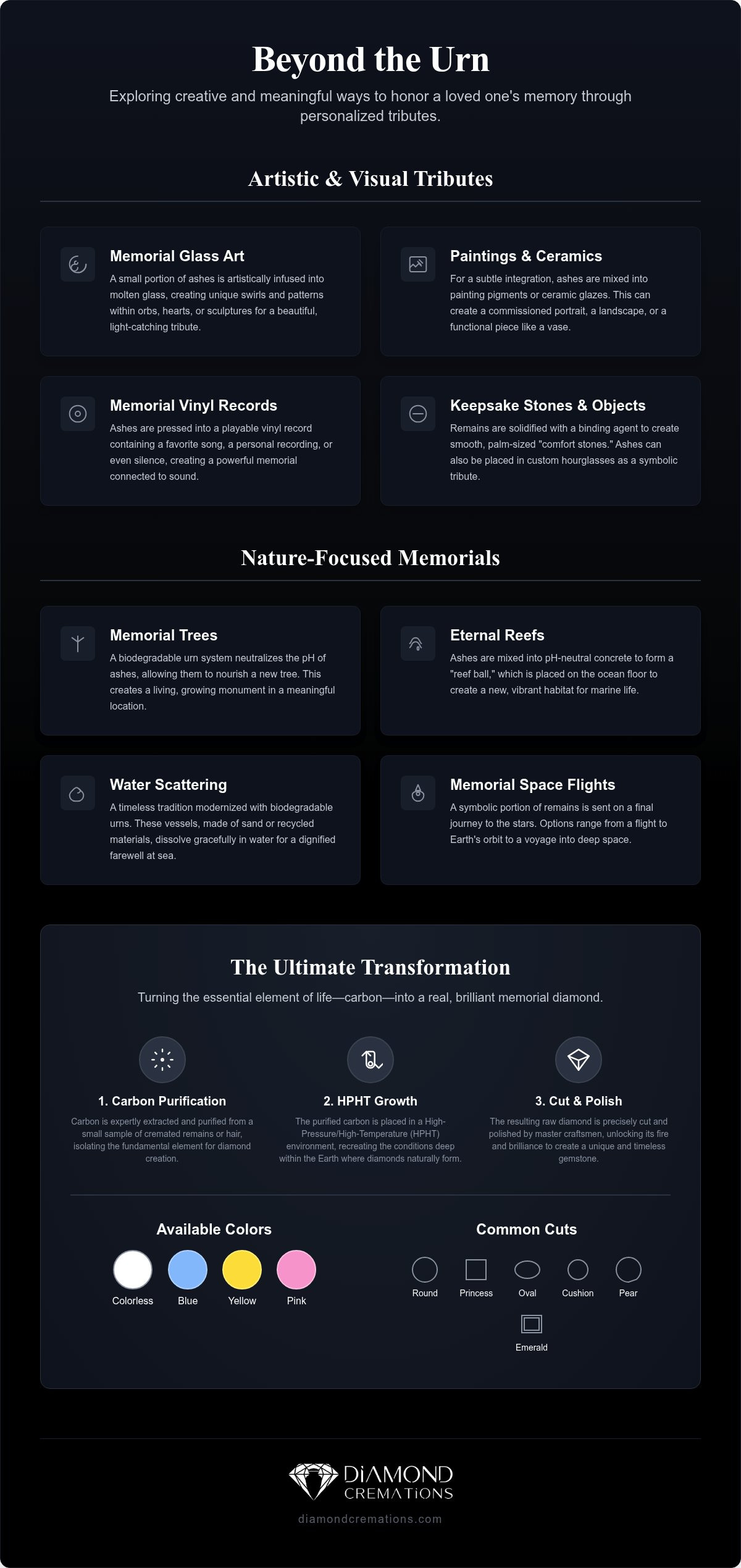
In this process, a small portion of ash is skillfully infused into molten glass by an artist. As the glass is shaped, the ashes create a unique pattern of swirls and specks, suspended within the colorful or transparent form. Popular shapes include orbs, hearts, and abstract sculptures. The way light passes through the glass can create a dynamic and beautiful visual effect, offering a constant and elegant reminder of a loved one.
2. Memorial Paintings and Ceramics
For a more subtle tribute, a small amount of ash can be mixed into the pigments used for a painting or the glaze of a ceramic piece. Families might commission a portrait of their loved one, a landscape of a favorite place, or an abstract piece that captures their personality. In ceramics, the ashes can be incorporated into the glaze of a vase, bowl, or decorative platter, creating a functional yet deeply personal object.
3. Memorial Vinyl Records
For the music lover, a truly unique option is to have ashes pressed into a playable vinyl record. A company can press a small amount of the remains into the vinyl material during production. You can choose a favorite song, a personal recording of their voice, or even a period of silence to create a "memorial soundtrack." It offers a way to connect a memory to the powerful medium of sound.
4. Keepsake Objects like Stones and Hourglasses
Cremated remains can also be solidified with a binding agent to create memorial stones. These are smooth, palm-sized "comfort stones" that can be held or kept in a special place. They offer a simple, tactile connection to a loved one's memory. In a more symbolic tribute, a portion of ashes can be placed inside a custom-made hourglass, representing the passage of time and an enduring presence.
Returning to the Earth: Nature-Focused Memorial Options
For those who had a deep connection to nature, an environmental memorial can be a fitting tribute. These options integrate a loved one's final legacy with the ongoing cycle of life, creating a living monument or contributing to the restoration of natural habitats.
5. Memorial Trees and Plantings
A popular and eco-conscious choice is a memorial tree. Because cremated remains have a high pH that can be harmful to plant roots, this process typically involves a special biodegradable urn or soil mixture. These systems are designed to neutralize the alkalinity of the ashes and release them slowly as nutrients, allowing a tree to grow and thrive. Families can choose a species of tree that held special meaning, creating a living legacy that will stand for decades.
6. Eternal Reefs
For those who loved the ocean, an eternal reef offers a way to give back to the marine ecosystem. In this process, cremated remains are mixed into a specialized, pH-neutral concrete to form a "reef ball." This structure is then lowered to the ocean floor in a permitted location, where it becomes a new habitat for fish and other marine life. It transforms a personal legacy into a vibrant, living part of the sea.
7. Water Scattering with Biodegradable Urns
Scattering ashes at sea is a timeless tradition. Modern, eco-friendly approaches often use biodegradable urns designed specifically for water burials. These urns are made from materials like recycled paper or sand that dissolve gracefully in the water, releasing the ashes. This method allows for a dignified ceremony at sea while minimizing environmental impact.
8. Memorial Space Flights
For the adventurer or dreamer, a memorial space flight offers a final journey to the stars. A symbolic portion of cremated remains is placed in a small capsule and launched into space. Options range from reaching the edge of Earth's atmosphere and returning, to entering Earth's orbit, or even journeying into deep space. It is a tribute that reaches for the cosmos, reflecting a spirit of exploration and wonder.
Wearable Memories: Keeping a Loved One Close
Wearable memorials provide a uniquely personal and portable way to keep a loved one's memory near. These tributes range from traditional jewelry that holds remains to modern marvels of science that transform them into something entirely new.
9. Cremation Jewelry That Holds Ashes
Traditional cremation jewelry is designed as a small, hollow vessel to hold a tiny portion of cremated remains. These pieces come in many forms, such as lockets, pendants, or bracelets with a hidden compartment sealed by a small screw. This allows the wearer to keep a physical part of their loved one with them. While deeply meaningful, it is important to distinguish this type of "vessel" jewelry from items where the ashes are permanently transformed and integrated into the material itself.
10. Memorial Diamonds Created from Carbon
The final creative idea on our list represents a complete transformation. A memorial diamond is not a vessel that holds ashes; it is a real lab-grown diamond created from the carbon purified from the cremated remains or hair of a loved one. This process turns the very elements of a life into a brilliant, enduring gemstone that can be set in a ring, pendant, or other piece of fine jewelry.
The Ultimate Transformation: Turning Carbon into a Memorial Diamond
For families seeking the most permanent and personal tribute, a memorial diamond offers a remarkable synthesis of science and sentiment. This process elevates a legacy into an heirloom-quality gem that is physically, chemically, and optically identical to a mined diamond.
The Science of Creating a Diamond
The journey from ashes to a diamond is a precise and controlled scientific process. It begins with the extraction and purification of carbon from the submitted cremated remains or hair. This purified carbon is then placed in a specialized environment that replicates the conditions deep within the Earth where natural diamonds form.
Using a process known as High-Pressure/High-Temperature (HPHT), the carbon is subjected to immense force—approximately 800,000 pounds per square inch (PSI)—and extreme heat. This environment encourages the carbon atoms to bond and crystallize. The growth process begins on a tiny diamond seed, which provides the foundational crystalline structure, and the carbon from the loved one crystallizes around it, layer by layer, to form a new, unique raw diamond.
Crafting a Bespoke Eternal Legacy
Once the raw diamond has finished growing, it is cut and polished by expert gem cutters, just like a mined diamond. This is where a family can personalize the tribute to reflect their loved one's personality. You can choose from a range of timeless cuts, such as the classic Round Brilliant, the elegant Emerald, or the modern Princess. Diamonds can be created in several colors, including colorless, blue, yellow, and pink, which are determined by the unique elements present during the growth process.
For those who wish, the finished diamond can be sent to an independent gemological laboratory, such as the Gemological Institute of America (GIA) or the International Gemological Institute (IGI), for an official grading report. This report documents the diamond's characteristics, including its cut, color, clarity, and carat weight. It is important to note that this grading verifies the diamond's quality and authenticity as a diamond, but it does not establish the biological source of the carbon.
The Journey to a Finished Memorial
The amount of ashes or hair required for creating a memorial diamond can vary, and families receive a secure collection kit with specific instructions for their order. The entire process, from receiving the remains to the delivery of the finished, polished diamond, takes approximately 60–90 days. The timeline can vary depending on factors like the diamond's size, color, and any optional grading or jewelry-setting services selected. The final result is one of the most permanent memorial ideas available—a brilliant tribute that transforms a legacy into a timeless symbol of love and remembrance.
Discover how to transform a legacy into a timeless diamond.
Frequently Asked Questions About Creative Memorials
-
Can you really turn human ashes into a diamond?
Yes. Cremated remains and hair contain carbon. Through a highly scientific process, this carbon can be extracted, purified, and placed in a high-pressure, high-temperature (HPHT) environment to grow a real, lab-grown diamond. -
How much of the ashes are needed for these creative ideas?
The amount varies greatly. Artistic glass or memorial paintings may only require a tablespoon of ashes. A memorial diamond company like Diamond Cremations provides a dedicated collection kit with instructions, as the required amount can differ based on the specific order. -
Is it possible to make multiple diamonds from one person's ashes?
Yes, if there is a sufficient amount of carbon available in the provided remains, it is often possible to create more than one memorial diamond. This allows multiple family members to each have a personal keepsake. -
Are memorial diamonds considered real diamonds by jewelers?
Absolutely. A memorial diamond created through the HPHT process has the exact same chemical, physical, and optical properties as a diamond mined from the earth. It is a genuine diamond and will be identified as such by any certified gemologist. -
Can I use hair instead of ashes for a memorial diamond?
Yes. Hair is a rich source of carbon and can be used to create a memorial diamond, either on its own or in combination with cremated remains. This is a meaningful option for families who may not have chosen cremation. You can even create a diamond from your pet's fur. -
What happens to the ashes that are not used in the creative process?
The policy depends on the specific service provider. For memorial diamonds, any unused remains are typically returned to the family along with the finished diamond, unless the family requests otherwise. -
How long do these creative memorial processes typically take?
Timelines vary. A custom glass piece might take a few weeks, while a memorial diamond process, which involves carbon purification, diamond growth, cutting, and polishing, takes approximately 60 to 90 days. -
Can I turn my pet's ashes into a diamond as well?
Yes. The process of creating a memorial diamond works with the carbon from any source, including the cremated remains or hair of a beloved pet. It is a beautiful way to honor the memory of a cherished animal companion.